Table of contents
Updated 13 November 2026
1:1, 1:few and 1:many are the three main types of ABM (account-based marketing). They differ in how many accounts you target and how much you personalize for each one. Pick 1:1 for a handful of top accounts, 1:few for clusters of similar accounts and 1:many for lists too large to personalize by hand.
Most teams choose one tier and apply it to every account. That is the wrong unit of choice. The tier belongs to the account, not to the program. A large enterprise target with a multi-million dollar deal deserves a custom plan. A list of 800 mid-market accounts cannot get one. Strong ABM programs run more than one tier and move accounts between them as the evidence changes.
What is the difference between one-to-one, one-to-few and one-to-many ABM?
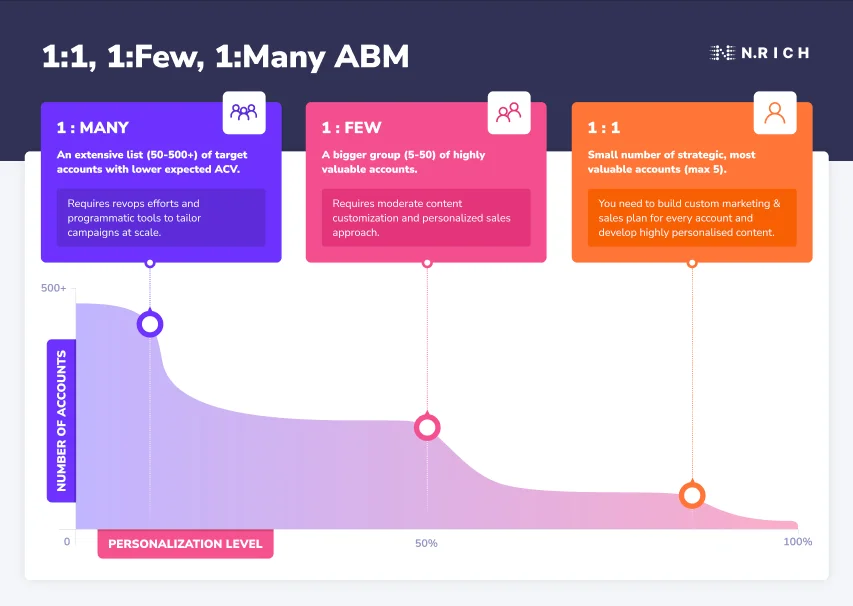
The three tiers sit on one scale. Moving from 1:1 to 1:many, the account count rises, while personalization and cost per account fall.
| 1:1 (strategic) | 1:few (ABM lite) | 1:many (programmatic) | |
|---|---|---|---|
| Accounts | Typical: up to 5 | Typical: 5 to 50, in clusters of similar accounts | Typical: 50 to 500 or more |
| Personalization | Custom for each account | Custom for each cluster | By segment, such as industry, region or use case |
| Budget per account | Highest | Moderate | Lowest |
| Channels | Sales outreach, executive contact, events, direct mail, account-specific ads and landing pages | Email, webinars and virtual events, direct mail, segment-level ads and landing pages | Programmatic ads, retargeting, automated email nurture |
| Content | Built from scratch for each account | Built once for each cluster | Existing content, adapted by vertical, region and use case |
| Team | Dedicated ABM team (strategist, writers, designer, analyst) working with sales | Smaller team with the same roles | Content writers, analytics and integration; a strategist is optional |
| How to measure | Pipeline, deal size and stakeholders reached in each account | Engagement in each cluster, opportunities created, deals closed, sales velocity | Share of the list that engages, cost per engagement, intent signals, then pipeline influence |
| Best for | Strategic, high-value and expansion accounts | Groups of similar accounts with shared pain points | New markets, awareness and large mid-market lists |
Two rules sit behind the table. Match effort to account value. Match team size to effort.
What is 1:1 (strategic) ABM and when should you use it?
1:1 ABM, also called strategic ABM, builds a custom campaign, message and content set for one named account. It covers up to 5 accounts. It has the highest cost per account of the three tiers. It needs a dedicated team that works closely with sales.
Run the numbers before you commit. If the deal value cannot pay for the team, choose another tier.
When 1:1 ABM fits
- You need to change how an account sees your brand. A 1:1 program lets you address the misconceptions of a specific account or buying group directly.
- You want a deeper relationship with a high-value account. Large enterprises have long sales cycles and many stakeholders. Each stakeholder needs tailored content and executive attention.
- You want to expand an existing customer. A custom campaign can show why a larger contract or an upgrade makes sense, and it is easier to grow an existing customer than to win a new one.
1:1 ABM campaign example: hiring a CRO
The 1:1 method also works outside sales. Kevin Chiu, co-founder of Catalyst, wanted Mark Kosoglow, then VP of Sales at Outreach, as Catalyst's Chief Revenue Officer. He joined Catalyst as its first CRO in October 2022.
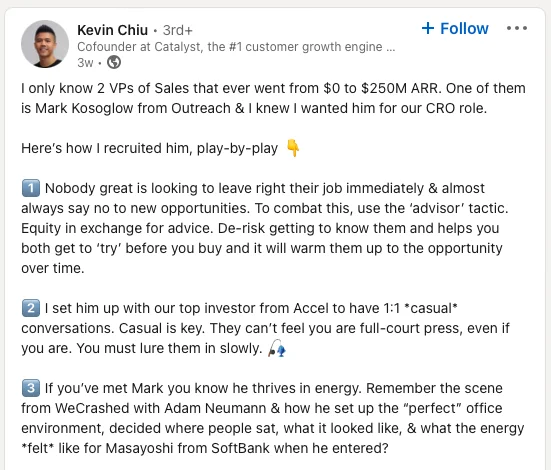
Chiu's public campaign was not a sale, but it has every element of a 1:1 program:
- Pick the best-fit target. Here, the target was one person.
- Research what the target cares about.
- Map the competition, meaning the other places the target might go.
- Create custom content, such as a report on why your company beats the alternatives.
- Involve other departments to build a personal experience.
1:1 ABM rewards the right target and punishes the wrong one. The effort is too high to spread across accounts you have not qualified.
Read the 1:1 ABM campaigns playbook for the step-by-step process: how to qualify an account, plan its campaign and run it.
What is 1:few ABM (ABM lite) and when does it fit?
1:few ABM, also called ABM lite, sits between the other two tiers. It groups accounts that share an industry, size or pain point and builds one campaign for each group. A 1:few program usually covers 5 to 50 accounts, grouped into clusters of similar accounts. A team can run several clusters at once.
Personalization happens at cluster level. A campaign for ten fintech accounts speaks to fintech pain points. It does not name each account's CEO.
ABM lite fits when you have a list of valuable accounts and too few people to build a custom plan for each one. It also works as a test bed. Try messages and formats on a cluster first. Then invest in 1:1 for the accounts that respond.
The team is smaller than a 1:1 team but still needs a strategist, writers, a designer and analytics support.
Where 1:few ABM helps
- Reaching several key accounts at once, when they share needs, budgets and buying stages.
- Building awareness and loyalty among key accounts with messages that speak to their problems.
- Spotting upsell, cross-sell and new market opportunities across a group of similar accounts.
1:few ABM campaign examples
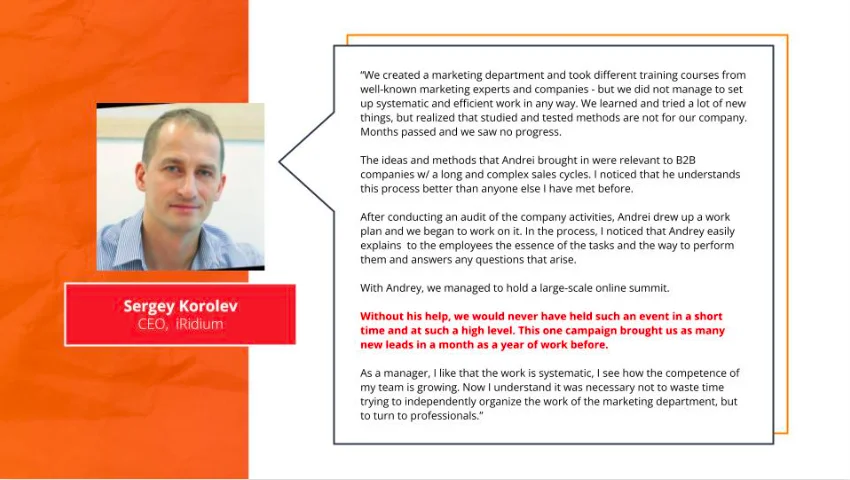
Iridium Mobile and Fullfunnel.io. Iridium Mobile wanted to expand, close larger clients, introduce new products and share its new market position. With the agency Fullfunnel.io, it ran a virtual summit on a budget of $3,000 with a team of three. The summit drew 2,320 sign-ups, but the team did not treat them equally. It hand-picked Tier 1 and Tier 2 accounts and ran two product webinars for each tier. It sent personalized invitations by email and SMS.
After the webinars, the team skipped the mass phone calls. It sent attendees a content hub with product information and answers to common questions. Engagement in the hub showed which accounts were warm, and personalized follow-ups went to those accounts. The result was 34 sales-qualified opportunities and five new customers, each with a lifetime value above $100,000, according to Fullfunnel.io. The typical sales cycle at Iridium Mobile runs 9 to 12 months.
BillingTree and Uviaus. BillingTree is a payment processing company. It used direct mail with gift cards to reach customers, but it struggled to book meetings with high-value targets. It often met people who could not make decisions. The agency Uviaus targeted the top 100 prospects instead of a mailing list of more than a thousand contacts.
Uviaus mailed each of the top 100 prospects a custom-branded case with two combination locks and an Amazon gift card worth up to $100. The recipient did not get the combination. A video player inside the case played an animated pitch when the case opened. More than 60% of the prospects reached out. 15% of those became opportunities, and BillingTree has closed over a quarter of them. The campaign won the 2019 Next Generation Innovative B2B Campaign Award.
Both examples share one pattern. A short, hand-picked list received an effort that a mass list never would.
Three tips for running 1:few ABM
- Align sales, marketing and customer success. Segment the accounts, for example by vertical. Then find the main pain points of each vertical and address them along the whole buyer journey. Take a campaign that promotes an advertising platform to cybersecurity marketers. Marketing publishes how-tos, PDF guides and videos about security threats. Sales brings competitor comparisons and case studies from similar companies. Customer success starts onboarding quickly with high-reach campaigns, so the value shows early.
- Be active where the audience is. Research the podcasts, keywords and influencers your best accounts follow. Narrow your focus to those places.
- Measure properly. Put every target account in your CRM. Log every interaction, including site visits, email clicks and webinar attendance. Then check whether engagement, opportunities and closed deals rise. Use sales velocity to judge the impact of the whole campaign.
What is 1:many ABM (programmatic ABM) and how do you launch it?
1:many ABM, also called programmatic ABM, uses technology to reach a large list of accounts with a segment-level message. It covers about 50 to 500 or more accounts. It has the lowest cost per account of the three tiers. Accounts are grouped by industry, size, region or challenge, and content is written for each group instead of each account.
Programmatic ABM does not mean low-value accounts. It means a list too large to personalize by hand, where the right buyers at each company must still see your message. A fixed list also stops spend from reaching companies outside your ideal customer profile.
Common uses:
- Demand generation, where the goal is to introduce your product to many target accounts.
- Entering a new market or launching a new product.
- Educating accounts that are not ready to buy yet.
- Upselling a large customer base on a higher plan or an add-on.
1:many ABM campaign example
AutoStore, a global warehouse automation company, runs ABM across EMEA, the USA and APAC on one platform. All advertising touchpoints are measured at account level, so the team can tie ad spend to pipeline and revenue. Read the AutoStore story.
How to launch a 1:many program in five steps
- Define goals and metrics. Programmatic ABM usually serves one of three goals. For awareness and engagement, track impressions, click-through rate, visitors and website activity. For new deals, track leads, cost per lead, conversion rate and cost per acquisition. For upsells, track ROI and revenue growth. Pick metrics from the goal, not the other way round.
- Build the target account list. Start with your total addressable market and your ideal customer profile. Score the accounts on sales velocity, so you know which ones are most likely to buy and which deserve more effort. The list can mix existing customers (for upsell) and new accounts (for acquisition).
- Develop the creative. Plan ads for social, display and search channels, plus content, event invitations, video, webinars and demos. Reuse existing content instead of writing from scratch. Personalize by vertical, geography and use case. Test creative before launch.
- Plan the buyer journey after the ad. An ad starts the journey, and it does not finish it. Build an email nurture stream for the leads you capture. Run retargeting on other platforms, such as LinkedIn lead gen ads. Give sales the content it needs, such as case studies, battle cards, explainers and proposals.
- Measure and iterate. Track campaign health as well as goal metrics. Watch the share of listed accounts that engage, the cost per click or per engagement, and buyer intent. Intent comes from first-party signals, such as site visits and ad engagement, and from third-party interest in relevant topics. N.Rich, for example, bills on engagement: an article read to 50%, a video watched for 20 seconds or a click on a display ad. Use the right ABM metrics for each goal, and review them on a fixed schedule.
How to choose a programmatic ABM tool
The tool carries the program, so check three things before you sign.
- Price. Check the budget fit and the commitment period. A 6-month commitment and a 2-year commitment change the risk a lot.
- Functionality. Look for targeting, creative asset management, automation and optimization, integrations with ad platforms and your CRM, and reporting and analytics.
- Ease of use and support. Read user reviews on G2 and similar sites. They show how fast support answers and how fast teams go live.
For a wider view of the market, read the guide to ABM software.
Which ABM strategy should you choose for your goals?
Match the tier to the goal:
- Land a large enterprise account with a complex buying committee and a long sales cycle: use 1:1.
- Enter a new market or vertical and build pipeline fast: use 1:many.
- Upsell or cross-sell to key existing customers: use 1:1.
- Build awareness across a broad mid-market segment: use 1:few and 1:many.
- Re-engage cold accounts that showed interest earlier: use 1:few, and add 1:1 for the few accounts of highest value.
Strategic and tactical ABM are two layers of one motion. They are not rival options.
Strategic ABM is the foundation. It covers the process, the sales and marketing alignment and the cross-functional work around a small group of high-value accounts. It maps to 1:1 and often to 1:few. Tactical ABM is the execution layer. It covers ads, intent data and personalized messaging at scale across hundreds or thousands of accounts. It maps to 1:many and often to 1:few.
Then check your own conditions. Choose 1:many (and sometimes 1:few) when you have hundreds or thousands of target accounts, you rely on automation, your sales cycle is short, and your focus is awareness, market expansion or mid-market nurture. Choose 1:1 (and sometimes 1:few) when you have a small number of accounts with high revenue potential, you can fund deep research, your sales cycle is long and your buyers make complex decisions. Choose 1:few when you have valuable accounts that share traits and you lack the capacity for 1:1.
Can you run 1:1, 1:few and 1:many ABM at the same time?
Yes. A hybrid program is the strongest setup. It gives your top accounts precision and your wider list reach.
Capacity is the usual reason to mix tiers. In N.Rich's 2025 State of ABM report, a survey of 107 B2B teams, 59% listed insufficient staff or resources among their biggest ABM challenges. 47% listed creating personalized content at scale.
Split the list by account value. Give the top few accounts a 1:1 plan. Group the next tier of similar accounts into 1:few clusters. Run the rest as 1:many. If you sell to both large enterprises and mid-sized startups, strategic ABM serves the first group with custom content, executive outreach, VIP events and dedicated sales time. Tactical ABM serves the second group with ads, automated email sequences, content personalization and programmatic outreach.
Then let evidence move accounts between tiers. An account in your 1:many list that engages with your ads and returns to your site often has earned more effort. Promote it to a 1:few cluster or a 1:1 plan. An account that ignores a costly 1:1 effort has not earned it. Move it down.
Measure each tier on its own terms, then compare all three on pipeline and sales velocity. The tier that costs most per account must also earn the most per account.
How does N.Rich support 1:1, 1:few and 1:many ABM?
N.Rich's intent, advertising and attribution work at account level. The ICP builder uses historical CRM opportunity data, so the account list and its tiers start from past wins instead of opinion. Intent data combines first-party signals, such as website visits and ad engagement, with third-party signals across thousands of topics. Accounts sit in journey stages: cold, in-market, engaged and hot. Those stages give you a clear trigger for moving an account up a tier.
For 1:many and 1:few, N.Rich's ABM advertising reaches target accounts and bills on engagement. Segments can also sync to LinkedIn as matched audiences. Attribution reports at account level, so you can see which tiers produce pipeline and revenue.
Book a demo to see how it works on your own accounts.
Frequently asked questions about ABM tiers
Is 1:few ABM the same as ABM lite?
Yes. Both names describe the middle tier. You group accounts that share traits, then build one campaign for each group instead of one for each account. The cost and the personalization both sit between 1:1 and 1:many.
Is programmatic ABM the same as 1:many ABM?
Yes. Programmatic ABM is the technology-led way to run 1:many. Ad platforms and automation deliver segment-level messages to a large account list. A team writes content for each segment, not for each account.
How many accounts should each ABM tier cover?
Team capacity and deal value set the numbers. Typical ranges are up to 5 accounts for 1:1, 5 to 50 accounts in clusters for 1:few and 50 to 500 or more accounts for 1:many. Start with the accounts that justify a custom plan, and that is your 1:1 tier. Group similar accounts into clusters for 1:few. Put the remaining target accounts in 1:many.
What team does each ABM tier need?
1:1 needs a dedicated ABM team working with sales: a strategist, writers, a designer and an analyst. 1:few needs the same roles at a smaller scale. 1:many leans on content writers, analytics and integration skills, because the platform handles delivery.
Can a small team run 1:1 ABM?
Yes, if the list is short. Start with one to three accounts where the deal value pays for the effort. Reuse the research later in a 1:few cluster.
How do you move an account between ABM tiers?
Use engagement and intent. Promote an account when it visits your site often, engages with your ads or enters a hot journey stage. Demote it when a high-touch effort draws no response. Review tiers on a fixed schedule, such as every quarter.
---
Create more pipeline and prove where it came from
Book an N.Rich demo and see how it works on your own data.
Book a demo
Table of contents
Stop building dashboards
Build apps that answer the questions your team actually asks. See what's possible in the N.Rich AI Playground.
Try the Playground