Ready to become an N.Rich AI builder and get paid for it?
Replay
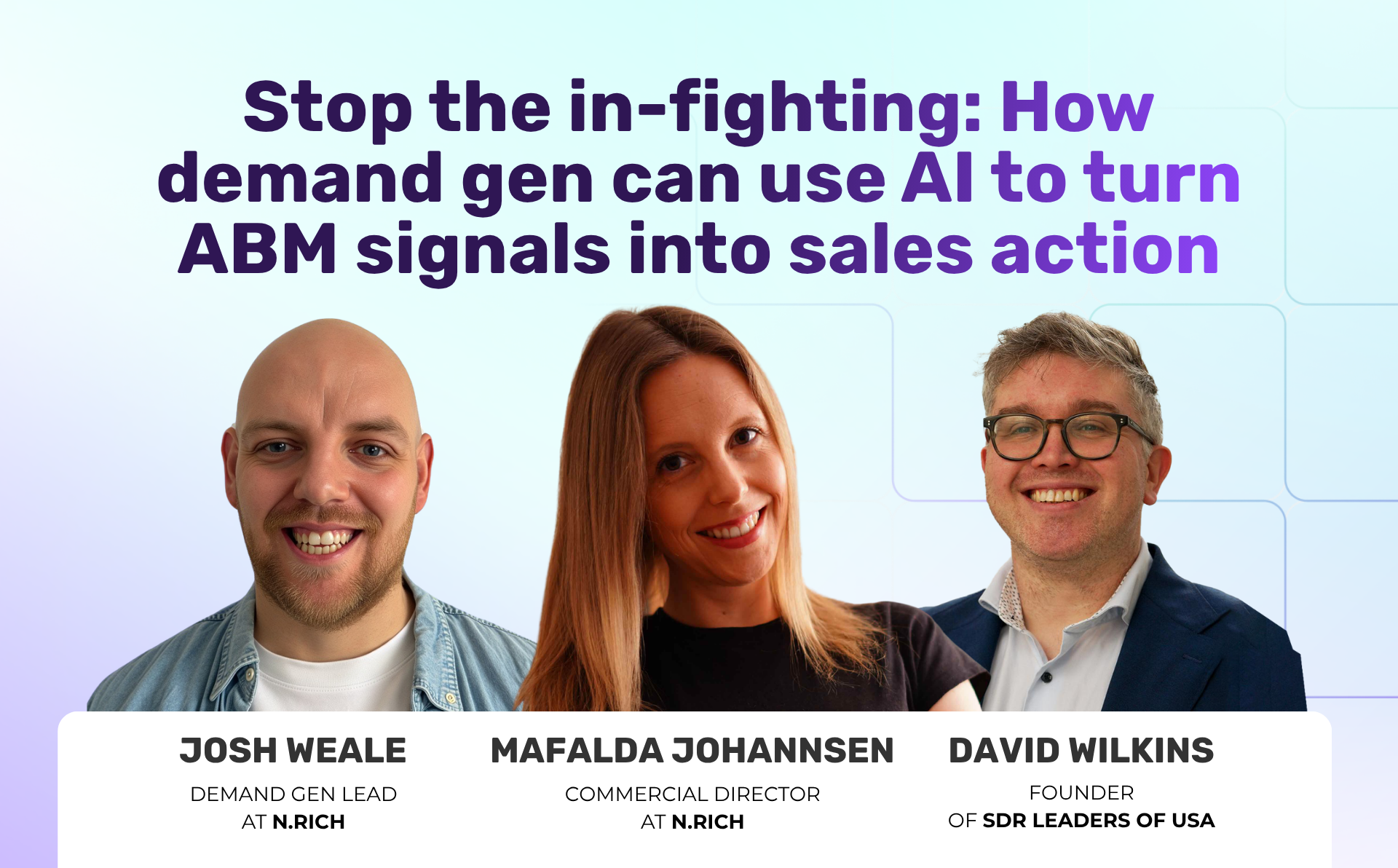
Stop the in-fighting: How demand gen can use AI to turn ABM signals into sales action
In this webinar session, Mafalda Johannsen hosted demand gen leader Josh Weale and SDR expert Dave Wilkins to explore how demand gen and sales development can stop the in-fighting by leveraging ABM and AI. They discussed account prioritization, engagement signals, and practical strategies for turning marketing insights into sales action.
They covered account-based marketing fundamentals, the importance of account-level and contact-level visibility, and how to build trust between marketing and sales teams. Watch the full recording to discover how AI can transform ABM signals into revenue-driving conversations.
Transcript:
Speakers:
Mafalda Johannsen — Commercial Director at N.Rich
David Wilkins — SDR Leader & Founder of SDR Leaders Global
Josh Weale — Head of Demand Gen at N.Rich
And we are live, everyone. I'm super happy to be here today with Dave and Josh. Today we will talk about how to stop the fighting between demand gen and business development using ABM and AI. With that, I will have the head of demand gen, Josh, talking on behalf of the demand gen side, and then Dave on behalf of the SDR years. Before I continue, I would love each one of you to introduce yourself. So I'll start with our guest, Dave.
Hi everyone, my name is Dave. I'm a Brit living in the Netherlands for the last 18 years. Typical Brit though, I can barely speak another language. I've been in the SDR space since I left the mayonnaise factory—which I really did work at—in 2013. Since then I've been working for Snowflake, leading their EMEA sales development organization. Most recently I run SDR Leaders Global, which is the largest sales development leadership community in the world.
Would you like to talk about the Funnel EMEA conference you are organizing, Dave?
You are organizing too.
Yes.
We're going to be running a 2-day conference in London on the 14th and 15th of October. We want to create a space for EMEA SDR leaders and a conference that's been made by EMEA SDR leaders. We want to have every single SDR leader from Europe, Middle East, and Africa coming along for those 2 days in London. We're going to have some of the best EMEA sales development leaders speaking around the future of sales development, but also how to practically do that. If you're interested, drop me a DM on LinkedIn and I'll show you where you can get a ticket.
And one of the speakers is actually Josh, who is here with us today. Josh, tell us a bit more about yourself.
Yeah, delighted to be here. My name is Josh. I'm the head of demand gen at N.Rich, but I've been in B2B marketing specifically for 12 years. Most recently over the last 5 years I've been building ABM strategies as the Director of ABM Strategy at a specialist ABM agency. ABM has been my main focus over the last 6 years and even more recently I've been building AI into everything I do. I'm a certified AI trainer, so my life now basically revolves around Claude. But yes, delighted to be here.
Thanks, Josh. You are one of the few people I know who actually understands AI beyond the prompting. And that's why we are here and at the conference in October. Before we jump into the webinar itself, let us know where you're tuning in on the chat. I'm right now in London, even though I live in Berlin, even though I'm Portuguese. Long story. But let us know where you're tuning in from.
You will get the recording after, but we would love you to stay with us until the end of the webinar. If you can't, no worries—you will receive the recording. Ask your questions. I will see if the questions make sense throughout the webinar. If they fit the flow, I will ask them. Otherwise I'm not ignoring you—I will ask them in the Q&A. Feel free to drop as many questions as you like. They will be addressed one way or the other, in the middle, at the beginning, or at the end.
N.Rich is doing a lot of webinars. We have more webinars—one more this month and more in July. Feel free to follow us and join the next ones as well. In the meantime, let us know where you're calling from and we will start the topic itself.
So let's start with live account prioritization. Josh, for those who don't know what it is, tell us a bit about it. Give us a high overview.
To get into account prioritization, I probably have to take a step back to talk about account-based marketing generally. The way we think about it is that account-based marketing is ultimately a strategy where you take your ideal customers, put them into account lists, and focus your marketing effort, resources, and sales resources on engaging with those accounts. You make sure you're really targeted and focused on who you're trying to reach. Effectively what you're trying to do is build up a level of engagement with these accounts at the right stage in the buyer journey.
What you can see on screen here is how N.Rich portrays the buyer journey. We have 4 stages: cold, in-market, engaged, and hot. Effectively what we're trying to do is track how different accounts are engaging with our ads, our website, our content as they move through. The goal, speaking from the marketer's side, is to generate enough engagement that when I send that list over to the sales team and say "Look, we've got these accounts that are showing a lot of engagement, they're visiting our website, they're spending time reading this content," that's given enough of a signal to the sales team to reach out to those accounts proactively. It's natural for the account and makes sense in terms of being more receptive because it's not just cold outbound. They know who we are. They know a little bit about the messaging. Hopefully it should create a much warmer handoff.
The prioritization itself is about how we build those signals together and then feed them into the sales team so that signal represents a good opportunity for the sales team to have great conversations.
That sounds great. And that actually sounds like a dream to the sales teams. I'm from the business development side, so that sounds amazing to me. But the reality is many sales teams and BDRs, even though they have these handed to them on a silver plate, they don't act on them. David, from your perspective as an SDR leader, why is that and how would you solve that issue?
A big part of this is around learned helplessness. In the past they may have been using something similar around account-based marketing tools that didn't actually aid BDRs or salespeople in engaging with accounts. There are some really great tools out there, but there are some where if an account has just checked something out on the website, that's fantastic if it's a one-person company. But if it's a BMW, Lufthansa, or Barclays, that's a bit of trouble.
What we've really developed, and what a lot of really powerful ABM programs have developed, is that we can actually see not just an account that's been engaged with, but actually the people who are engaging with that. That layer below is really valuable for leaders to be able to tell their teams: "This is worth going after."
We can do that in the US, but in Europe, not so much. But from the European side of things, we know the location, right? So I recommend my team for European contacts to see the location where the people are engaging and the titles that are relevant from that location. Then we most likely have the people and contacts who could be relevant for our outreach. Josh, do you have anything to add?
Just to reiterate what Dave said. Account-based marketing has a bad reputation—general sweeping statement—but there is laziness on both sides. It comes from that learned helplessness. If you try it once and it doesn't work, it only has to fail once and you lose trust in the process. If you can build enough goodwill to at least try and build up the relationship between sales and marketing, to have that partnership where you're in it together and you know not everything is going to be perfect, but from a marketer's point of view you can give accounts in good faith and say, as Mafalda said, the location, the reason why the account is warming up. Then actually being able to hand that over in the right way rather than what's happening in a lot of businesses and with a lot of vendors in the past: throwing it over the wall and just hoping that somebody catches it and makes magic happen.
Absolutely. And highlighting what you and Dave said, I also had some bad experiences with other ABM providers in my past as a head of business development and as a BDR. That's one of the reasons why I joined N.Rich—because here I can see these motions finally happening and it really makes sense and helps the team. We will talk about that now. So AI-generated outreach from intent signals. Josh, you've built this in N.Rich, right? Tell us about this process.
The traditional process typically revolves around spreadsheets or account lists in whatever CRM system you've got. They are quite often limited in the sense that the data is quite static—mostly thermographic information. It's not actually plugging in additional context around the signal that you're sending over. The main focus from my point of view, working with the demand gen leader, is about how can I fill in some potential blanks around the accounts' engagement.
The workflow we've built: we take the accounts that are surging in intent from N.Rich as a whole account, pull that into a workflow that has several different AI calls to ultimately analyze the signals it's picking up from the platform. So what topics are they consuming? What ads are they engaging with? Which campaign? What stage are they in the buying process? But then it also goes off and does additional research: who have we already got within our CRM? Who have we not got in our CRM? Where are the contacts? To Dave's point, having an account is great, but you also need to know the people. It's not always easy, especially in Europe, to identify right down to the person level. But if we can see these are our typical personas, people that we care about, handing that over to the BDR helps as well.
Then additional things like what is the company doing from a hiring point of view? An investment point of view? Do they have any big strategic pivots they're going through at the moment? We pull all that into a concise but actionable pack that you can give to the BDR team. From the marketing point of view, that's helpful because it means the team can go and bring that personalization into the process rather than just generic outreach sequences.
David, if you had an SDR team and you'd be working with Josh, he would hand this over to you. How would you organize your team and how do you think is the best way to go about this?
The context is critical, especially with so much noise out there—we're all dealing with so many messages and phone calls going to prospects. By calling with intent, calling with true context, emailing with true context and true intent, that's great. Then you can fashion the information into something that is actually valuable to the prospects you're engaging with rather than talk about yourself, which no one cares about. No one cares about you. But they care about what pain you can help solve. This piece that Josh spoke about is where sales development is going.
When I had less gray hair 12 years ago as a BDR, we used to have this. And to really have that context and then go and say, "This is how we can help you, and this is how we've helped other people, and this is why we believe this is important for you as well"—that's the difference between the best and the also-rans.
Amazing. I cannot agree more. And with AI, Claude, and everything we can do what you just mentioned, Dave and Josh, much faster, right? Because in my BDR times, I also had to do everything manually. If I wanted that angle and personalization, I could maybe do 5 accounts per hour. Now you can do way more. Josh, how can you automate the process from the CRM and till the sequence with AI and technology to make our lives easier?
Automation has been around for a long time—it's not necessarily that automation in itself is new. But what has essentially happened more recently with advancements in AI is that it's becoming easier to format and contextualize unstructured data. In my previous role, I used to do account insights reports—like 2 or 3 hours of research in an account, looking through investor relations, strategy docs, and all of that. You spend hours reading through, only to find out the thing that's actually most important was probably the first thing you looked at. What's effectively happening now is that AI is helping compress the time it takes to get that information.
There is a note on that though. As Dave said, there's still noise and hallucinations. You have to have a human in the loop to make sure that what you're using as a key input is valid and makes sense. AI is ultimately helping us take unstructured data and build it into processes where you ultimately need something you can trust and rely on.
The way we're building it at N.Rich: when an account hits the score threshold and becomes a hot account, we have an intent score model—first party intent, not third party. Mostly first party: what ads are they engaging with? Are they visiting your website? Once that threshold is hit, the CRM gets updated with a note on exactly why they've been made a hot account. They get pushed to a priority segment so it's easier to maintain and monitor how accounts are moving into the hot priority segment and how they're being followed up on and engaged.
We also get Slack messages into the right channels and the right people so they can follow up as quickly as possible—because time kills opportunities. The longer it takes to follow up on a signal, the less likely it is to have an impact. Then we're able to enroll that into an outreach flow—not necessarily enroll and send, but enroll it to a place where the BDRs are operating. As marketers, sometimes it's easy to think BDRs or the sales team are going to come to where we are and in the platforms we're in. But the reality is BDRs and salespeople and AEs are all working in CRMs, working where your work is. It's about how can marketing get that context and information to where you are so it's as easy as possible for you to review it and action it.
Dave, I see you nodding a lot. What would you like to add?
Especially about the handover and about where to put the information for our rep, our BDRs, SDRs, reps—for them to actually work on it. We always go into a park and you see the path and you see where people have just walked and cut across. Sometimes I've been in situations where you have a path and you're not allowed to go past it. But then you've got other companies with a growth mindset that are saying, "Actually, it looks like a new path has been created. Why don't we just go to the path of least resistance and make sure there's more people engaged and follow that?"
I think that's a really good thing—that agility that we're starting to see with a lot of marketing leaders now showing more than they already are. Josh made a great point there. He's a smart guy, this Josh.
Yeah, he is.
When you talk about these kinds of things, it sounds common sense. But I think the challenge is—and I've experienced it with clients I've worked with in the past, especially larger organizations—common sense doesn't always win out because people are so busy and they're in their own world. They just think that because something is happening, it means everybody else is aware of it. My opinion is that you have to be deliberate about these things. You have to have a process. You have to have it agreed. Yes, there's give and take on both sides, but this is ultimately where a lot of sales and marketing alignment falls down because there isn't this shared goodwill that you're both approaching this in the right way with the right viewpoint that you're trying to mutually help each other. I think that ultimately that's the key for a lot of sales and marketing alignment.
I agree. I think the goodwill is really important and starting from the point that I know my marketing colleague or my sales colleague is doing their best to make this work. If something doesn't work well, it wasn't because they didn't want to—it's just because we're all very busy and we're all humans. But we really want to do the best for the company and for our teams, right Josh?
Yeah, nobody sets out in the morning to do a bad job. At least I may be naive in saying that, but I don't think it's a common thing.
Absolutely. And Josh, you mentioned that AI can do a lot of things, but you still have to monitor, right? I'd be interested to know: what were the things that you had to put your foot down on because AI was going crazy? What were you monitoring? Any specific example?
Every day you look at something that AI gives you and for some reason at the moment, they're really bad at computing different time spans. Like comparing 6 weeks ago versus the previous 6 weeks—it can't quite understand that there's a 12-week period. It's just like, there's all sorts of issues.
The specific example I'll talk to is in our sequencing process—how we take the signal and build it into the Slack pack that your team gets. I still manually review every single one that comes into Slack. I have it open all the time. When we get a new inbound lead, either from a content download or a hot account, I still review it manually because there are occasions where I'll look at what AI has generated and it's pulled information for X company. But there's actually another very similar company with a similar name. There's an issue with the data hygiene or fuzzy matching on the name, and it's pulling a completely different set of information. If the salesperson ran with that and put that into a personalized sequence, the people on the receiving end would say, "Sorry, we are not in that industry. That's not our company whatsoever." That's a terrible first impression.
This is what it is to have a human in the loop: you can't just set and forget something. You have to make sure you do have an active eye over what is live. And obviously as the models change, you have to be aware that just because something worked yesterday doesn't mean it's going to work today because things are changing behind the scenes all the time.
I think that's a great segue for David. What was working yesterday and not working today on the business development side? And how do you use AI and where do you need the human touch?
I asked this poll at our meetups in Europe and America. I asked how long SDRs are doing admin time, like manual admin work. In one room in London, when I said "their SDRs are spending each 3 hours per day on manual admin tasks," a third of the room had their hands up.
This is where AI becomes really effective because that piece around account prioritization, account enrichment, giving you the right insights can now be done in the click of a button. I used to have to do my account mapping manually and go through 10Ks and yearly reports with a highlighter, printed it out, highlighted it. And now that can all be done very quickly. And then you can get back time to actually do the job. What is the job now? It's humans connecting with humans. Calling works. It hasn't gone away. It works. If you've got all that information ready for you to go, you're not going to just go and find some more leads. No, all of that's been done for you, so you can just concentrate on making money for yourself and for the business.
But also what I see a lot is SDR teams using AI in the wrong way. Instead of using insights to do cold calling or to really spend time personalizing a LinkedIn message, what they do is just send the same email to more people. Do you see that as well, Dave?
I did see that a lot at the start when ChatGPT started really coming into fashion. I think now it's less. But the knock-on effect is now email open rates and reply rates have cratered because prospects just got a flood of really bad generic AI-generated emails. This is where it's really critical that human-to-human piece is so important. I think it's better now.
Let's hope so. I really try to tell my BDRs, please personalize and use AI to help you as well, to give you insights and perspectives. That's what AI is there for. It's a huge luxury that I didn't have at the time. All right, let's go to building a shared signal taxonomy. Josh, what is that and why is that so important to create alignment?
Signal taxonomy can sound like you're trying to make something more complex than it actually is. Ultimately it's about how there's a mutual agreement: if we see this particular signal and we see these actions being taken by the accounts we're focused on, this is what we want to happen in terms of how the marketer is going to use that information and package it up, but also how the salesperson is going to act on it.
What we don't want to happen is that every account just gets treated in exactly the same way no matter how they're engaging. In the past, with clients and organizations I've worked with, especially larger ones, the default is that any kind of intent—doesn't matter what it is. Is it somebody visiting the pricing page? Is it somebody visiting the demo page? Is it just somebody searching and there's third-party intent signal? It could be completely unrelated. But it's flagged in the system and all that happens is the exact same default response. We send this to the AE. The AE goes and reaches out with the same message. There's no contextual thread between what that account is doing and what follow-up they actually receive.
This shared signal taxonomy—mapping out what the signal is versus what the appropriate action is—is about having that agreed playbook and agreed SLA between marketing and sales. This is what makes sense.
This sounds great to me and I think it makes sense. SLAs make sense. But for you, Josh, and then for you, Dave, what is the main obstacle in putting this into practice in a seamless manner to make sure that people actually act on the SLA that was agreed by both parties?
The biggest obstacle is reality. You build this in a vacuum—you build it in a way that's best case scenario, how we would like to work. But the reality is, on any given day, there could be any number of reasons why the BDR or the sales team can't reach out. Data hygiene issues, what they're actually getting—there's issues with that. There are all sorts of different things that can pop up and stand in the way of best laid plans, as we say in the UK.
What about you, Dave? Do you agree, disagree? What would you like to add?
I'd build on what Josh said. You have to get your senior leadership team on board with this, and then they have to reinforce it. But the level below them, their minus ones as you say in leadership terms, also need to be on board to reinforce it. Because again, best laid plans might be great, but if there's people not holding others to account then this process won't be followed. Where I've seen these kind of changes happening and they're effective is not just somebody at the top saying it. It's the person below that—if it comes from the CRO, it could be the VP for EMEA who then is reinforcing that, and then it could be the regional leaders for the UK, Netherlands, Benelux. That's where you need to get that alignment.
Specifically for account-based marketing, there is sometimes just a barrier that companies struggle to break down: the sales team are incentivized on a commission structure that doesn't align with an account-based methodology. Marketing is pushing these accounts over to the sales team saying, "Hey, these accounts are hot, they're visiting the website." But if the sales team are incentivized to follow up on an actual qualified demo booking, why are they going to reach out to these accounts that haven't booked a demo but they're higher up the funnel?
The reason and the methodology is because you're able to drive higher ACVs and better pipeline velocity because you're warming them up from a better point of view—there's more personalization and nurturing through that process and you're building stronger relationships. But ultimately, if you have a sales team incentivized on that last mile piece, it's difficult to break that down. No amount of goodwill and good faith will get in the way of everyone having to make their money, right? That's something a lot of organizations struggle to figure out how to get around.
Absolutely. I cannot agree more. And I would say there are companies and organizations that love to add work to the sales and BDR teams that is not related to either prospecting or selling, right? And that takes their productivity and focus away. When we try to reinforce this SLA and taxonomy, if you have 3 other things that have nothing to do with sales or marketing or prospecting but you still enforce your teams to do, there are too many things at the same time and it's hard for teams to actually focus on what matters, what actually brings revenue to them. I see you nodding, Dave.
You're totally right. You've said it best.
Thank you. Josh, would you like to add anything before we move on?
No, I think that covers everything.
Amazing. Josh, you created something that I love for my team: AI interpreting signals and giving context. Let me know—let us know what was before and what's now. How did you create it and what's the benefit?
The before was a handful of HubSpot properties got updated and said this account is now hot, this is their new score, now go and speak to them. That's basically a signal to action, but it's not actually a signal to take the right action or reach out in the right way. The reason we have this AI interpretation layer is exactly to achieve that context.
As Dave was saying before, in all of these examples, the most important thing is context—both in how you're using AI full stop, but also how the output of AI is adding to the process. The score interpretation breaks it down into different buckets: what are they engaging with? How long have they engaged with it? Why is it relevant? How can it feed into our overall messaging? Our value proposition makes clear there are different personas within the buying unit. We have to make an educated assumption about who's engaging based on the content they're engaging with. Then being able to pull it together into a thread that ties a consistent message so that the marketing feels connected to the sales piece.
There's nothing worse than when you're engaging with something and then you get a completely unrelated message—you're on a web page and I have no idea how they know it's me, but then all of a sudden I get a phone call from someone with a completely unrelated message, almost like it's a different company. This interpretation layer is about creating that consistency and creating that common thread between the sales and marketing piece.
Amazing. Dave, imagine that you're working with Josh and you get these kinds of signals. How would you advise your team to go about them in the ideal world?
On the before side, I would say put your fingers in your ears and just pretend you haven't seen it, because you're just wasting time. But on the second piece, what I want to see is why you, why now, so what. It's hitting those 3 things. Why am I speaking to you? Why am I speaking to you now? And how is this going to make a difference to you? That's what you need—that context. We can't have someone calling and just getting a random generic pitch. They could be ready to buy something and you just ruined that with that generic pitch.
This is why the context piece is so critical because every second of time that you have them on the phone listening or viewing something that you've written is golden. That's why you need: why you, why now, so what.
And would you say, Dave, that with why you, why now, and so what, would you recommend them to send an email first, LinkedIn, or phone call? Because each person has a different opinion and I have my own, but I'd love to hear how you would structure it usually.
Calls. The reason is that you're also driving the conversation and you're a little bit more in control. When you're calling somebody, you're going to know pretty quick if it's a yes or a no. Whereas if you send an email, you're not driving the conversation—you're waiting for somebody to respond to you.
The other big reason is that nobody's making as many calls as they used to, but we're seeing connect rates start to increase. So now's the best time to just pick up the phone and call them.
Yeah, especially with all the AI slog that we have from the emails we already mentioned. That's definitely a straightforward way to go about it. Josh, do you have anything to add?
Nothing else to add. It reminded me of a phrase I used to really like around pitch slapping. You only get one opportunity in most cases, especially if you're targeting, as we do, going upmarket and targeting more and more enterprise companies. With these kinds of senior decision makers and senior leaders, you get one opportunity to make a good first impression. If you're going to waste that opportunity on a pitch slap—which is just completely unrelated nonsense about what we do and speaking too much about us and not about why it matters to them—you may as well pack it in straight away because you're not going to get what you want out of that interaction.
Absolutely. We're almost wrapping up. We have a GTM Leader Dashboard that basically shows which accounts have been touched by sales and which haven't from the hot and engaged ones. Josh, why do you think this dashboard is useful and how should sales leaders use it ideally?
The whole premise behind the leader dashboard is that it gives sales and marketing a single source of truth. You don't end up in that situation where it's like the blame game—marketing saying we've created all of this engagement, the sales team saying there's no engaged accounts or the engaged accounts are crap.
It's about having this shared source of truth where both the sales and marketing leader can come into the platform and say, "Okay, so we can see this is the engagement that we've created. And then marketing can see how fast sales are engaging with these accounts." Back to the point previously around how important it is to have a very quick follow-up so you don't lose momentum.
Ultimately it's about shared accountability of the whole process. There's not just one side putting blame on the other saying there's something wrong at either end. It's about having a mutually agreed view of this is what is actually happening in our process, in our system, and being able to track that right down to the granular level of an individual sales rep or an individual account and making sure across the whole thing it is clear that the process is working, that the accounts are being engaged and followed up on, and that everybody is doing their best to move them along into a buying decision ultimately.
Absolutely. Dave, if you were an SDR leader and you had access to these, you talked about reinforcement. How, at which frequency would you reinforce whenever you see there is some sales coverage lacking? Let's say 20% attached—how would you go about that? What's the best way to ensure that the sales teams are going after the hot and engaged accounts?
The best way is rather than just have stuffy old me telling people to do this. Get the people that are getting success from getting meetings, pipeline, revenue in front of the group, of the team I'd be leading, and say, "Hey, we've got Josh here who is going to share with you how he used this and he generated X amount of revenue. Or as a BDR, here's my colleague who is going to show how she blew out her number by using this." That peer-to-peer reinforcement is really critical. That's what I would do. It's not just me saying it—it's these people that are now making more money than you doing it.
I personally love that as well—being able to champion and celebrate the process working so it doesn't feel like a top-down instruction but it feels like everybody is together and can see what good looks like. That to me has been the most effective way of driving any high-performing account-based program I've worked on.
Absolutely. And I think it's like that with every process, right? Every time I have a process or I want my BDRs to try a new thing, I always show them how it works and I show them the results, right? Because if that means more meetings for them, they will be willing to do it because that means also more money and less stress to reach the targets.
All right, we have a couple of minutes, so just a quick question for each one of you. Josh, if you have to pick one metric from all of these to focus on, which one would it be and why? And then Dave, same question for you.
Ultimately the metric that matters most is pipeline influenced and pipeline closed. The only way anybody gets paid in marketing or sales is if the company is doing well. So what I want to see is that the pipeline that marketing is influencing is going up and to the right, as we all do. From a sales perspective, how the pipeline number means they've got more opportunities to work with and more volume they can deal with, and it gives them more opportunity to sell ultimately.
Each of these is important in its own way, but to me that's really the one that moves beyond the MQL debate. It's not about throwing a load of leads over the fence. It's about actually moving pipeline.
Yeah. Absolutely. Dave, what's your take?
Executive dashboard. Everybody is speaking the same language. I've been in too many meetings where the numbers do not add up around pipeline contribution and revenue contribution from different departments. I've had one person call out someone from a separate department in front of the CEO saying this doesn't add up. That was fun to be in. That's the piece—executive dashboard, one stream of data.
Amazing. Guys, thank you so much for your insights today and your perspectives, both on the demand gen side and on the business development side. If anyone has any questions, feel free to write to each one of us on LinkedIn. Dave, Josh, and I are all on LinkedIn, so feel free to ask questions there if you didn't ask today. We are super happy to help you further. And thanks again, Josh and Dave, for being here today with me.
No worries, cheers. Pleasure.
Have a good one, everyone.
Cool.