
Table of contents
For the past decade, the B2B growth playbook was simple: Inbound Marketing. Write content, optimize for search, and harvest the hand-raisers.
This model built the mid-market SaaS unicorns. It relies on high-velocity, low-touch sales. But as organizations attempt to move upmarket to target the Global 2000, this engine seizes up.
We call this the Inbound Wall.
The same strategies that deliver steady growth in the 10k–50k ACV range frequently fail when applied to deals above 100k. Hand-raisers disappear. Pipeline slows. Revenue leaders push harder on the same levers, assuming the issue is scale rather than structure.
It is not.
Here is why the mid-market playbook breaks at scale, and how challenger brands are fixing it with a Mixbound strategy.
1. Why your mid-market playbook breaks at $100k+ ACV
The "Mid-Market False Positive" is the most dangerous trap in B2B growth.
Marketing teams often achieve early wins in the SMB/Mid-Market segment. Buyers here act like "prosumers." They search for solutions, read blogs, and willingly request demos. This success creates organizational arrogance. Leadership assumes scaling revenue is simply a matter of scaling the existing engine—more ads, more content, more SDRs.
The math is broken.
What breaks first is not content or channels, but coordination. Marketing and sales continue to operate in parallel, optimized for different signals, while enterprise buyers require sustained, account-level trust building.Enterprise buyer behavior is not a linear extrapolation of mid-market behavior. When you target enterprise accounts, the hand-raising stops.
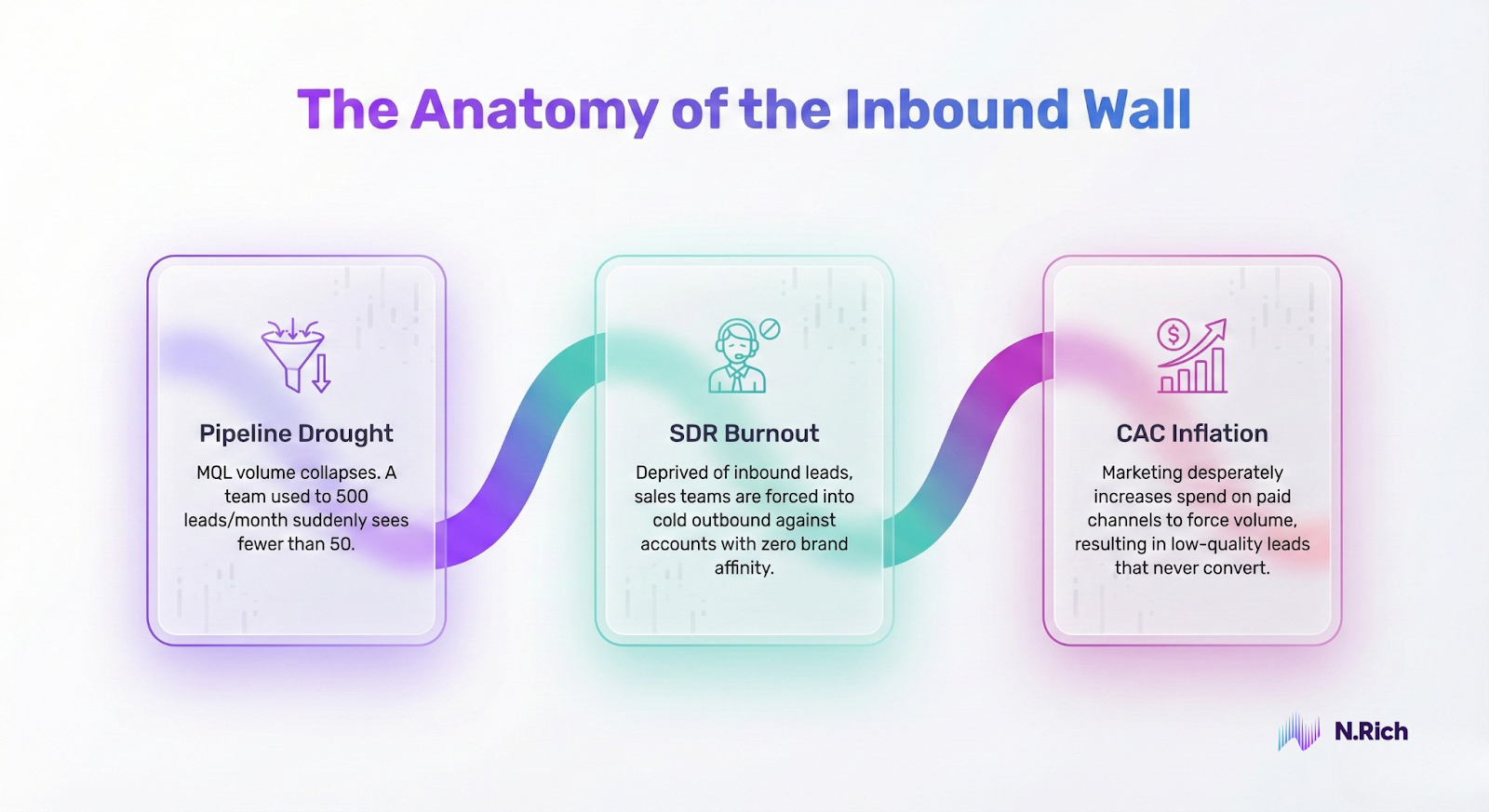
The anatomy of the Inbound Wall
In the enterprise, decision-makers rarely fill out forms unsolicited. They are insulated by gatekeepers and rely on peer networks, not Google searches.
When you hit this wall, the revenue organization fractures:
- Pipeline drought: MQL volume collapses. A team used to 500 leads/month suddenly sees fewer than 50.
- SDR burnout: Deprived of "easy" inbound leads, sales teams are forced into cold outbound against accounts that have no affinity for the brand.
- CAC inflation: Marketing desperately increases spend on paid channels to force volume, resulting in low-quality leads that never convert.
2. The psychology of the enterprise buyer
To scale the wall, you must understand the psychology of the enterprise. It is defined not by "gain maximization," but by risk mitigation.
The trust gap
This gap is why some teams shift from volume-based inbound metrics to account readiness signals, focusing less on who raised a hand and more on whether the account has been sufficiently warmed across stakeholders.
For a challenger brand, the barrier to entry isn’t visibility. It is credibility.
You might have a superior product, but you will lose to the incumbent because of the "Risk Premium." If a mid-market manager buys a tool that fails, they lose a few thousand dollars. If a CIO authorizes a global rollout that fails, they lose their job.
This creates a Trust Gap. Even if your cold outreach connects, the conversion rate remains stubbornly low (often ~5%) because the account does not trust you yet.
The buying committee nightmare
In SMB sales, you convince one person. In enterprise, you must navigate a "nightmare" of 6–12 stakeholders with conflicting incentives.
- Champion: Wants efficiency.
- CFO: Wants risk mitigation and ROI.
- CIO: Wants security compliance.
- Legal: Wants liability reduction.
Your "persona-based" marketing fails here. You cannot just market to the end-user. You must surround the account.
The buying decision is collective, and risk is distributed. Messaging must account for finance, security, legal, and executive alignment, not just product usage.
Table 1 illustrates the diverging priorities of a typical Enterprise Buying Committee:
|
Stakeholder |
Primary Focus |
Psychological Driver |
Typical Objection |
|
Champion (End User) |
Functionality, Ease of Use |
Relief from pain, Efficiency |
"Will this actually solve my daily problem?" |
|
Financial Buyer (CFO) |
ROI, TCO, Payment Terms |
Risk mitigation, Budget adherence |
"Why is this better than the cheaper option?" |
|
Technical Validator (CIO) |
Integration, Security, Compliance |
Stability, Security posture |
"Does this meet our SOC2/ISO requirements?" |
|
Legal / Procurement |
Contract Terms, Liability |
Liability reduction |
"We need to redline your standard MSA." |
|
Executive Sponsor |
Strategic Alignment |
Innovation, Competitive edge |
"Does this align with our 5-year roadmap?” |
Table 1: The Enterprise Buying Committee Structure and Drivers.
3. The "Fish Finder" fallacy: Why intent data fails challengers
To bridge the gap, organizations often rush to buy enterprise-grade tech like 6sense or Demandbase.
These tools are often bought prematurely, leading to expensive "shelfware". To understand why, use the Fish Finder analogy.
- The technology: Intent platforms are high-tech Fish Finders. They tell you exactly where the fish are swimming (who is researching).
- The market leader advantage: If you are Salesforce (Market Leader), this works perfectly. You use "bait" the fish already know and love. You just need to know where they are.
- The challenger reality: If you are a Challenger Brand, you have "bait" the fish do not recognize. You can cast your line right in front of them, but they won’t bite because they don't trust the food.
Knowing who is looking is irrelevant if they don't care about you. Applying a Demand Capture tool to a Demand Generation problem is a recipe for failure.
In practice, this has led some challenger teams to delay heavy intent tooling until they have established consistent account-level demand generation. In these cases, outbound activity is triggered only after accounts show sustained engagement across marketing touchpoints rather than isolated research signals.
4. The Mixbound solution: A practical framework
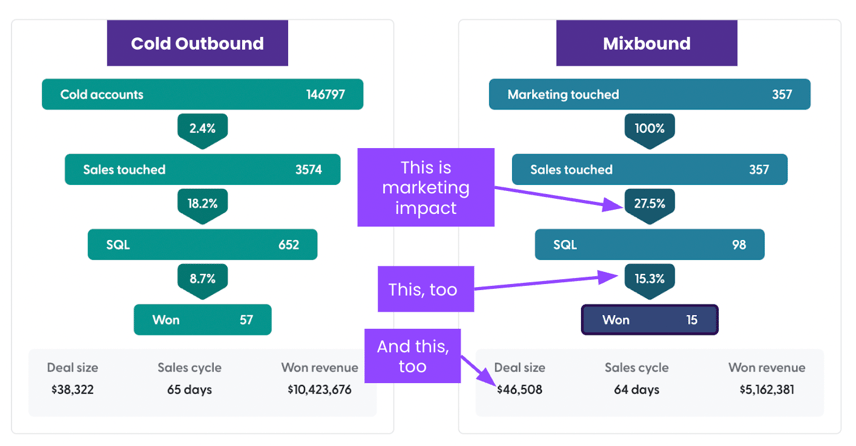
You cannot rely on inbound (they won’t come) and you cannot rely on cold outbound (they don’t trust you). Mixbound is the "middle way." It combines account-based demand generation with signal-based outbound execution.
The goal isn't more volume; it’s better timing.
The Foundation: Precision ICP Building
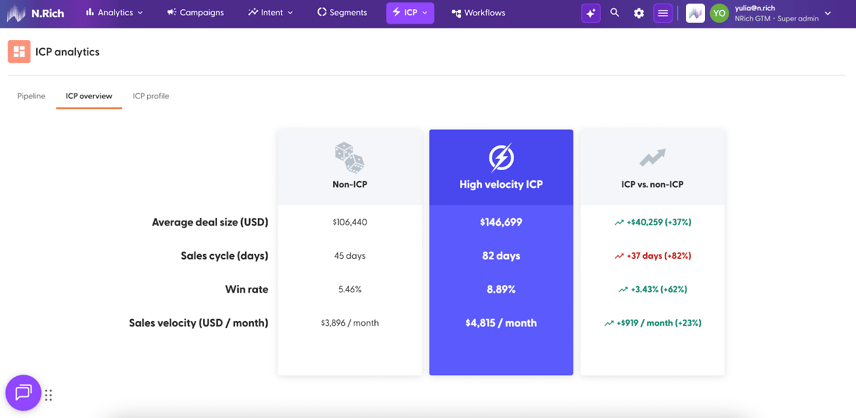
The Mixbound motion fails if Sales and Marketing are working off different lists. You need a Dynamic ICP—a list of accounts that not only fit your profile but are actively showing signs of atmospheric pressure in their category.
Strategic tip: Use tools that automate this discovery. You can build and sync your target account list (ICP) to ensure your ads and your SDRs are always hitting the same high-value targets.
Chumming the water
Before Sales casts their line, Marketing must "chum the water." In the enterprise, this means proactively warming up the entire buying committee.
Strategic tip: Instead of guessing if an account is ready, use Progression Analytics to track how accounts move from "Unaware" to "Aware" to "Highly Engaged." When the account engagement score hits a "Hot" threshold, the SDR is alerted to "cast the line."
The Mixbound Play:
- Target: Identify a high-value account (e.g., a Fortune 500 retailer).
- Chum: Serve programmatic ads to the committee for 3–4 weeks. The CFO sees ROI calculators; the CIO sees security specs; the end-user sees a case study.
- Signal: When the account engagement score hits a "Hot" threshold (e.g., 3+ stakeholders visiting high-intent pages), the SDR is alerted.
- Cast: The SDR calls. The prospect already recognizes the brand.
Practical execution: Tips from the playbook
While the full mechanics are detailed in our GTM Playbook, here are the three critical levers we used at N.Rich to move from "parallel silos" to a unified Mixbound motion:
1. Sync account lists across the stack
The most common point of failure is data fragmentation. For Mixbound to work, your LinkedIn Ads, CRM, and Outreach platforms must be targeting the exact same list of accounts simultaneously. If Marketing is warming up Account A while Sales is cold-calling Account B, you are just running two expensive, inefficient motions in parallel.
2. Establish a "Signal SLA"
To avoid Slack-based arguments over who "owns" a lead, you need a documented definition of influence. We define a Mixbound-ready account using a specific window of engagement:
- Marketing Signals: 3+ website visits, ad engagements, or event attendance within the last 40 days.
- Sales Signals: LinkedIn profile visits or email opens within the last 45 days.
- The Result: When these signals overlap, the account is flagged for immediate priority outreach.
Strategic Tip: Use tools that automate this discovery. You can build and sync your target account list with N.Rich to ensure your ads and your SDRs are always hitting the same high-value targets.
3. The "Incentive Flip" (The Secret Sauce)
Most SDR compensation models inadvertently punish collaboration. If an SDR gets a lower commission for a "Marketing Lead," they will ignore your warmed-up accounts in favor of "pure" outbound.
We did the opposite: We increased commissions by 10% for deals closed in marketing-touched accounts. This incentivized SDRs to hunt where the water was already chummed.
4. Measuring what matters: Opportunity Influence
To avoid Slack-based arguments over "who brought in the lead," you need a documented definition of influence.
Strategic tip: We use Opportunity Influence tracking to visualize every marketing touchpoint—ads, website visits, and events—that occurred before and after the opportunity was created. This proves that while the SDR "scored the goal," Marketing "provided the assist.
The ROI: Conversion Lift
In the Mixbound model, we stop measuring MQL volume and start measuring Sales Velocity. By engaging accounts later in the trust curve, the efficiency gains are exponential.
|
Account State |
Outreach Type |
Conversion Rate |
|
Cold |
Pure Outbound |
~5% |
|
In-Market (Intent Only) |
Demand Capture |
~5% |
|
Hot / Engaged |
Mixbound (Warmed Up) |
17.2% |
This 3x improvement in sales efficiency is the primary ROI of the marketing function.
Read also: Sales velocity configuration tooltip.
Marketing acts as air cover, softening the target so Sales can win.
Want the full implementation guide?
We’ve detailed our entire internal process—including our shared account scoring rubrics and the exact compensation spreadsheets we used to align our teams.
Download the Mixbound GTM Playbook here.
5. Operationalizing the shift
Transitioning to Mixbound requires four specific operational changes.
Overcome "persona nostalgia"
Marketing teams love the mid-market end-user because they generate volume. You must stop optimizing for users who are no longer your core audience12. Build landing pages for the Financial Buyer, not just the user.
From signups to bridges
In PLG, a signup is a win. In enterprise, a signup is just a data point.
Replace the "Free Trial" button with Interactive Demos. Enterprise buyers want to see the product without the risk of a sales call. Navattic data suggests 8.5% of buyers convert after viewing interactive demos. It is a low-risk bridge to trust.
Borrowed trust
If you lack brand authority, borrow it. Prioritize Resonance over Relevance.
- Relevance: "We have feature X."
- Resonance: "We understand the specific pain of the CFO."
Feature industry experts, partners, and customers in your content. If the CFO doesn't trust you, make sure they trust the person you are interviewing.
6. Strategic alignment: The revenue architecture
This shift cannot happen in a marketing silo. Hybrid motions like Mixbound require explicit agreement on shared accounts, shared signals, and shared definitions of progress. Without this, teams revert to familiar metrics and the same inbound–outbound tension reappears.
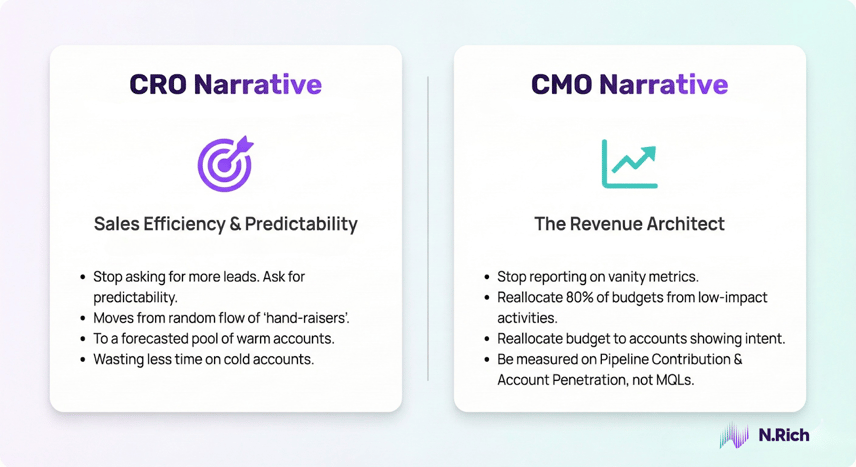
The CRO narrative:
Stop asking for more leads. Ask for predictability. Mixbound moves you from a random flow of "hand-raisers" to a forecasted pool of warm accounts. It is about Sales Efficiency—wasting less time on cold accounts.
The CMO narrative:
Stop reporting on vanity metrics. Become the Revenue Architect.
- The spend illusion: 80% of budgets go to low-impact activities.
- The signal shift: Reallocate budget to accounts showing intent.
- The goal: Be measured on Pipeline Contribution and Account Penetration, not MQLs.
The downside of a Mixbound approach
This is the part most teams underestimate.
It takes time.
Mixbound does not answer the question
“What is the ROI of this one LinkedIn ad, blog post, or webinar?”
Because that question assumes B2B buying works in isolation. It does not.
This approach exists precisely because enterprise revenue cannot be attributed to a single channel or moment. Trust is built across dozens of touches, many of which are invisible, indirect, or delayed.
In practice, it took months to see a meaningful signal.
Roughly nine months to earn buy-in from leadership and finance.
Closer to twelve months to see the full effect on pipeline and revenue.
This is not an immediate fix.
If leadership remains committed to campaign-level ROI and MQL-based accountability, adoption will be slow. The sales cycle for this idea will be longer than the sales cycle for the product.
But for teams willing to commit to alignment, patience, and shared accountability, the payoff compounds.
The future of enterprise GTM
The Inbound Wall is real. The tactics that built your mid-market business—PLG, volume-based inbound, and generic community building—will fail upmarket.
Success requires a Mixbound approach:
- Strategic patience: Accept longer cycles to build trust.
- Operational integration: Marketing warms; Sales closes.
- Tech discipline: Don't buy the Fish Finder until you have the Bait.
For the Challenger brand, the goal is not to be everywhere. It is to be everything to the accounts that matter.
FAQ: Common questions on the enterprise transition
Q: Is moving upmarket to enterprise sales worth the longer sales cycles? It depends on your capital runway. You are trading velocity for deal size. Moving upmarket inevitably leads to slower deals and larger transactions. If you are a startup without a financial buffer, the "feast or famine" nature of enterprise sales can be fatal. Do not abandon your mid-market revenue engine until your enterprise motion is predictable.
Q: Why are tools like 6sense or Demandbase often called a "waste of money"? These tools are often purchased out of sequence. They are "Fish Finders" designed to capture existing demand. If you are a challenger brand with low awareness, identifying intent is useless because the buyer does not trust you yet. Build your demand generation strategy (the "bait") before investing in expensive identification tech.
Q: How do we handle the "buying committee" nightmare? Stop selling to a single persona. While Sales works the Champion, Marketing must target the "Veto Holders" (CFO, CIO, Legal) with specific messages relevant to their risks. Create a "Trust Center" or pre-packaged security documentation to speed up the "no trust" phase.
Q: My sales team says marketing leads are "trash." How do we fix this? This is a definition mismatch caused by the "Mid-Market False Positive." Marketing is likely celebrating MQLs (e.g., ebook downloads) while Sales needs meetings with intent. Implement a "Mixbound" SLA: Marketing warms the account until a specific engagement threshold is met, and only then does Sales engage.
Q: Can we execute ABM without a big budget? Yes, but you cannot scale without budget. You can execute "Poor Man's ABM" by manually curating a list of 50 target accounts and running highly targeted LinkedIn ads. This is a valid way to validate the strategy before purchasing a dedicated platform, though manual processes are hard to sustain long-term.
Q: How do we get enterprise buyers to trust a "Challenger" brand? Prioritize Resonance over Relevance. Instead of listing features (Relevance), demonstrate that you understand their specific industry pain (Resonance). Leverage "Borrowed Trust" by featuring industry experts, partners, and customers in your content. If you lack authority, borrow it from someone who has it.
This article outlines why inbound-led GTM motions stall at enterprise scale and what changes when buying behavior shifts.
For a practical walkthrough of how one team operationalized a hybrid GTM motion, including alignment, measurement, and compensation changes, you can download the full Mixbound GTM Playbook here.
Create more pipeline and prove where it came from
Book an N.Rich demo and see how it works on your own data.
Book a demo
Table of contents
Stop building dashboards
N.Rich AI gives your team apps that answer the questions you actually ask.
Book a demo
![Step-by-Step ABM Workflow: How To Launch An ABM Marketing Pilot [Updated]](https://nrich.io/hubfs/abm-pilot-launch-hero.jpg)