Table of contents
Intent data for ABM is behavioral data that shows which of your target accounts are researching a problem you solve. ABM teams use it to decide which accounts to advertise to, which to pass to sales and when. It tells you when to act on accounts you already chose. It does not choose the accounts for you.
Many teams buy intent data and see no change in pipeline. The data is rarely the cause. The cause is that nobody decided in advance what happens when an account starts to show interest. This guide covers what intent data is, how to find in-market accounts, eight ways ABM teams use it and how to measure the result.
What is intent data?
Intent data records behavior that suggests a company is researching a purchase. Examples include visits to your pricing page, reading articles about a problem and searching for a topic.
In ABM, you read that behavior at account level. You see that a company on your target list is active on a topic. You do not get a promise that the company will buy. The signal is a prompt to act, and the act is a decision your team makes.
What types of intent data are there?
Intent data has two types.
First-party intent data comes from your own properties. It includes website visits, content downloads, webinar registrations, form submissions and engagement with your ads. It is narrow, because it only covers accounts that already know you. It is also the most reliable type.
Third-party intent data comes from outside your properties, such as industry sites, forums and review sites. It shows research that happens before an account touches your brand. It is broader, and its coverage differs by country and language. Ask any provider how well it covers your target markets before you buy.
Use both types. First-party data shows who is already warming to you. Third-party data shows who is researching your topic elsewhere.
Why does intent data matter in ABM?
A target account list tells you who fits. It does not tell you who is buying now. At any moment, only some of the accounts on the list are researching a purchase. Without intent data, teams spread ads and outreach evenly across all of them.
Intent data fixes three things:
- Effort moves to the accounts that are active.
- The message can match the topic the account is researching.
- Sales and marketing look at the same account with the same signal.
Add intent data to your ABM workflow as a layer on top of fit. Fit decides who belongs on the list. Intent decides who gets attention this week.
Intent data does not create trust. A buyer who has never heard of you will ignore outreach even when intent is high. Pair intent with advertising that makes accounts familiar with you before sales calls.
How do you identify in-market B2B accounts using intent data?
Follow five steps.
- Start with your ideal customer profile (ICP) list. Intent data ranks accounts that already fit. It does not replace fit.
- Choose topics that describe the problem you solve. Do not use only your product name, because buyers research the problem first. Add topics in the languages your buyers search in.
- Score first-party and third-party signals separately and keep both visible, so you can see why an account ranks high. Give recent activity more weight than old activity.
- Set score thresholds that define four stages: cold, in-market, engaged and hot.
- Decide the action for each stage before scores move. For example, an in-market account joins an ad audience, and a hot account goes to its sales owner.
Review the thresholds each month against what happened. An account that was active and then goes quiet has cooled. It has not been lost.
Fit and data are where most teams get stuck. In N.Rich's 2025 State of ABM report, a survey of 107 B2B teams, 56% listed data challenges such as accuracy and ICP inputs among their biggest ABM challenges. 44% listed choosing the right target accounts.
How do you use intent data in ABM?
The 2023 State of Intent Data study, run by N.Rich and Driving Demand, surveyed 50 B2B marketing and sales leaders (n=50). Respondents could name more than one use, so the shares add to more than 100%.
Each use below shows who uses it and what triggers it. The 'Used by' and 'Trigger' lines are our guidance, not study results.
1. Prioritize leads and accounts (69%)
In ABM: prioritize target accounts.
Used by: demand generation, marketing operations and sales.
Trigger: an ICP account shows activity on your topics.
This is the most common use. Teams rank their ICP list by fit and intent together, and they spend first on accounts that score high on both.
2. Improve outreach efficiency (48%)
In ABM: time and target outreach.
Used by: sales development reps and account executives.
Trigger: an account moves into a higher stage, or its score rises.
Sales teams contact the accounts that are active now and leave quiet accounts for later. They also open with the topic the account is researching.
3. Improve marketing campaign performance (40%)
In ABM: advertise to accounts that show intent.
Used by: paid media and demand generation teams.
Trigger: ICP accounts show intent on a topic that one of your campaigns covers.
Marketers add active accounts to ad audiences and show them content that matches the topic. They also retarget accounts that engaged with an earlier ad. Elsa Giraudineau, then Director of Demand Generation at Telnyx, lists these among her main use cases: "Account targeting through display ads" and "Website personalization based on industry, intent scoring etc."
4. Personalize based on intent (17%)
In ABM: personalize content.
Used by: content and product marketing.
Trigger: several accounts research the same topic in the same period.
If many accounts research cybersecurity compliance, the team publishes compliance guides, case studies or a webinar for that group.
5. Gain insights into audience behavior (15%)
In ABM: learn which accounts match your ICP and are active.
Used by: marketing leaders and revenue operations.
Trigger: a pattern appears in which accounts are active.
Teams compare intent with ICP fit to see which segments research most. They use the result to adjust the target list and the plan for the quarter. Sara Bonilla Reyes, then Global Head of Growth Marketing at Plentific, says: "We're using intent data to identify leads with higher propensity to convert based on recent behavior. We would combine these with lead prioritization based on higher expected revenue leads/accounts. It is important to be clear on these concepts with sales, because marketing might get push back if we only focus on 'hot leads'."
6. Align marketing and sales (10%)
In ABM: both teams act on the same stage model.
Used by: marketing and sales leaders together.
Trigger: an account crosses a stage threshold that both teams agreed in advance.
Both teams see the same account and the same signal. A shared stage model gives each team a clear job:
| Account stage | Marketing does | Sales does |
|---|---|---|
| Cold | Runs demand generation campaigns to raise awareness | Makes softer outreach |
| In-market | Runs activation campaigns | Starts personalized outreach based on the signals |
| Engaged | Runs content campaigns tailored to what the account engaged with | Opens conversations on the topics the account engaged with |
| Hot | Runs influence campaigns with executive content and case studies | Engages directly |
When an account has an open deal, marketing runs acceleration campaigns aimed at the buying committee. Sales brings in more stakeholders and decision makers.
7. Prevent churn (4%)
In ABM: retain and expand existing customers.
Used by: the people who own customer accounts, such as account executives and customer success.
Trigger: a customer account shows a spike in activity or researches competitors.
Intent data does not only help you win new accounts. Joe Kevens, then Director of Demand Generation at PartnerStack, describes alerts for existing customers: "the account owner alerts are for retention, cross-sell, and up-sell opportunities rather than finding and closing new business."
8. Prioritize features for product teams (2%)
In ABM: prioritize product work.
Used by: product teams.
Trigger: the same topics keep appearing in what target accounts research.
Product teams use topic trends to see what the market looks for, and they compare the trends with their roadmap. This is the least common use, and it works best when product shares a topic list with marketing.
How do you measure the impact of intent data?
Measure intent data against a baseline. Accounts that show intent are already more likely to convert, so a high conversion rate alone does not prove that the data caused it. Compare accounts you acted on with accounts that showed the same signal and that you did not act on. If you cannot hold back a group, compare against the same accounts in an earlier period.
The same 2023 study asked respondents how they measure impact. These are the metrics a team can track, in order of how many respondents named them:
| Metric | Share of respondents | What to track |
|---|---|---|
| Conversion rate | 32% | Share of in-market accounts that reach the next funnel stage, against other ICP accounts |
| Influenced pipeline and opportunities | 16% | Opportunities where the account showed intent before the opportunity opened |
| Return on investment and return on ad spend | 14% | Pipeline or revenue from intent-led campaigns, divided by what the campaigns cost |
| SQLs | 9% | Number and quality of sales qualified leads (SQLs) from accounts that showed intent |
| New meetings booked | 7% | Meetings booked with accounts that showed intent, against other ICP accounts |
| Revenue and new sales | 5% | Closed-won revenue from accounts that showed intent |
| Sales velocity and deal size | 4% | Days from first intent signal to closed-won, and average deal value |
The study also lists lead volume, customer acquisition cost, lifetime value and lead quality. This guide leaves them out. Volume counts contacts rather than accounts, and cost and lifetime value are hard to tie to intent alone.
Newer data shows the same gap. In the 2025 State of ABM report, 81% of teams tracked pipeline from target accounts and 69% tracked revenue from ABM accounts. Only 36% measured ROI.
Pick two or three metrics, and agree on them with sales before you start. For a longer list of ABM measures, read the guide to ABM metrics to track.
How does N.Rich use intent data?
N.Rich's intent, advertising and attribution work at account level. The platform shows which companies visit your site, what they read and what they research across the web. It tracks more than 18,000 topics, as listed on the intent data platform page.
A few details matter when you compare tools:
- N.Rich combines first-party signals, such as website visits and ad engagement, with third-party topic signals. It calculates the two scores separately, and both stay visible. You can see why an account scores high.
- Custom Intent Topics lets you group keywords into your own topics.
- Alerts reach your CRM and Slack when an account heats up.
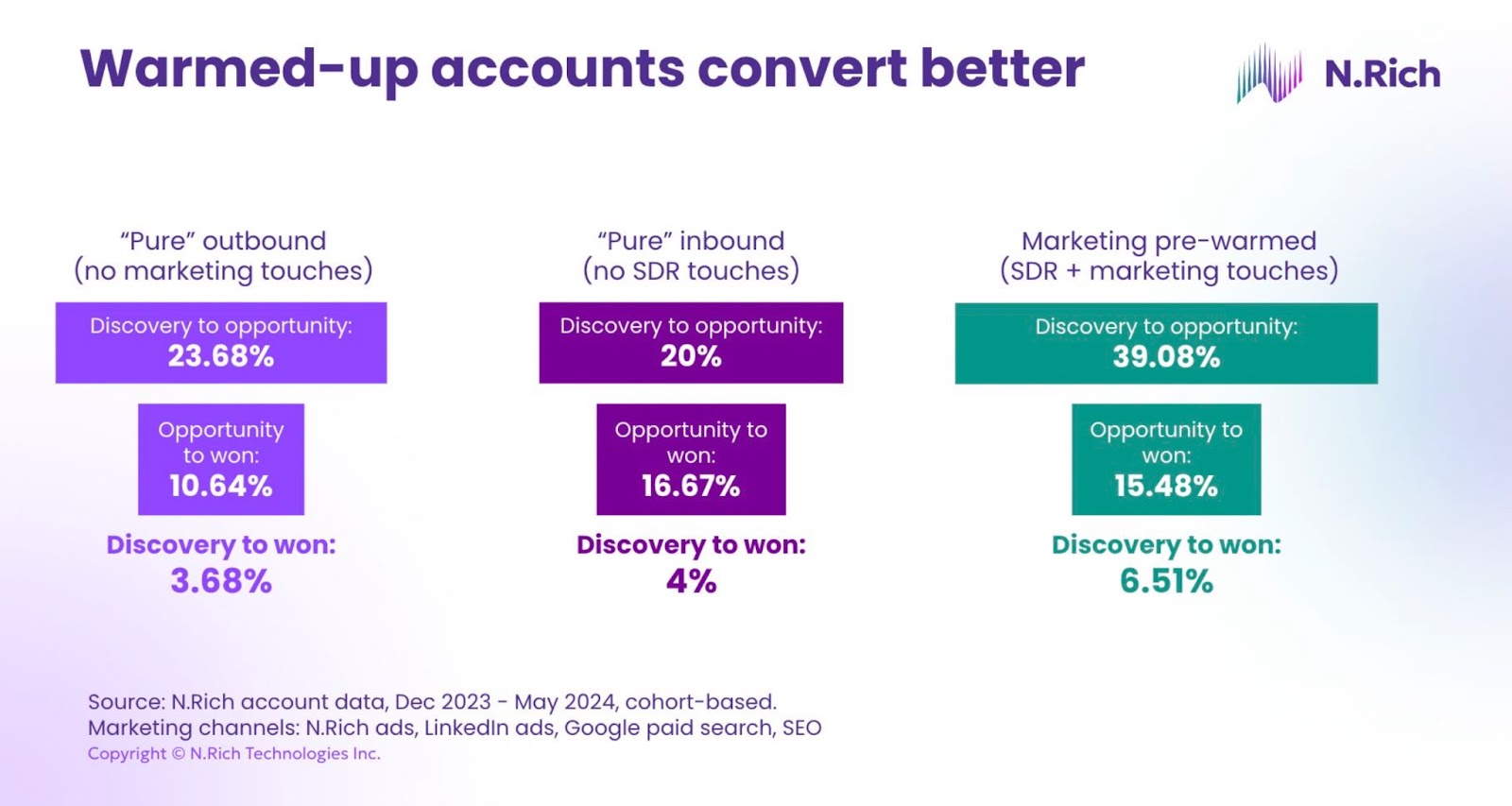
N.Rich used the same approach on itself. That 2024 program used three tiers: cold, engaged and hot. It focused sales development reps (SDRs) on the hot tier, and marketing worked the same accounts with content tailored to what each account had engaged with.
The results come from N.Rich account data from December 2023 to May 2024. The data is cohort-based. The marketing channels were N.Rich ads, LinkedIn ads, Google paid search and SEO.
- Pure outbound accounts (no marketing touches) reached 23.68% discovery-to-opportunity and 3.68% discovery-to-won.
- Pure inbound accounts (no SDR touches) reached 20% and 4%.
- Marketing pre-warmed accounts (SDR plus marketing touches) reached 39.08% and 6.51%.
N.Rich calls this combined motion Mixbound: account-based demand generation joined to signal-based outbound.
Where should you go next?
Is your team set up to act when an account lights up, or only to report that it did? If you cannot answer in one sentence, start with step 5 in the section on in-market accounts.
Three guides go deeper on topics this post only touches:
- Best B2B intent data providers compares tools.
- Intent-based marketing: implementation guide covers how to roll out an intent-led program.
- How to use intent signals effectively for B2B sales covers the signals themselves.
To see account-level intent on your own target list, book an N.Rich demo.
Create more pipeline and prove where it came from
Book an N.Rich demo and see how it works on your own data.
Book a demo
Table of contents
Stop building dashboards
Build apps that answer the questions your team actually asks. See what's possible in the N.Rich AI Playground.
Try the Playground