Ready to become an N.Rich AI builder and get paid for it?
On-demand
N.Rich event playbook: 1M in won revenue and 13M in pipeline
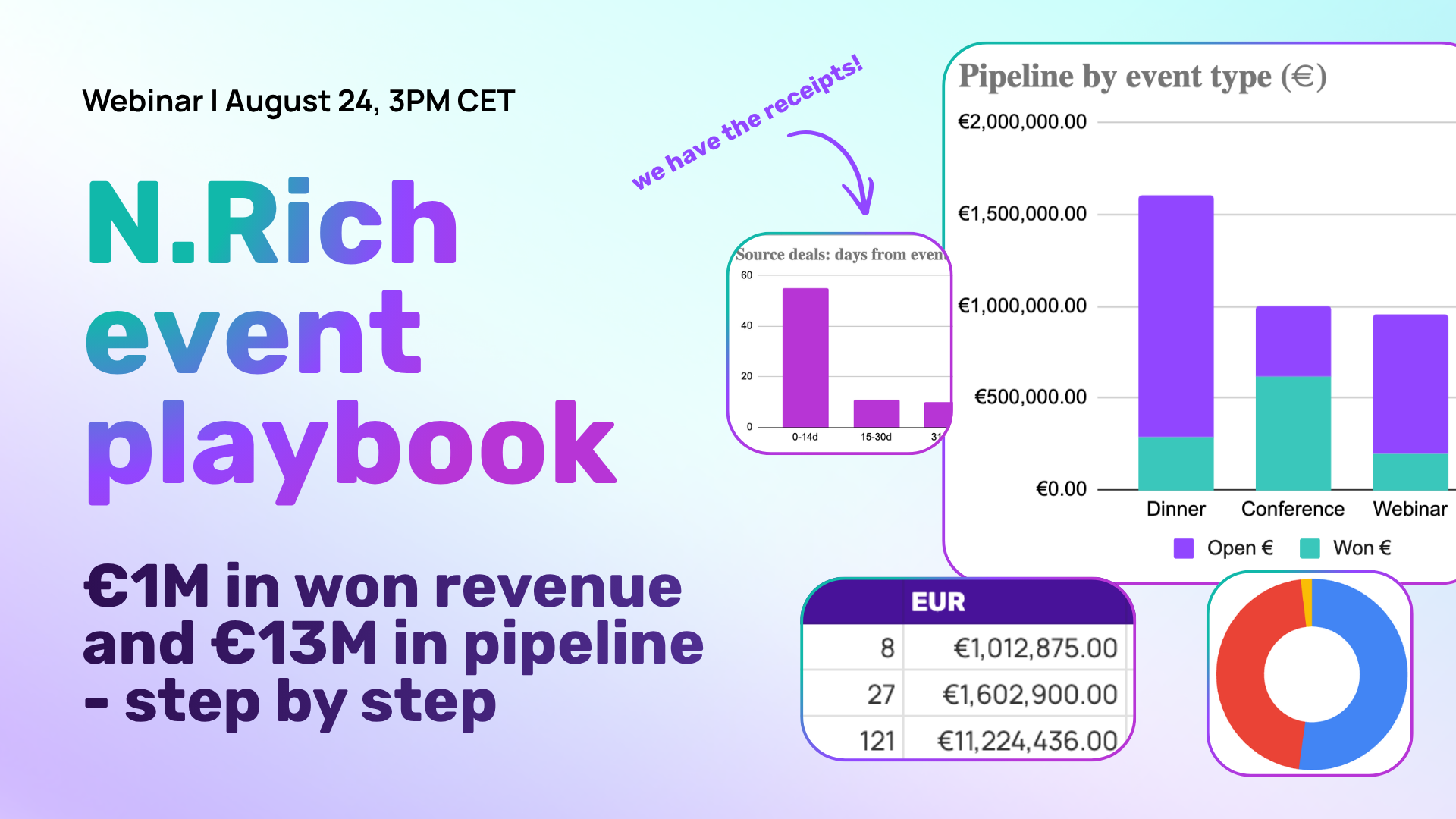
In this session, Yulia Ole, Jovana Stankovic, Mafalda, and Sara Storm from N.Rich shared their event playbook strategy that generated over 1 million euros in closed won revenue and 13 million euros in pipeline. They discussed their approach to planning, executing, and closing deals from events across dinners, conferences, and webinars.
The team covered event planning timelines, marketing execution, sales coordination, and deal closure tactics. Watch the replay to learn how N.Rich achieved nearly 200x ROI on their flagship GTM Secret Dinners and closed deals within 14 days of events.
Transcript:
Speakers:
Yulia Olennikova, Team Member, N.Rich
Sara Storm, VP of Sales EMEA, N.Rich
Jovana Stankovic, Field Marketing Manager, N.Rich
Mafalda Johannsen, Director of Commercial Strategy, N.Rich
Alright, we are live for the event that I was literally dreaming for us all to hold together, the breakdown of our event playbook here at N.Rich. This is a very real look into our event strategy, into our event playbook, and how we ended up where we ended up with really good numbers that we are going to showcase today. I am here with Jovana, our Field Marketing Manager, Mafalda, our Director of Commercial Strategy, who is responsible for our community and for the performance of the BDR team, and with Sara, who is our VP of Sales for EMEA and who very much contributes to the awareness and to the community building in the Nordics especially.
So we are here today with our event playbook. Let me share my screen and let's get it started. Yes, everyone can see the screen, I think, right?
Yes.
Okay, amazing. So a bit of the intro and the agenda. First, I will briefly walk everyone through the ROI and through the real numbers. I have been with N.Rich since 2021 and saw the early days of how we participated in events. We came a long way and made a lot of mistakes at some point, but now we are in a really good place and you will see it by the numbers we are going to share. Then the actual practical part where Jovana, Mafalda, and Sara will talk about how we run all the event motion at N.Rich.
Let's get to the results and numbers from our analytics dashboards. It is over 1 million euros in closed won revenue directly attributed to the event source or event-influenced deals. Still over 1.5 million euros in open pipeline with deals still in motion, and over 11 million euros in deals that were marked as closed loss. In this context, I would prefer that we rebrand closed loss as meaningful ICP touches because we are landing new logos or waking up the old ones with our events.
We roughly attract an equal part of pipeline from net new accounts. About 54 percent of pipeline comes from accounts that previously were closed lost deals. We have three main types of events. First, dinners that we organize ourselves, with our flagship GTM Secret Dinner concept producing the biggest return on investment in terms of pipeline per euro spent, almost 200x at our record event. Then we have conferences producing good results especially in terms of closed ones. And we have webinars that generate quite a lot of pipeline and revenue as well.
Regarding the elephant in the room, the question of how much time should we allow for the event to produce pipeline or revenue, in our case the answer is we do not really need to wait one or two years. The absolute majority of our deals get created within 14 days, and this is the merit of the team and the level of coordination that exists now. Now to the playbook part and how we actually do it from the logistics to the live event to close deal. I would love to first ask Jovana about the marketing part for N.Rich events.
Thanks for making this webinar happen finally, Yulia. I know it took a while to accept to speak. This is my first time speaking at a webinar, so please bear with me. As Yulia said, this is not an event manager project, it is a project of the whole team. I should also say that we are not wizards and we are not spending a million dollars on events. We tested a lot, researched a lot, learned from our own experience, and we work really hard on events across the sales team, marketing team, and RevOps team to make everything as it should be.
To start from the very beginning, first thing is planning. When I say planning, I am not thinking making decisions two weeks ahead about some nice conferences. Events need to be planned four to six months before. At N.Rich, we do this by quarter or ideally by half of the year. Before I put anything in our calendar and strategy playbook, I talk with my sales team, with sales reps, with the VP of Sales. Nothing formal, but casual one-on-one conversations with all of them to check what is happening in their pipeline, which markets are important, and to share thoughts about different events happening this year. I am very lucky because I work with the sales team. Before Yulia and Sara joined N.Rich, we made a few mistakes. We sponsored some events that were not good fits for us, or we hosted dinners at the wrong timing, or we spent money on random gifting. But since they joined, they really believe in event strategy and all dots connected together.
When I get all the inputs from the VP of Sales for each region, I start to build the event calendar. I do a lot of research. I do not just see an event with 5,000 people and sign the contract. I really need to research what is happening and get feedback from companies that sponsored events before, checking with real feedback from real people. A lot of numbers on event websites are not real and not realistic. I have seen sponsors' logos that they sponsored five years ago still on the website, or promises of 1,000 people when the real number is actually 100 people. You really need to dig and validate all the information.
I put all events, but not just events, into consideration. After all the testing and learning, we concluded that the best mix is to sponsor the conference and do a side dinner by ourselves at the same time, but also to connect those two events. We are doing three types of dinners. We do small C-level dinners up to 10 to 15 people that need to be hosted alongside the conference which also has senior level people. Then we do regular GTM Secret Dinners where we can target a mix of titles, inviting GTM leaders and so on, or like our GTM Women Voices Awards. That also needs to be connected with the main conference happening. If budget allows, you can sponsor all of these conferences, but you can also just attend. But then it will be much harder for your team because when you have a booth, a speaking session, and access to the attendee list, you are giving your sales team much more reason and opportunities to actually start conversations.
When I have all that together, I make a nice fancy deck. I am a visual person and do not do Excel files. Then we choose together with my VP of Sales. We narrow the list because you have five events happening at the same time and cannot do them all. Realistically we do one event per month. Together we build that list and with all the budget calculation, that list goes to our CEO and CRO for approval. Once that approval is done, preparation starts from the marketing team side.
This is the phase where each event manager needs to be slightly obsessed because there are too many details but you need to be a detail person. You need to talk with organizers, choose the venue, build the concept for the dinner, build the messaging invite, and create all information for your sales team so they can start the real pre-work before each event. That is the most important thing in this playbook. To choose the right events, but also to start and do pre-work at least a month before each event. We tested doing things ad hoc but that is just the worst thing you can do to yourself and to your team. When everything is upfront, you have time to do everything properly.
A month ahead, you start from the marketing side with marketing email invitations and LinkedIn promotion. The SDR starts outreach as well at this point. Communication is very important. We have Slack channels for each event because this is the way to deliver good results. When everyone is informed, aligned, and knows what to do, you need to have at least proper results.
You also need to give people a reason to come to your dinners and events. You cannot invite C-level people and then let them sit with just salespeople. You need your leadership team at your dinners. You need your customers and their C-level. Then your sales team has perfect messaging to invite prospects. They know who will be at that dinner, at least four or five people. It is very different when you just say we are hosting a dinner, please come, versus when you offer real value.
You cannot let chance handle things for you. You need to check everything. You need to choose your booth location for conferences. You need to check the floor plan and see who your neighbors are, where the main stage is, where the coffee station is. For dinners, the same applies. Where is that venue? You are inviting local people there, so that venue, that restaurant needs to be interesting for them too, with an amazing view or famous chef or whatever. You need to offer real value and the whole concept about everything. I think this is why our dinners are so popular and famous. But Sara will talk more about that.
I think about the on-site and the after event, Sara has some really great examples. From myself, I can only add that your side event will be one of five, six, ten side events at the conference. The bigger the conference, the more events. That is something that is sometimes not taken into account, but it is a major thing. We are now moving to Mafalda because the BDR role in event preparation is usually seen as something where there will be someone who will just send out invitations and then people will somehow sign up and then something is going to happen. I would say that BDRs are the most overlooked part of the event if you are not incorporating them in the proper manner. What do we do differently, Mafalda, when it comes to our own events?
Organizing this is a lot of effort, as everything Jovana shared shows. There is a lot of details, money spent, and energy. So it is really important to fill these with the right people with the right ICP and personas. As Jovana mentioned, we cannot put a CEO with a salesperson on the same table because they would not come to this dinner. That is why it is so important to do the groundwork from the BDR perspective. We know from marketing which kind of companies and which kind of role we want in the dinners. The first thing we need to do is create those lists on Sales Navigator and make sure they are enriched with emails and phone numbers so we have the list of people.
We have dinners with conferences and we have dinners that are standalones. With conferences, we also use the conference app to reach out, but usually these apps are only open two weeks before. As Jovana said, we do not want to do that to ourselves. We have to make sure that outreach from the BDR team starts before the apps open up. We reach out per email, we reach out per LinkedIn, which is very successful, and sometimes we even give them a call.
Super important on the messaging, I make sure that I correct and review the messaging. It is really important to show that this will be, for example, a dinner for C-level so they know they will not get pitched on. We make sure that we will not pitch them either, so they feel more relaxed to come. They do not feel it is a trap, and it is not. We also mention to them that it is invitation only, so they also feel it is exclusive, and obviously they do not have to pay for the dinner. I say obviously because we have had prospects asking that, so we started adding that to our invitation.
There is a lot of iteration about which messages work and which do not. In a very short message, we need to convey that this will be something useful for them, whether it is the topic or the people they will speak with. They will not get pitched. It is going to be a nice experience. As Jovana mentioned, we also talk about the site. Is it a good chef? Is this a good restaurant? People are local, right? We are doing a dinner in Stockholm. We say which restaurant it is and they know it has, for example, a nice view. We make sure that they understand in a short message which kind of experience they will have.
Then it is sales. Even if you write a beautiful invitation that is exclusive and awesome, we still need to follow up. That is why we need at least a month before to do that. We do multi-threading. We do email, we do LinkedIn, and we also make sure that we call them if we need to. Then it is super important that life happens and sometimes we have last-minute cancellations. I make sure with my BDRs that even when they fill the spots, we have some extra people lining up on the waiting list to make sure that we can fill out the spots.
We also remind them. We make sure that they accept the calendar invitation so they do not forget about the event or nothing else comes in. We also make sure that we keep them engaged once they accept. A couple of days before, on the day, we say hi, I will look forward to see you tonight, to nudge if they cannot come to let us know so we can also let the waiting list come in. If it is a conference plus dinner and if we still have some spot available, it is also a great opportunity when we have great conversations with the right target group to re-engage them.
Now another super important thing is the connection. This is a whole event strategy, meaning that we not only do events, we also do webinars. I also nudge my BDRs. If the person cannot attend the dinner, if there is an interesting and relevant webinar that we are organizing coming up, we can also send an invitation so they keep engaged with the brand. Next time we do a dinner in that city, the person is more likely to respond and come because there was engagement before. We also reach out to prospects who could not come in previous editions to also join our events. Sometimes we have recurring ones because many people come to several of our events, dinners, webinars until they become our customers.
We keep our prospects engaged. It is not a one-time thing, it is an engine going on and we need to make sure we understand that. With some dinners, we also did a follow-up webinar with the winners where we discussed the GTM topics from that day so people who could not join the dinner could also learn about the topics and anyone can attend that webinar. We also open those topics to other personas that could not or were not a fit for the dinner itself.
In terms of post-event, and then I will let Sara talk more in detail about that as well, we coordinate with the sales team, meaning BDR and AEs, to see who makes sense to follow up. If the AE spent a whole dinner speaking with a person, it makes sense for the AE to speak to the person and not the BDR, right? If the AE did not have any conversation with that specific person, then the BDR who invited the person is able to follow up. Or a couple of weeks later, if we did not have any meetings booked with certain people from the webinars, we re-engage again to see if that is a better timing.
We have to make sure that BDRs have time on their agendas to do the pre, the during, and the after. We make sure that we allocate time for them because Jovana can create the best dinner ever if we do not have any attendees. Then it was all for nothing. We have to really make sure that we do the right thing.
Before we continue, I wanted to ask you to elaborate on what we do differently, maybe like using the example of Aika and Sara as the team for the Nordics region, because this is where our most successful formats essentially started and then we scaled it to the other regions as well. If you could describe in a couple of words what does Aika as the BDR for Nordics do differently and what should each BDR do at each company when it comes to events?
I can talk about Aika, but because it is a Sara and Aika collaboration, I think it makes sense that Sara chimes in. First of all, Aika is very hardworking. I have to say this. We cannot do miracles, but I know that sounds obvious, but that is one of the reasons she does not sleep until we have the dinner covered. That is the reality of it. Hard work is the main ingredient here. She really prioritizes these over the rest.
No miracles, yeah.
If I can add, it is also about the relationship and a little community that she built with her territory and her contacts. But yes, Sara will tell us probably more.
Yeah, absolutely. They really focus. They make sure that they follow up and then she also makes sure that she keeps it engaged and she coordinates with Sara. She coordinates with the AE team, so she also divides to conquer, which is something that is very overlooked by other companies. I can talk from experience. In other companies, many AEs expect the BDRs to do everything and they just show up. Here, they help nudging, especially when we want certain C-level people. The AEs also chime in and try to invite themselves coordinating with my BDRs. This is basically the non-sexy secret sauce of this, but I will let Sara complete my intervention.
Yeah, hey guys, super nice to be here and meet everyone in the chat. We have a bunch of questions, I will answer a few of them and I already answered one. A bit of background I think is important before I get into the details of the part that has to do with what sales do. I have been on the sales side for 22 years and most of people here now are marketers. When I start presenting my slides, you should send this to your sales team and their leaders and you should start watching from whatever timestamp this is. One of the biggest challenges with creating events, even perfect events for marketing, is sales not following up. At the end of the day, this is one of the biggest challenges.
I also want to make a point that we are sitting here in a room now with Yulia, Jovana, Mafalda, and me because we are a team working on this. Many companies struggle so hard with creating these experience-based activities. They spend sometimes very limited budget on doing this type of events and then they get asked what is the ROI? And then they say that is a great question, I do not know, because the sales team has not done anything with the people who came to our dinner, with the people who were supposed to come to our dinner, with the people in the booth, they went to sessions. This is a huge problem.
Feel free to DM me on LinkedIn if you want me to jump into one of your internal meetings. I will shape them up because this is one of our biggest pipeline generators. But it requires collaboration in this room. Giovana, I am so happy you are here finally. We have been on you forever about doing webinars because you are amazing. None of this would be possible without all four of us. It would not work if I slacked off with my team. It would not work if Mafalda did not do her part, if Giovana did not do all of the amazing work she does, if Yulia did not manage our social media and make sure that all of these things come into play. We would have no ROI at the end of the day. This is what I wanted to add before I go into my slide with a bit more detail because I think it is super important.
I will now share the screen and I think we are ready, right? Everyone is listening?
Can you see this? Yeah, we do see it. Okay, great. So we can see the screen. If it is too small, tell us and we can probably zoom in a bit, or you can zoom in yourself if you cannot see.
What we do, and Jovana has already addressed part of this, is borrow a room that already exists, and that means connecting a dinner in most cases to an event. Because the people you are trying to reach are already in the city, right? They are already there. Do not get limited by Brella or whatever app you are using. Make sure that you go locally across the country where this event is, even if you do not see them on the app, to invite.
About eight weeks before, or at least more, I think Jovana starts finding events very early. Once we have done that, we move over to building lists, tiering, landing page, Luma, LinkedIn event, and the sequences to invite. This is something where Giovana and Mafalda and me collaborate to make sure we hit the right target accounts that we want to target to be able to invite them to dinner, depending on the format. Because C-level is very often tier one for us, while the bigger dinners are tier one to tier two to tier three, with other decision makers. If you look at C-level versus the layer below, which is very often GTM operators who need to sit with peers to figure out their own GTM, we talk a lot about events for the operators. And there I have some great examples coming up.
When it comes to invitations, this is one of these things where we nailed it down eventually. When I came in and Mafalda started and we had this ability to create the collaboration with Giovana and the marketing team, we looked at how to get people in that are really relevant for us. AEs and BDRs and seniors like me in a VP role do invitations rolling towards these tier one and tier two accounts. I support and do sequencing. Our AEs do sequencing. Mafalda does sequencing. In many cases, we might talk to the same person from two different directions because one message they will see, the other one they will not. We do not concern ourselves with, oh, maybe it looks too pushy to join in two channels. It is not because people are busy. We need to recognize that, especially C-level, which is very interesting for dinners that we have with C-level and very good pipeline generation, because if they want to go, there is no discussion. They will tell the team to go.
And then we start inviting, and that is about four weeks before the event. This is important that it starts early, because if it does not, you will sit in a challenging situation. Once we go to about three weeks before, we have a gate which is let us make sure we tier check that these people who have signed up, because we do social posting as well, so people who we have not invited personally will still sign up. We then approve weekly and add to the calendar invite and make sure we send a reminder, already done, that they have been approved. We send them an invitation through email personalized that is like, you have been approved of this dinner, we are so excited, good to see you. If you need anything, here is how to find us. And then we approve rollingly and we try to have some be cool when it comes to not rushing accepting invitations or accepting participants, because we know more people who are highly qualified will come in during this period. So do not approve too fast, because then you will be stuck in a room that has half of the people you want and half people you do not want to do business with.
Once we have the room ready and set up, we do reminders the day before. Normally, we have a waiting list of like 40 to 50 people on these events and the ones we want to make sure we can call the same day if we get cancellations, which you will always do, those are then prepped so we can just reach out to them. We are also informing them, you are on the waitlist, but you are very close to the top, so you might get a call this day. Give us your phone number so we can reach you if we do not already have it. And then we do a very clear tiering and then we do a very clear table placement because you want to mention like one of the things that is important is to make sure that this is an experience for them, right? The goal is obviously pipeline, but we need to create an experience that is unforgettable for our prospects. It is super important in this scenario, which is why we add customers to talk to the customers without us having to pitch anything. Because the dinner is not a place to pitch. And seating has to do with the best experience for the individuals.
I do a ton of research because it is my market, the MEI Smart Market. I do a ton of research on each individual coming and then I do a table placement based on where they would have the best night. We place people next to each other that have commonalities, that can discuss their own problems and have similar problems next to them. We do assignments for each person joining the dinner. So our CEO Marcus has an assignment: these are the two people you should talk to, this is what you should talk to them about, write down your notes the same day after the dinner to make sure you put it in the CRM. We are riding our CRO, like everyone is on board. This is one of these things that is super challenging for a lot of marketing managers and marketing teams that we do not have alignment.
Sales people do not report to you guys. The CEOs do not report to you guys. There needs to be an understanding and a commitment to events is how we go. If you do not get that, your job is to either educate and get them to a point where they can align, or stay and fail in your job, or leave the company. These are your three options. You cannot do any other thing than those three. It sounds very rough, but it is kind of rough because we need to get to a point where everyone understands the ROI importance of events and that everyone needs to do their job.
During the dinners, we will then talk to the people at the tables. We will not pitch anything, we will not show anything on we will demo nothing. The point of the dinner is an experience. And then once we have done that, everyone needs to record a voice note of the information they received from the people they had as assignments to talk to, or write down notes. We need that the day after for follow-up. We need to understand what the conversation was, because the CEO Marcus will probably not do a follow-up email. It will be one of us in our team. So then the thing that really lifted this is also 24 hours later we do a gift and an ask for a meeting. We send them something from Reachdesk, which is our place that we use for gifting, and it can be something that is a spa package, a bottle of bubbly, whatever. And then we message that tied to what was said and the CTA is a session with us.
We have also experimented, interestingly enough, with gifting before the event happens. The best gifting we have seen so far before an event is an Uber voucher so they can get to the event, so they can get to the dinner. So here is a free ride from us to get there. And when we do that, we also get the last minute info. If they cannot make it, they will always tell us. We very rarely have no-shows. We get the information, especially when we do gifting, because they are like, no, I cannot take this, I actually cannot come because of why. This creates a sense that we really want you there, we really make sure that you can get there.
And then we move over to pipeline. I have some conversion numbers in the next slide, but I wanted to answer a question too related to do you think it is possible to create such event dinners without having a sales BDR department? My answer honestly, guys, would be if you are not Salesforce, probably not. This is the piece that is missing. So if you are not Salesforce, where people come because of your brand, if you are a challenger on the market like us, that not all your target accounts that you are looking to reach, they do not know who you are. I have had so many conversations at dinners where people are like, I had no idea what N.Rich did until now. Now I know. It is a very clear statement to our brand awareness. That is something that we need to continue working on because without that brand awareness, where dinners is a tiny piece. If you look at the top of this slide, we have something that we call always on for this, that makes this dinner successful. We have our N.Rich ABM campaigns that we run always on in different stages of the tier one to tier two accounts we have. We are then pushing engaged in Hotti Council LinkedIn campaigns to do even more events management, like event marketing there and also marketing for us. We have email marketing for the dinners, we have LinkedIn posts from the company and all individual contributors in the revenue team and our managers, including our CEO and our CRO, are all posting. Together in our group, we have a reach of over 500,000 people. We need to proactively build this awareness so that when the dinner invitation lands, they are like, right, I want to meet this brand. Even if they do not know even what we do specifically, that is again not the point.
And having a seat at the dinner, just to make sure you understand how we build pipeline, Yulia showed before like one to 14 days is how when the meetings trickle in and when the deal is created. So having a dinner seat is not a meeting, it is not pipeline, it is not a deal. The deal does not get created in our pipeline until they have accepted an exploratory discovery conversation after the dinner. That is when we create the deal. So having a bunch of people come to a dinner does not mean that they are in market right now. It does not mean there is an active opportunity. It does not mean any of these things. We need to make it an opportunity. And then we need to do very tailored approaches and actually care enough about the dinner guests to do notes about what we talked about afterwards.
This is actually the same as events where you have booths and things. We will meet 100 people at an event. There is no chance that your reps or their manager will remember those conversations. And if we do not do notes or record a voice note, which I do after every time I interact with someone at an event, because I am also there talking to people. If we do not do that, that information will never hit the CRM. You will never be able to tag the lead to the event. You will never be able to track your ROI. There are so many things going into running ABM this way with dinners as a focal point in the process that need to depend on sales. And if the sales manager is not forcing people, it will not happen. This is the takeaway. This is the part of the section I think you guys should share with your sales management. Because if they are not on board with what you are doing, they need to get on board. I talked for a long time, sorry. I hope that answers your question, Anna. I really appreciate the questions. You should ask more in the chat, all of you.
I could add an answer to the question, is it possible to do it without SDR team? Yes, but you need a partner who will do that work for you. Without the pre-work and after work, like the event or the dinner, it is just 20 percent of the whole work. Someone needs to do it. Either it is a BDR partner or whatever, but someone needs to do it. If you are a smaller company, your AEs can do it if they are being told by the manager. Otherwise they will not because they want to talk to people they already know.
I am a bit disenchanted with sales and I am a sales manager, like I am a sales leader, and this is something where we are wasting money if they do not do their job. You want us all effort, all the effort of Mafalda, like we are just wasting our team's efforts and our budget if we do not turn this into pipeline. And it is also sort of, you are not doing your job as a sales leader if you do not get this to work. I am rough, but it is true.
Let us talk about AI. No webinar, I think, in 2026 goes without a mention of AI. So how do we use AI in the preparation and the execution stage? Sara, you probably have some place to share, right?
I do. I am an AI nerd at this point and everyone should be, obviously. One of the things that I found most useful is doing research about the people coming, because now you have to remember I am in the process of converting into pipeline. So placement at the table is super important. Doing research on the individuals that are coming to the table, doing research on what should we talk to them about when I give assignments to my AEs and my CEO and my CRO to make sure that they have a short like cheat sheet on, okay, this is what we should engage with this person on, this is what we should talk to them about, this is what we should ask to understand like timing, is there a buying window? These are things that I think AI is doing excellently. So far, our dinner placement since I started using this in our process has been excellent. You guys will see an example later of a person on LinkedIn raving about our dinner, right? So this is a very important part.
We also do a lot of messaging through AI when it comes to fine-tuning, like how are we gonna tailor. We do not necessarily always do it in sequences. Sometimes we do the first touchpoint after dinner, really tailored. We sit and actually give it a think on the account level, like what should we suggest as next step, because sometimes we might want to suggest like a working session where we dive into their GTM and sort of break it down and see if we can break more things.
Here is the example. So I wanted to share this. I know it is a little small text, but like Johanna, who is also a customer by the way, they become a customer a few months after the event, and she basically said, as a marketeer, I was in awe of this event. This is a great peer-to-peer confirmation about how we are doing this. And then she also mentioned the follow-up, do not even get me started. And one of the things that this is the point of here is that this is a very crucial part. If you do not follow through the experience will be a lot less interesting for the person too, because if they leave the table with great conversations, they want to be able to connect to the people who joined, they want to be able to talk more to us. And if we just leave them, then what will they do of that? They will walk away from the dinner, remember it as a great experience, and then nothing will happen.
So I think this is like, the curation of guests was very important for her, the partnership, like how the best of class companies that was there, the social build-up, the secret dinner, exclusivity, waiting lists, like all of these things were lifted. And this is feedback we get all the time from people we speak to about these like situations. The beautiful facilitation, all of this is Jovana and Mafalda and my work. Like this is all coming together in a beautiful type of motion that brings again a lot of pipeline. And that is my target goal, right? As a sales leader, my goal is money, money on the table, money, much more money than we spent on this activity. So this is the whole point.
But AI is again partly used for outreach, it is used for invitations, it is used for placement, it is used for research, it is used for creating curated lists. We are using AI across the board here. We pull from our marketing campaigns to understand what they engaged in to be able to tailor on that. There are so many places where AI is in motion. And also in N.Rich, our own platform, AI is part of what makes sure that these ads that we are running are placed in front of the right people in the right companies to be able to run a really good DSP and to reach the places where these people are actually surfing. So that is also a part, but AI there has been part of our platform for a while. It is not as new.
Yeah, and we have a part about this because, yeah, me personally as a product evangelism manager, I cannot skip the product part in any of the webinars. Here though, I would like to clarify that, Sara, I do not think we ever send like AI-generated follow-up, AI-generated like 100 percent AI-generated text to anyone, right?
Never, never fully automated. The human in the loop, and I mean like the human who actually clicks the button is like non-negotiable, right? Until we get to a point where AI can mimic my voice or Aika's voice or whatever, and that is not here now, we would never do that because we are looking at high contract value customers, CEOs, CMOs, CROs, like no. It is absolutely not suitable because when you are running a big account motion with big contract values, you cannot get away with that. Like you will not get away with it. It ruins the experience 100 percent. So just no, do not do that.
Okay, we have a lot of bad news here in this webinar. You have to work hard, you do not have to use AI for creating content at scale. So there is also a lot of disappointment apparently. But we do have two friends of our team. One is called Dora, the other one is called Wall-E. The two agents built by Josh, our head of demand generation, who really automate a huge part of our workflow. Dora is someone that use to see under every incoming lead in Slack. We get the notification in Slack about the dinners sign up or webinar sign up, or I do not know, someone just downloaded gated content. Dora pulls data from a lot of sources. What I like in particular about it is that it also gives you an overview of like ABM stage, so where exactly this account is in terms of previous engagement with our campaigns, be it N.Rich or LinkedIn or whatever, who are the contacts, what is like, what is the current status and the recommended next steps. But it never happens in a way that like the AI recommends and executes and sends and you then need to deal with consequences. There is like the human part, of course, in the very end.
And when it comes to webinars, all of the post-webinar process, which we all know how time-consuming it can be, it is automated through the webinar producer, Wally. So it actually creates a kit of materials which is transcript, webinar replay, landing page that goes automatically on the website, social posts, blog posts, suggestions for the video clips. Yeah, for me and for Jovana and for everyone on the marketing team, this is automating like probably 90 percent of our effort here. There is a necessary disclaimer that N.Rich, of course, is a huge part of our event strategy because our event strategy is a huge part of our ABM motion, naturally.
So account prioritization, every time someone visits the website, every time we have someone appearing on the dedicated landing page of the event or something, we have immediately the notification on Slack about the visitor. We obviously run pre-event campaigns four to six weeks as Sara described already. Important disclaimer: we are not looking for direct leads from those banners because I do not know, when was the last time you clicked a display banner in your life? But this is just to warm the audience and make them feel like, okay, I know those guys, I have seen them somewhere when they are already there at the event, near the booth, and so on. And in terms of the post-event tracking, we have now GTMS, which is a fantastic, I would say one of the most advanced data interpretation layers in your ABM program. So you can actually go there and write a prompt, basically talk to your data and write something like, okay, now show me all the ICP accounts that visited the event page and sales for some reason did not get in touch with them. That is something that we as marketers do on a regular basis and it just shows you that, okay, like this account, ICP Tier One, Tier Two, and it for some reason has not been touched by sales. And this is not like to blame someone, and this is not to tell like, hey, sales are not following up. If they are not following up, there should be a reason. So this can be like a useful feedback loop. Okay, do we need to revise the targeting? Do we need to revise the personas? Is there something else, like maybe we have some data migration problem or whatever, that we can discuss to make our processes better?
Anything that we use N.Rich for besides that, maybe? Maybe I missed something.
I do not think so. I think the point here, just to add, by the way, I would blame sales, just to be clear, 100 percent. So if accounts are not touched, like that is sales responsibility. And when I say sales, I mean me and Mafalda, because at the end of the day, we own the teams. So blame, you should blame sales. Do it smartly, do it politically correct, but like make it clear and visual, which is why I love GTMS myself. Make it clear and visible for leadership that we are doing our job on the marketing side and over here they are not. Because we have this struggle, like as marketeers now working with marketeers for, I think it is the last 12 years, myself in different companies, we have this problem on the marketing side, which is we do not get them to understand that what we are doing is dependent on sales to do something with. And then it looks like we are failing on the marketing side. It is very rarely the case. So we need to be able to build clear data points and show those, which is here is where the ball is dropping, here the ball is in the air only, right? And I am saying this with all the love to marketing because you guys have an uphill job, like it is an uphill job to get this to happen. So you should blame sales, make sure you have data that supports it, right? At the end of the day.
Coming from someone with the title VP of Sales, this is rare. This is, I think, disappearingly rare. So yeah, this really means a lot. We are almost at the end. We have been talking for almost an hour and we could go on, I think. This is such a huge topic. We have not touched on a lot of arguments here and probably I am sure people will want to catch you somewhere and talk to you in person, ladies. And those are the next events where you can do this. Starting tomorrow, our team will be in Copenhagen. I guess all the three of you will be there, right? Yeah.
Yes, yes, yes. All three of us will be there. So you can meet Jovana. Do not hire her. She is ours. Please stay away. You can meet Mafalda and you can meet me at Tech Barbecue in Copenhagen tomorrow and we also have a dinner tomorrow night and if there are translations, sign up for it. Let us see if you are here in the territory or going to the event, feel free to come to the booth, whatever. Also if you are not in Copenhagen, feel free to go to LinkedIn, click connect and just ask us whatever. We will be happy to support.
Yeah, absolutely. And if you are in the United States in September we will be there. I think Jovana and Mafalda, you will be at Unbound, right? Sara, are you coming as well?
I will not be, but Jovana is.
Okay, yeah, Unbound in Boston, make sure to find us. We are running probably the ads at you already, so you know about it. And September 29th, the Pavilion GTM 2026. We are having the GTM Women Voices Awards, the US edition, for the first time. So go to our events page and be sure to find the event which suits you in your location. That is it. I am actually stopping to share. We can answer some questions if we have any.
There is none, I have answered everything. But I would like to have a final sentence for, and I think we should all do that, like the most priority. So I would say the following from my side: get your sales leaders on board, do it as soon as you can, otherwise your events will not succeed in pipeline and you guys will be blamed for it on the marketing side. It is unfair, but it is true. And if you guys need political help to discuss or navigate or have someone else say it in the room, I am right here. I am happy to help. I have had these meetings a lot, meeting salespeople, sorry, sales leaders, to tell them what is up, like to get them on board. And you can say the same things and somehow an outside voice makes a whole different even though I say the same thing as you do internally. So that is my closing remark.
So my closing remark is what you mentioned, obviously, but also create an event that you would like to go to, right? So something that you know, I always have a great time in our own events. It is not a sacrifice I make. So make sure that this event is relevant and it is special to your prospects. Pipeline will come from it, I would not say automatically, but will come from it. So the event should be a special moment for your prospects, no pitching, and really a great experience. You do the pitching and everything sales-wise after and before, not during.
Jovana, what about you?
From my side, I would say from marketing events manager perspective that you need to choose the right events and not most events. And also be BFF with your sales team. Mafalda loves to say this sentence many times, but now I am really stealing this line because it is very, very true. And be obsessed with details because the experience is all about. Not just with the dinners. We are now focusing on the dinners because this is our event strategy, but the same goes with your booth or with your session that you are hosting at the conference. So the experience and the reason for people to come and to listen to you, to talk with you, is all about.
Yeah, and as Sara rightfully mentioned, sometimes it is really hard to do this like from the inside because there are certain patterns and certain history of relationships between teams. Do not be afraid to bring in someone externally, and actually the events are a very good place for this, that you can just meet someone, you can speak in person, you can just exchange your problems, your challenges, and you can really get some fresh ideas or even bring in someone to the leadership, to your sales counterparts, to just support your points, your argument. I did this myself several times, it works. Thank you, ladies. Thank you to everyone who was here for your questions, for your input. We will share the recording. It is 2026, we are sharing the recordings, we are sharing the slides. See you in the next webinars and see you at our events, obviously online, offline. Let us keep in touch. Thank you, everyone.
Thank you, guys.
Bye.
Create more pipeline and prove where it came from
Book an N.Rich demo and see how it works on your own data.
Book a demo