Ready to become an N.Rich AI builder and get paid for it?
On-demand
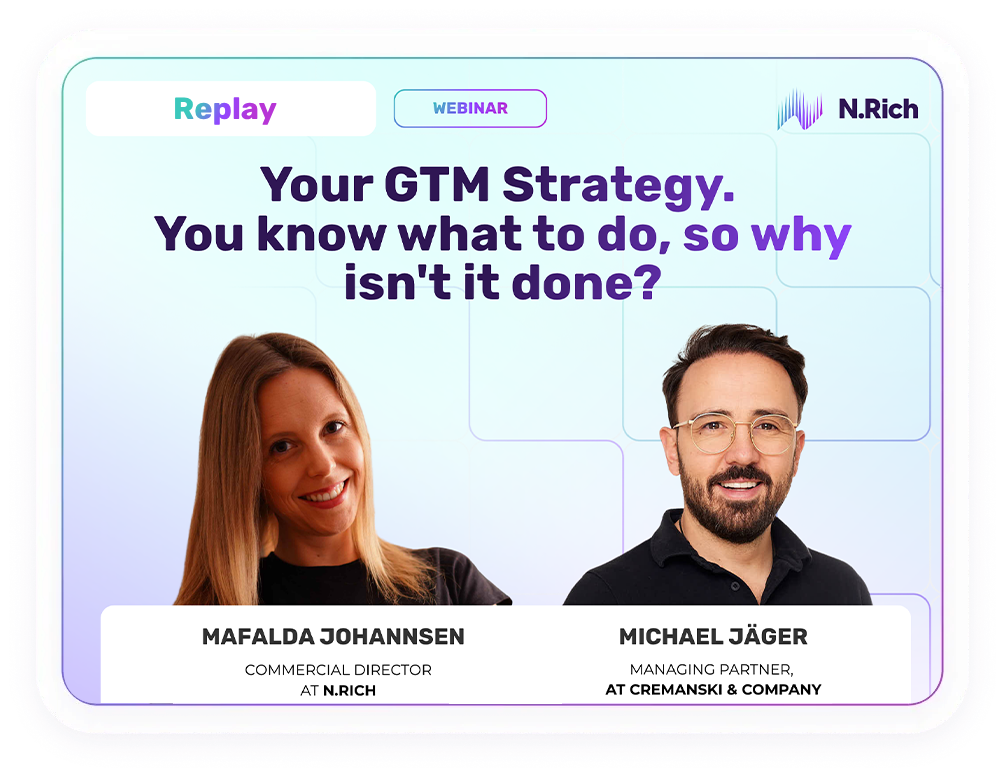
Your GTM Strategy. You know what to do, so why isn't it done?
In this webinar session, Mafalda Johannsen and Michael Jäger discussed GTM execution challenges affecting B2B software companies. They explored why strategy alone isn't enough and examined the operational and organizational barriers preventing effective go-to-market implementation across sales, marketing, and customer success teams.
They covered why execution fails, common GTM pitfalls including misaligned incentives and diffused ownership, and how companies can strengthen governance and process discipline. Watch the full recording to learn how to move beyond strategic planning to effective GTM operations.
Transcript:
Speakers:
Mafalda Johannsen, Director of Commercial Strategy at N.Rich
Michael Jeager, Managing Partner at Cremanski
Good afternoon, good morning, good evening, depending where you are. Welcome to another N.Rich webinar today with Michael Jäger. I will let him introduce in a bit. So today we will talk about GTM, not much about strategy, but more about execution. So your GTM strategy, you know what to do, so why isn't it done?
Before I go through some housekeeping, let me introduce myself. My name is Mafalda, I'm the Director of Commercial Strategy here at N.Rich. And my guest today, Michael, he's based in Berlin, he's from Cremanski, but I'll let him introduce himself.
Welcome! Thank you very much for having me. So my name is Michael, I'm the Managing Partner of Cremanski Company, the revenue architects and we are a consulting firm helping B2B software and service companies to restructure their go-to-market. Our main target is between 10 and 200 million ARR, and what we do is we deploy operational support squads. Meaning we have very experienced operational people for marketing, sales, customer success, RevOps, go-to-market, engineering, or systems. We deploy them in the RevOps teams as commercial support, usually a minimum of 3, and then we help to restructure and optimize the entire go-to-market approach.
We're 8 years on the market. We have structured more than 650 companies so far. So we did a lot of learnings on what is a good process, what's a bad process, and how you can scale properly. And that's why I think we lead to this today's topic as well, because what we see is that everybody knows the theory. There's a lot of content out there. We need to read a lot of blogs and LinkedIn posts and still, I think the biggest topic or the biggest challenge we see within these companies is the execution, and that's why let's discuss this topic today. I'm really looking forward to our discussion.
Yeah, absolutely. Thank you so much. And yes, GTM has been the present and the future. GTM has been a topic that at N.Rich events we organize dinners and we organize roundtables and panel talks, and that's been a hot topic for us as well. And that's why I thought this was a great partnership for you to come and talk about these topics, because it's something that we see, our clients and our contacts mentioning and discussing.
So before we actually dive in, your engagement matters. We do these webinars for you to help you. The more you ask, the more tailored it will be. As a moderator, if the question makes sense within the discussion, I'm happy to ask during the discussion. And if it's a bit different or not on the flow, I will make sure I will ask the question in the end. I'm not ignoring you, and please bring your questions. The more the merrier.
As you see, my colleague Jovana is here. She is in Belgrade. I'm in Berlin, like Michael. I would love to know where you guys are tuning in as well, so we also have an idea. And yes, these will be recorded. So that's a very frequent question. These will be recorded. I hope you stay until the end, but if you can't, we will make sure we'll send you the recording.
And we do a lot of webinars at N.Rich, a lot of them in different topics: sales and marketing alignment, ABM, and now GTM. If any of these topics are of interest on an ongoing basis, just follow LinkedIn, follow me, and you will get to know the upcoming events. All right, so let's start, Michael.
Absolutely.
It's not a strategy problem, it's an execution problem. Why is that?
Good question, very direct. So in my opinion, we're not used to, or we somehow don't want to control the people and control the processes, right? We somehow sit down, we strategize who we want to talk to. In best case, we even define how we want to work, we define the governance. And then we implement this into the systems, but then it stops, right? We assume everybody is a professional in go-to-market and just follows the rules and follows the barriers, the right definitions, and we only work in what we have defined.
But when we really look into the operations and how the companies operate, we see one big topic. We don't really put a lot of focus on this governance and on these processes, right? We accept deviations, so starting from the ICP, "oh, it's a little bit smaller, we still take it in. Oh, it's a little bit bigger, nice, we still take it in" without thinking about the consequences. So we have defined the barriers on SQL, but we have a gut feeling that this client is interesting, so we move it around.
I think the biggest challenge or why we have this execution problem is because we don't control it. Because we could put the standards in which we have defined, and we could make every deviation from the governance, from the standard visible, and then discuss it. And through this focus, we already get it done, but we don't.
Yeah, I think so. And I think it's also a bit of this fear of missing out as well, no? Would you say so? Because, you know, it just reminds me what you told me, you know, we define the ICP, but this potential customer finds it interesting, let's go for it. Would you think it's also this kind of cognitive biases also on the way?
Yeah, so I wouldn't say it's the fear of missing out. It's rather, right, obviously we want to make deals, right? We want to get clients, we want to make revenue. In sales, we want to do our commissions. As a leader, we need to reach our goals. And I think the biggest problem is it's quite often very short-sighted, right? We live in today, in today's deals, this month's quota, and we don't think about the consequences we have there. And so it's human-driven, right? We want to have success and it's hard to think holistically on it.
It's hard to have a view over the next 12, 18, or longer time cycles, right, to see, hey, if we do this, what is the consequence around it. So it's just like we want to get the success, we want to get it fast, and that's why we accept the deviation, I think.
Yeah. And before we go more deeper on why it fails, do you think it got worse in the last year, year and a half, 2 years also due to these constant changes on AI, this faster pace? Or because you've been doing this for 8 years, right? Have you seen a huge shift from these deviations in the last 2 years, or it has been more or less the same?
So look, in the end, when there's an economic crisis, which we somehow are in, right, and cost pressure goes up and performance pressure goes up and it's harder to get deals, obviously the deviation from what we have defined goes up, right? Because we somehow need to get clients in. And I would say in the past 3, 4, 5 years, right, since 2022 when we saw the downturn, where we saw the change in investments and all of it, it definitely went up. Yeah. And the consequences are much harder, right? Because you get your deals in the beginning, it looks good that you get your revenue growth, but then when you look at the real metrics and you see, hey, my metrics go down, my churn goes up, my average basket goes down, it has a huge impact on your next financing round.
I'm not sure if AI really has an impact on this deviation on the ICP, but definitely the economic pressure.
Makes sense. Let's go then, let's go deeper on why the GTMs fail. So we have here a couple of reasons, different system, diffused ownership, misaligned incentives. Which one would you like to start from?
So I think the, let's go a little bit through the journey, right? So quite often we have different departments within go-to-market with own incentives, own goals, and quite often managed by one leader, yeah, a kind of old way to operate, but still very common even in the most modern companies, yeah. And one big mistake already is starting in the beginning that you don't holistically look at your customer journey, right? You structure for internal way of working in marketing, in sales, in customer success, but we should structure on buying behavior of our clients, right?
So we have one journey in one segment because different segments in the B2B have different behaviors and we need to do it end to end, right, to have one structure, one aligned way or one aligned journey, and then it could be different systems, but obviously they need to work together. And I think the biggest problem here is we do not, or the biggest challenge is nobody looks holistically on it, and then we have the ownership and the goals of the individual departments, and obviously they look at their goals and optimize on their own.
I could talk about right here the different systems quite often is one big topic. We see marketing deciding on their own systems, sales deciding on their own systems, sometimes even customer success then on their own systems when they initially or when they change it, and then you optimize the processes for on your own goals and your own part of the journey. But in the end, you're just a role, right, fulfilling one, two, multiple tasks along the journey, and we need to build it in one level.
And as we don't, we give the client somehow even the feeling they're buying from 3 different companies, right? Marketing has a message and then sales has the next message and then customer success somehow cleans what we have sold. And that's, so there's definitely diffused ownership and misaligned incentives in the end because we incentivize on our own goals. But I think the biggest problem is a management problem that we're not holistically plan it.
And building on that, because I agree with you, I think definitely it feels many times in companies that each department is pushing different direction even though revenue and growth is the same goal. The follow-up question here is, how do you really recommend having, let's say, incentives or KPIs for each department, but they are aligned to go on the same goal.
Look, if you think in these holistic journeys, right, where we believe, look, we have different motions with a different focus having one journey end to end, right? We come to an end, let's take the example of enterprise, we plan a journey in multiple steps, right, where we have, let's say, the bowtie model, very easy, right? We have the capturing the awareness and so on, but in the end, right, we have each lifecycle stage has steps to fulfill which qualifies the lead further, and then it has a barrier which needs to reach in order to move further, right?
So we capture the lead, we qualify and enrich it, and then we get it further qualified to an MQL, then it moves to sales, we do our discovery calls, we ask further questions, we have different steps and KPIs then. There, then we have the sales qualified leads, then it moves into a deal and so on. And obviously on these steps we can incentive or we can set the KPIs for this part of the journey, what we want to reach, what is expected behavior and how and what we need to fulfill, right? So there's already setting the KPIs.
In the end, we only have one goal, right, is getting this client signed, so getting some revenue in, and then getting the client, so we grow the client towards the average baskets which we have defined for the segment. And this you can both incentivize, right? We can incentivize saying, look, we have done our job, or we can structure it as we have done our job in defining the segment and the ICP, defining how the journey looks like, defining the business model around it, right?
How much, what's the touch level we can afford in a certain basket level? What's the acquisition cost we can afford in just for the step, let's say, for the CAC for marketing, the full CAC for sales, but then the full CAC, and what is the intended lifetime value we want to achieve, and we achieve it through the initial sales or the initial signature and the growth. And obviously, you need to set the incentives on the way where it's somehow handleable and it's in a time frame where we pay commissions on part or we pay on the bonuses in times which are reasonable. And ideally, it's not longer than 3 months, right? I don't believe in incentives on the entire year.
So you get incentives structured on your goals, but as well on the common goal. And then you have a double incentive, right, where you reach your own individual KPIs, but you get the real let's say the real connection to your bonus or to a commission is when we reach the aligned common goal of that journey or that motion. A lot of words. Does it answer?
It does, it does. But I do have a follow-up question on it. Because you've mentioned before that a lot of leaders are not doing this. From your experience on the advisory, why do you think, what is the one or two reasons why leaders are not managing to, let's say, follow this model? What's stopping them?
It's a very good question. So first of all, it's two things. So it's not that trivial, right, to think end-to-end and to come up with expectations you have or definitions you want to achieve on this, right? So we need to be very clear on who's your ICP? What's your segment? And how does the journey look like? And I think one of the biggest problems we have here is we build journeys selling our product.
And if you go into most companies we go into, they have built the journey how they sell their product. They haven't built a journey how the client, the segment, is buying software or how they buy certain products. That's the first problem. Then the second topic is if you holistically plan, obviously, these roles just need to fulfill a job within the journey, right? So you cannot build the marketing kingdom and the sales kingdom and the customer success kingdom. You can build the revenue team, and then you have the different roles to it, right? So you really need to be very clear on who do you hire, who are your leaders of the different roles, and then make them very clearly aligned to work one, to one common goal.
But quite often the reality is, right, we start with something. Quite often we start with a marketing person and some sales, right, and sales is then quite powerful. And then we have a sales lead growing into a CRO, thinking in a way that, hey, we close deals, right? Data is one thing, but we rather close deals, and then we go to the client and do the old way. Instead of thinking about data. And then we don't, the CRO quite often doesn't have enough knowledge on the marketing side or the CS side, and then we don't really holistically plan, and then we let marketing do their thing and we do let CS doing their thing.
And so 3 topics, then a lot of words again, right? But in the end, it's 3 topics, right? So it's not that easy. We plan it from the different angle, right? Not from the buying behavior, and we need to put the people along the journey to really function as a team.
And so you mentioned something that stuck with me, that I also agree from my experience, is a lot of the time CROs come from sales and they have less knowledge on marketing and customer success. That's one of the reasons why, you know, this happens, this misalignment. What will be your solution for that? How could they, you know, gather that knowledge? Or what would be your advice whenever you have a customer who's a CRO, comes from sales, this is happening, right? The whole misalignment, the fees ownership, everything that's on the side. What would be your next step to work with, for example, this CRO specifically?
Yeah, so, right, we don't structure journeys based on an individual knowledge or something. We structure journeys based on this buying behavior and we know, right, let's say a big enterprise, let's say Siemens, right, they will not change how they buy because you come with your next product to them, right? It's very clear how an enterprise client needs to be qualified, how you need to work with them, what are the general steps you need to follow, and more or less the same is for mid-market and for SMB, right? It gets easier, a couple of less people involved, but it's very clearly, so it's very present and it's very transparent how they buy.
So if you end-to-end structure your journey and you define your ICP and you find a business model around it, where you clearly know in this ICP and segment, I have this basket, I have this lifetime expectations, which sometimes I don't know, and I can allow myself these costs connected to the basket, I can drill down the KPIs for each team, right? And then I can work very KPI-driven and argumentation-driven with the teams, even I don't, I'm not the expert in that field, right? I can lead a customer success team based on their goals, based on the definitions, even argumentation discussion, but I don't necessarily need to know how to perform the best onboarding or what is the, right, what are the best individual topics they need to do.
So what we believe in is that you need to zoom out and you need to set the KPIs and the goals towards it, and then you hire the best leaders to work with them. Obviously, you need to have a general belief in that growth needs to be data-driven and it's science and it's not arts. If you're the sales lead who believes it's arts and we just go to the person, we have some dinners and then we close that thing, then obviously all the data and all the data available are not so interesting anymore. And then you can talk about RevOps, who are the data guys, yeah, and they support us a little bit, but we do it on our own.
Yeah, yeah. Before we move on to the GTM Factory, which I think it's a great segue for what you just mentioned, we have the first question from the audience, from Dick from Sweden. He asking, most SaaS products are built as a one-size-fits-all old, but with AI and coding now easily accessible, many companies can build what they need and skip everything else. How do you stay relevant? It's a very good topic. Do you get these nowadays at Cremanski, these kind of, that they ask themselves if they should buy or they should build?
Yeah, of course. So, look, I think we had this in 20 years ago, right? Where, or 50 years ago where you discussed, hey, do I buy this or do I build this? And now we have this again. Yeah. Do I buy it or is it quickly, easily built with AI? I think one thing we clearly see all the companies are neglecting or not really thinking about, whatever I build, I need to maintain. Yeah, and I still need to think about governance. I need to think about the different roles, their needs. I need to think about the adaption and I need to think about the holistic view. And I think most of what we see, most companies don't, right? They build one thing for marketing and then they build one thing what is needed for the STRs, and it already makes it very even harder sometimes to operate in.
I don't really think that a lot of tools one size fits all really works, yeah, because in a big, right, obviously if you're between 0 and 15 employees, you can use everything. Nobody cares. There's not much governance. But if you have 1,000, it definitely is a completely big different topic. You need an organizational structure, you need governance in there, you need data protection, you need different roles and accessibility, different decision levels, and then it gets much more complex. And a lot of things are just not ready there.
And the big problem we see with the self-coded AI topic as it's now so easy, there's quite often the, let's say, the solution architect missing, really thinking holistically about all the needs the companies have and the teams have. So it's going to be very interesting. We quite often have the discussion, right, the CRM SaaS is dead and then AI lives. I don't think so. I think in the 0 to 15 employees most probably, but if the companies get bigger, I think it will stay highly relevant, the service for the software providers, and maybe in a different way, but they still build it for you, right? They maintain it for you, they will develop it further, but maybe I'm wrong. Yeah, maybe I have no idea about the market.
I don't make hard statements anymore.
Look, it could be I'm completely wrong, but at the moment what we're seeing, I think we're seeing a lot of workflows, a lot of things built which nobody understands anymore or nobody's maintaining, and it might maintain itself, but I don't see it really successfully.
All right, so I would, so if I can summarize the answer for our audience, I would say then you stay relevant by governance, security, have maintenance ways of keeping.
No, obviously you need to listen to your clients and what they need and how to adapt to their needs and all of it, right? So it's still, you're still relevant, but providing a product which has impact. But it's not going to be so easily replaced how a lot of people think, or let's say post in LinkedIn about it.
Yeah, yeah, no, absolutely. So we talk about already a lot why GTM execution fails very often. So let's talk about your concept of GTM factory. How does it look like and why does it work?
Yeah, so look, I believe growth is science, yeah, and I believe in structures, processes, and governance helping people to know what they need to do, helping people to understand what is next, and then helping the teams and the companies to really align. And the picture of this go-to-market factory or a production factory can really help because if you have your production lines or if you build your factory, you plan your factory and you have your production lines, you more or less clearly defined what is the outcome, what you're producing, right? The outcome product is very, is in every detail defined. And to get to this outcome, you have the production lines, right? And each production line has steps to do things to fulfill, and each production line has quality management, right?
So there is a very narrow controlling around every process of the production. And what I'm missing in go-to-market is this narrow controlling of the production or of the journey. And what we see if we have defined the governance and we have defined the structures and we align the teams by controlling if there is deviation. We don't want to control what they do, we just control the deviation of the steps.
So if we have defined, for example, an SLA of 48 hours after events for the leads, and there are 20 leads on 48 hours and 1 minute not reached out to, they will pop up. They will pop up on the IC level, they will pop up in the go-to-market alignment meeting. Like this, we can make it transparent and then we can go back to the teams, whoever is responsible, say like, look, you need to take care of your job. And that's why this picture of a factory, of production factory, really helps to build go-to-market in a way. We define this process, we find the standards, we define the way we want to work, we define on who we want to work, and then we control that everybody is following what we want to do and that we don't have a deviation, right, from ICP, from processes, from length of time from activity model, etc. And this really helps tremendously to first of all build towards transparency, but it really helps you to steer and put focus on the deviations, get the teams back aligned, and work towards growth excellence.
Yeah, and building on that, so who should be, let's say, building these SLAs and these KPIs? Would you say it comes from, let's say, C-level and then the heads of departments? Should come from heads of departments and then approved by C-level? What's your view on getting these actually done?
So in the perfect world, right, you have one revenue leader leading go-to-market. Let's call him or her the CRO. So obviously the holistic, so the responsibility is with this person. So planning, holding the responsibility, and then you ideally have a commercial support team. We can call it RevOps or whatever the name is now, right? Every year it changes, but there is a support team holistically supporting the journeys or more or less supporting all the go-to-market teams. So usually the structures and processes and so the strategy comes from the CRO, the responsibilities with the CRO, and the RevOps teams or the commercial support teams structure the needs by taking the inputs by the professionals, right, by the leaders or even the ICs.
What we don't want is we don't want to have a discussion and find compromise on every topic, right, because the compromise is the biggest threat to excellence, right. So, and we don't want to build processes around on individual opinions, we want to build processes around for buying behaviour, and that's why I would say the responsibility of building those journeys lies with RevOps, to build it or to structure it, getting the input. The CRO has the ultimate responsibility on agreeing, and then the operational teams have the duty to fulfill those tasks.
Yeah, and you mentioned already a couple of times the buyer journey and that we should, you know, build the processes according to the buyer journey. How do you make the research on the buyer journey to have insights to build that strategy?
Yeah, it's a fair question. In the end, you need to look for content defining buyer journeys on segments and segment behavior, and I think that's the most important thing. That's what we always forget. Yeah, right, that we have the long tail, the SMB, the mid-market, and the enterprise in the direct sales, and it's 4 segments we have which we can play with. And you can obviously look at each of these journeys or look at content for each of these journeys. How do you tackle the long tail? Most probably PLG, right? So what's the way of there or how much touch, right? It's always connected to the journeys of the touch level from low touch to highest touch.
We, for example, as Cremanski Company, we have a lot of content around those. So we do articles, we have the Beyond Revenue podcast, we have clear, we have a lot of masterclasses which we show where we show those journeys and fitting to the buying behavior of those. On the other side, right, it's very easy to network nowadays, right? So to speak with an enterprise head of sales or VP sales and get a couple of hours from them and ask, say, look, what's the general behavior you see and what are the steps to do? So we have, for example, a couple of podcasts with very experienced enterprise sales leads. And the same you can do for mid-market and for, so you need to go away from your own product and what you sell to, hey, how can I speak to people who are actually in the field selling to this kind of segment? And then what is quite interesting is it doesn't matter if they're in Industry 1 or Industry 2, right? They more or less buy the same way because they have requirements, they have sourcing departments, etc., and they have legal departments, certain steps they need to follow. And there you get your info from.
That's why I would even say if you're very early stage, a lot of companies, if they're very early stage, they don't structure their journeys because they say they don't know. But what my opinion is, if you build a product, I should define to which segment or to whom I want to sell because it comes with requirements. I cannot sell to SMB and enterprise at the same time with the one product. Which is just fitting to SMB because organizational requirements are so different. And when I define the ICP, I should even define before building the product who are the users using my product, right? So I can even define, or I should define, what's the best way of using my product because product should think about user journeys. What is 100% onboarded? What is the best way of using our product? Which most companies don't do.
But like this, I define quite early on what segment I'm tackling, and it doesn't mean I will never change that because it's just a proof of concept world, right? So I start with SMB and say that's what I want to tackle, so I build for them my initial steps, and then I build a journey fitting to their buying behavior. And then if I decide this test has failed, I want to go now into enterprise, I build an enterprise journey on the go-to-market, but I build the product fitting to the enterprise requirements, and then I can test this and go back. Most of the time, both is missing, right? The ICP, the product fitting to the needs, and that's why I'm very blurry with my journey, and that's going to get very hard to build something where I learn from and can optimize.
Question on that. This is a bit provocative, but on that part, that the ICP blurry part, would you say it's a strategy or an execution problem?
So it's a strategy, it's a management problem. Execution follows strategy, right? So if we have nothing defined, what can we execute on? So let's, we don't work so much with early stage anymore. We did, I think the first 300 clients were between 500,000 and 10 million. But they hire people and then they fail and they say, ah, the salespeople didn't work out. It's like, in your environment, they cannot work out. They don't know what they sell. Nothing is clear. And I don't think it gives you good answers on your tests because it could be the product, it could be the price, it could be the person, it could be the argument, it could be everything why it fails. And that's why you don't learn and that's why you don't optimize. You cannot really get better into it.
And in my opinion, if you want to test something, it needs to come with an assumption. So we built a product for a mid-market company in finance to solve these 3 problems. There are my 5 user types which I want to tackle because I solve these very specific problems. And then I start my go-to-market and then I test against this against these assumptions. But if I leave everything open, what do you test against? So you're just running for revenue. So you get some deals in and then everybody's happy you reached the 1, 2 million and then you get your next financing round. If you're very lucky, you go further on and then you develop it further. But why not getting with some assumptions in, starting against them and then always work with assumptions, work against those assumptions, learn faster and ideally be faster faster successful.
Yeah, how do you, and that's a follow-up question on what you mentioned, because as you mentioned, you know, if we don't test, we don't know. Can be a product-market fit problem, can be a person's problem, leadership, messaging, process. How do you isolate each variable to see which one is actually the one moving the needle in the wrong or right way?
Look, there are certain things which need to come from management, which cannot come from operations. So if I haven't defined clearly who I want to target, how can I expect an aligned approach between marketing, sales, and customer success? So non-definition of ICP is a management topic. Or another topic. So for example, there we have quite often the hate between sales and ops, right? Very common, everybody knows it. Or sales and the scoping team, the sales engineering team, because they need to implement. And then we have this going on and on, and the ICs on the sales side and the ICs on the ops side or the implementation side, they always fight about how much it is, how big the implementation needs to be, or they need to fix the mess sales is selling.
This is a management problem because an IC cannot fix it. It needs to be clear rules, clear definitions on what we sell, how we sell, because closed one, right, signing a deal is a barrier as well. It's not only SQL, it's a barrier, right? It's we define what closed one means. So when are you allowed to sign a deal? It's not getting a signature, it has rules around it, right? We need to have questions answered, fields filled in, etc., right? So if these problems between ICs and the department, it clearly shows we're lagging in definitions.
Or how big should be the implementation. Is it really an IC topic that they decide how much risk the company takes on the how much they charge on an implementation? I don't think so. I think it's a management topic saying, look, on this ICP type, yes, we calculate the scope and we will always have the discussion between what is sellable and what do we need in order to implement, but let's not reinvent the wheel all the time. Let's define how much risk can we take, right? So if we have 100 hours or 200 hours implementation on a tool and implementation says they need 300, yeah, where do we find, so if they say, look, we're not getting it solved before further, so we define, hey, on this client with this ACV, you need to be in this bucket of implementation, and that's the risk you can take, and that's the variety you can have. But not further. So sales, you need to sell the minimum of this, and implementation, you need to get it in a right way. And if we then have a risk of 20 hours, or we can define a risk of 40 hours, which is okay. A risk of 500 hours we shouldn't take, right? And these are rules and regulations you more or less define, and this is a management topic.
Yeah.
And most of the time it ends up at the IC level, and then everybody's complaining about them hating each other. But it's then hate by design.
I agree. And I think the hate each other on the ICs, I agree with you. It's a lot of on management. And I think it's also many times encouraged or allowed by management, right? So giving like a personal example, I've led business development teams for the past years. They always had a good relationship with marketing. Why? Because I encourage them so, right? So I never have these, my team against the other teams, right? And we always, I always foster these recurring every week, what are the issues that we should solve instead of waiting for the end of the quarter, the semester, and then doing the blaming game, right? So before they escalate, we solve them during, let's say, the quarter. So I agree that it should be management having a constructive way of going forward instead of sometimes fostering this blaming game.
Yeah.
Yeah, 100%. Still on the alignment, I know you don't love the handover, handover word. Why is that?
I think most companies come and say we need to clearly define the handover between marketing and sales, and then we need to define a process how to hand over. And I believe a journey is a qualification, a customer journey is in the end a qualification journey, right? We start with zero and then we slowly get more and more information into it. And if we define a journey where we have steps and each, and in each of these steps has tasks, what questions we need to ask, what information we want to gather, and then build towards MQL and then build towards SQL, right? So, and then towards proposal, to maybe able to do a proposal, right? It has requirements we need to have in information gathered.
So if we follow those structures, we don't need to hand over or have a handover process because the barriers and the rules around how we gather and when we gather information is good enough and then it's system-based. Because if we haven't gathered those information, you cannot move on. We don't need to speak. And then it goes from, goes for MQL, it goes for SQL, it goes for when are we allowed to open working on a proposal, right? So what are the information we need in order to send it home? And it even goes to the closed one asset, right? We need to define rules. What is the information we want to have and what's the details we want to have about the client, their goals, whatever is about the product in order to be able to sign a deal. And I would say this is the, if you define that properly, this handover is not a big topic. And if a handover is a big topic, it's usually a quite easy sign. You can easily spot there are process problems.
Yeah, it's a good symptom for the diagnosis, right? Yeah, 100%. So what would be, let's say, your 3, 2, 4, you can decide the number of pieces of advice to build a healthy operating rhythm. So we define the strategy, we define the buyer journey. So the strategy, it's all there. What would be your best advice to build a healthy operating rhythm?
So look, in the end, right, the operating rhythm is more or less what brings everything to life, right? So we have the strategy, the processes in the systems, the teams are enabled. But now we need to work with everything, yeah, and the operating rhythm puts focus at the right time on the right things, yeah. So when I would build an operating rhythm, let's say for sales or for the GOMA, we would have one meeting on Monday where we go on go-to-market alignment, right, where we look at the numbers, where we look at the controlling, where we look at the goals and align on the topics. Let's take the example now on sales, right, on sales we have one week structured, so we have the first meeting should be beginning of the week, I would let the team members set their goals in terms of how many meetings they want to have, how many offers they want to send, the amount of offers, how many deals they want to close, and the amount of closing. So even in enterprise sales, we do that because we want to have a weekly focus on these two topics: pipe gen, deal progression, and closing.
On Tuesdays, I would do a pipeline review individually, where the head of sales has an individual meeting with their direct report. And this is not a reporting meeting, this is a strategy meeting where we train our IC on weekly basis how to keep your goals in the view of this and the next quarter, how to build up your pipeline and how you manage against those, right? So we look at the pipeline coverage, we look at what you have in there, we look how it's progressing, we discuss strategies, what you need to do in order to achieve your current goal and the next quarter's goal.
Wednesday, again a one-on-one meeting with my IC where I do deal review. Yeah, in this deal review, I really help them to strategize deal by deal, and I train them how to get a specific deal closed, and as well as I control a little bit if they have followed my rules, right? So into it, right? And like this, I have 2 structured meetings a week with my IC where I help them to train. Quite often I get the comments, way too many meetings, and I'm always wondering what the leadership roles, like a head of sales, is doing all day if they don't spend time training their people, because for me, that's their job.
Yeah.
And it's not being in Excel. Yeah. So in my opinion, they spend way too less time training, and then they do these meetings where everybody does an update and then everybody wants to be efficient. We do pipeline review, deal review in a team all together, and then everybody reads out numbers from their HubSpot or Salesforce. And it's update calls are the most boring calls if you just read out numbers, right? And with these two meetings, you already build up your, right, you build up your forecast and you build up into your forecast, you go bottom up. And then Thursday, you usually have your forecast call of the region, and then you put it all in general, and then you push it to the board. And that's like this, you have a sales cadence. And like this, you can think in for marketing as well, for your individual roles or the individual motions or campaigns. So you discuss it, you discuss what they do, you help them to strategize, you help, you be the partner to not only get an update, you be the partner helping them getting better in what they do. And the same for customer success. And I think leadership roles should rethink how they operate because in my opinion, they spend way too less time training their people. And then one day they hire a sales coach who should solve everything. And if you are CRO, obviously there's a different job than if you are a head of sales, but that's what I would do.
No, I agree. I agree. And, you know, as I mentioned, I've been leading business development and customer success departments once, and I always make time for my team because, well, that's my job as a manager. And when I hear my peers saying, oh, I don't really have time to train or to onboard or to, you know, focus on my team. I was like, what are you doing then? That's your job. Are you going fishing or what? It's like, what are you doing? So I also have that question. Um, question for you, I'd love to hear your opinion here. I agree that, you know, the leader of the department should be there to train, to do deal review, if it's a head of sales, every week. How do you do it in a way that the IC feels that the manager is supporting and not micromanaging? Because I know there are some frictions there in many companies.
Look, out of every one of those meetings, I and the IC need to have the feeling, I'm better than before. Right? So I can give you a feeling and just point out things, what you haven't done and what you should do, or I really sit down and say, okay, I don't know, your quarter quota is 200,000. Here's your pipeline, right? That's your thing. That's where you look at that are your numbers. What we've seen lately, this has worked for you. Hey, how can we do this? Here I have some ideas on with some other AEs we can start this initiatives, whatever, right? So we really strategize or we point out, hey, on your, you usually take, I don't know, 6 months to build pipeline and progress it. So in order to reach your next quarter's goals. You hear a couple of numbers behind, what can we do, and really help them together.
And the same is on the deal level, right? I want to discuss the client, right, the gut feeling of the AE. I want to ask, want to help him by me asking the right question about what are the buyer personas, how do they feel, what are the answers, right? And then give the person direction on what they could do in order to build better rapport, to build more trust, or if we should meet. And I have those meetings, and I don't think they feel micromanaged by me because it's not me. I hate micromanaging.
Same.
But I think controlling is somehow necessary, right? And pointing out, but it's a discussion as well. I want them that they feel if they go in a meeting with them, they can even disagree with my opinion. Of course they can. I'm not, I don't know everything, but I want us to have a proper discussion around it, right, to have arguments, right, to, hey, if we think in scenarios, if we do this, what would you think, what could we expect, right? So we really play on the strategy, on the topics we do, and like this we build a trusted environment where we help each other and where we really get, where they really get something out of it and where they want to reach out because they believe my expertise helps them. If I only talk bullshit and I give them, I don't listen and half of the meeting I look somewhere else and I read, right? So it doesn't make sense. So it obviously needs to generate value. If I don't, then I should ask myself, what do I do there?
Yeah, 100%. We are almost done. And obviously, due to the times we're living, it's possible for me not to ask you that question. So what's your opinion, you know, to the audience here? Where does AI actually have impact, meaning helps in the execution of the GTM strategy, and where do you think it adds noise. What's your take on this topic?
So AI will definitely help us to be faster, get more transparency, etc. And what I truly believe is AI can best support us in a structured environment, right? So if we identify things, AI can take over tasks and do stuff and help us to have more transparency faster or get things done. Where I don't believe AI works is we just put AI on top of an unstructured environment and then we believe it solves the world, because it doesn't. It increases the mess. Messy setups, it increases the mess further. I don't believe AI should write 500 emails a day for more outreach and we believe we build trust with our clients. I don't think so. I think trust becomes a much more important role, especially due to AI. So I would rather not do it and really think about how I can approach potential clients, right, with a direct motion where I use AI to understand their problems, their needs, their goals, but with a personal approach.
We use AI, right? You can use it as amazing interfaces. I guess you guys have a lot of experience there, right, Mafalda? To use it for your headless, more or less CRM and helps you to be faster. It can help in many ways, but it first of all needs to be thought through. In my opinion, a lot of companies don't. They just build workflows, they just build things, they hardly maintain the stuff. It costs a lot of money, more than the evil CRMs which are so expensive. And I believe it can help us tremendously if we think it through and be very thoughtful about it. And it can damage a lot of things if we don't think it through and we just throw it at everything.
No, I agree. The black box is huge, right? Because when you do something, whatever that is, without the help of AI, it's easier for you to go back to see where the mistake is and to fix it. When it's a black box, it's like something went wrong, and the time that you spent trying to get where it's longer because you haven't done the process from the beginning to the end. And I think that's so easy to get out of our control because of that, because we were not the one building whatever that was.
Yeah, yeah, absolutely.
And I agree. And that's actually a good segue for how, just a quick note on how we use AI at N.Rich, because I agree with you, we shouldn't be using AI to replace us and to just send spam to prospects. And something you mentioned that really resonated was AI needs to be maintained, right? So it's not something that runs on its own, or it is, but it's not a good idea that it does. So something that we build at N.Rich is our N.Rich AI, where we help the GTM ideas with dashboards that we can build easily by asking the AI using the information you have on your CRM, on your ABM platform, and to actually help align. So this is one way that we use AI. I gave an example here very quickly. We know which one of our ICP companies are engaging in different channels, which ones we should prioritize, right? So this is where AI can help you, right?
But the foundations, building the ICP, the ICP is there, but we defined it. It was not AI who defined that ICP, it was us, right? So we are the one doing ads and doing webinars and creating marketing, right? So this is not AI doing it for us. What AI does in, for example, this specific case is giving the data and showing us where we should direct our GTM strategy. So this is how we should use this super powerful tool. And as you mentioned as well, it's the first time that we in very fast, we can understand our prospect. We can understand our client like we didn't do before because it used to take half an hour, one hour to maybe prepare for a call. So now we can have more quality, but that's not what we are seeing a lot, right? So we don't see AI being used very carefully. I think carefully, it's the word, right?
It's the right word. Yeah.
Good. I will give some time for questions. Let's do it. I love getting questions from the audience. So here we have, I feel AI will help us get back to personal relationships since people are sick of AI-generated emails and content. What are your thoughts?
Yes, I think so. I think so too, or ideally. In my opinion, right, we already wrote a bunch of shitty emails before that, before AI, with fully automated, and nobody wanted to get them. And AI just increased that. And the interesting thing is, all the time we see that emails in our clients, we always ask, do you want to get your own emails? And I would say 8 out of 10 times the answer is no. It's like, why do you write it? Yeah. And, right, it's a little bit sad that it takes so long and so little performance that we finally get into it saying, look, hey, we need to change our tactics and get into a way where we spend more time thoroughly thinking about our clients, their needs, and then even spend time meeting them. Because that should be the standard, but using less words, just yes.
It's funny because before AI, so we were in 2018 and I was team lead, business development department, and I asked that question to my BDR. So he was doing an onboarding and then he wrote a prospecting email. And I was like, okay, if you get this email, would you answer it? He's like, probably not. I'm like, why are you sending it then? Just for the sake of sending it? That's not the way to do it. So I think this mentality has been going through and now it's amplified by AI, right? So before, these revs would send, I don't know, 20 emails per hour and now it's 200 per hour and that's a problem, right? So yeah.
4 minutes left. So if you guys have one more question, we still have time. Otherwise, Michael, if you want to, you know, give one piece of advice, you know, it's Thursday, let's say people will think about the webinar tomorrow and during the weekend. What would be one easy piece of advice to do Monday morning next week?
Monday morning next week, have proper coffee after a long weekend. No, but I think the most important thing is be sure that you thought about the way you operate, right? So are you following what you have defined and have you defined the things and are you clear with what, who you target and what do you want to achieve, right? And I think defining this and thinking about this is not rocket science and it doesn't take a huge of time and it can really help to focus or refocus your entire organization.
Amazing. Good. Then thank you so much, Michael, for sharing your expertise with us. If you have further questions, feel free to follow or connect with Michael on LinkedIn, Michael Jäger from Cremanski. Also with me, I'm also on LinkedIn and at N.Rich. So if you enjoyed the webinar, we have more content in different forms. We have webinars, we have dinners, we have blogs. So if you like to stay connected, you know where to find us. It was a pleasure, Michael, and I hope to see you again soon.
Yeah, me too. Thank you very much for having me.
Thank you. Bye-bye.
Bye-bye.
Create more pipeline and prove where it came from
Book an N.Rich demo and see how it works on your own data.
Book a demo