Ready to become an N.Rich AI builder and get paid for it?
REPLAY
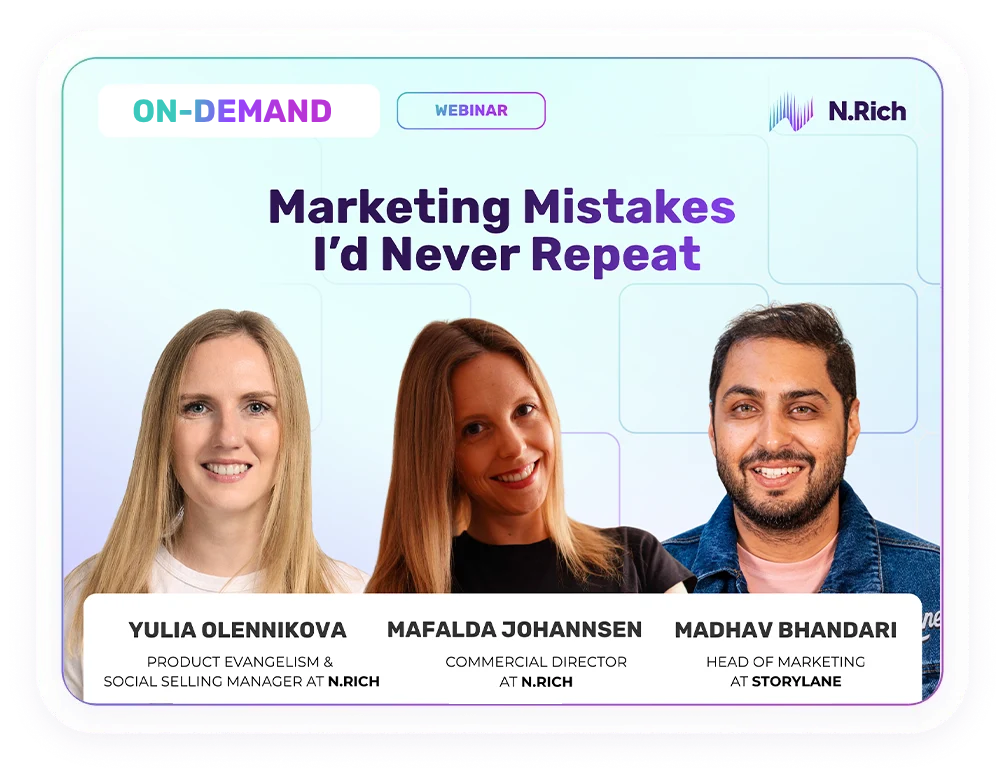
Marketing Mistakes I’d Never Repeat
In this webinar session, host Jovana Stankovic discussed marketing mistakes with guests Madhav Bhandari from Storylane and Yulia Ole from N.Rich. Both speakers shared honest insights from their 15+ years in B2B marketing, covering lessons learned from strategic missteps and how to apply those learnings.
They covered SEO strategy mistakes, middle-of-funnel content gaps, and the importance of consistent investment in foundational marketing channels. Watch the full recording to learn from their experiences and avoid repeating similar mistakes in your own marketing.
Transcript:
Speakers:
Mafalda Johannsen, Commercial Director, N.Rich
Madhav Bhandari, Head of Marketing, Storylane
Yulia Olennikovannikova, Product Evangelism & Social Selling manager, N.Rich
Hey everyone, welcome to another N.Rich webinar, the last one before a couple of weeks without a webinar. We will have our next one on the 25th of August with Yulia, who is also a speaker today. So today we decided to do a very honest and therapeutic webinar. We will talk about the marketing mistakes that both of my guest speakers have made in their careers, and we will talk about the lessons and what we can learn from it.
Before I introduce our guests, let me just remind you of a couple of housekeeping items. First of all, yes, this will be recorded. I want you to stay until the end, but if you can't, you will get the recording in your email. Ask as many questions as you like. Please use the chat. I might address them within the webinar or at the end, depending on what fits what we are talking about, but I promise you I won't forget about you. The more questions you ask, the more relevant this webinar will be for you. Feel free to comment along the way and ask. We are here.
We do a lot of webinars, so feel free to follow us on LinkedIn because we will be announcing more webinars until the end of the year. We would love for you to join us. So with no further ado, Madhav, would you like to introduce yourself?
Yeah, absolutely. I run marketing at Storylane, and I've been in B2B marketing for about 15 years now. I've led marketing at a few companies. I especially enjoy the early-stage journey, anywhere from like $5 million onwards, where things start stabilizing. I really enjoy my work.
Amazing. Those who have been to webinars from N.Rich before might know Yulia already, but nevertheless, Yulia, who are you and what do you do at N.Rich?
Hi everyone, thank you for joining today. I am Yulia, and I'm with the N.Rich marketing team. I've been with N.Rich for almost 5 years, and I was the only person on the marketing team for some time. I've been in marketing for about 15 years, same as Madhav. I was the head of marketing at N.Rich for a period of time, and then I stepped down to be an individual contributor, which allowed me to reevaluate a lot of things that I was doing in the leadership position and write them as my mistakes that I would never repeat. I'm happy to share them today with you.
Amazing. I already see some interaction in the chat. Keep going, people. All right, so we have a lot of mistakes to cover. Let's start with the first one. Madhav, I guess this is yours. Would you like to walk us through this mistake?
Yeah, absolutely. For context, Storylane is demo automation software. Our model includes a sales-led motion and a product-led growth motion. Anyone in PLG knows you need a lot of volume of traffic to make it happen. That's the context for this mistake.
I spent a lot of time focusing on how to grow our SEO traffic. I took a bet called Demo-led SEO, where I replaced text content with template content that grew our traffic 10x. But I did that by deprioritizing traditional blog SEO like best demo automation software and competitor alternatives. For about a year, I thought it wasn't worth the effort. Then I saw a gap. Our demos had dipped and traffic started eroding on those particular high-converting assets. The AEO playbook was being built, so I wasn't sure what the future would look like. In hindsight, I should have continued investing.
For the last 4 to 5 months, I've been deep into trying to connect our blog SEO traffic with our demos. Our current approach is very different from a year or two ago. Earlier, we had an editor, writers, a project management board, keyword analysis, and a tech SEO agency. Today, it's basically one growth engineer running it using a tool called Airtops and an internal tool we've built. We're tackling it in a very different way, but that was my mistake. I think especially your own branded keywords and bottom of the funnel queries will always remain important. They always require consistent investment. That's probably one mistake I'd share.
Yulia, did you go through this similar mistake or did you figure it out from the beginning?
For us, that's the next step to figure out in our SEO strategy, which is not only SEO but also AEO and optimizing for LLMs. That's something that is becoming a real priority for us now. It's good to know which mistake we could avoid and not repeat.
Yeah, amazing. Let's go to the next one, Yulia. You ignored the boring middle of funnel content. Would you like to go through that mistake?
Yeah, this is kind of a continuation of what Madhav was talking about. After stepping down from my head of marketing role, I realized the big mistake was overfocusing on either the very top of the funnel or the very bottom of the funnel. Here's why. Bottom of the funnel content generates immediate conversion, so it's easily prioritized by leadership and simple to attribute. You can say, "Hey, this is how much marketing generated." On the other extreme, we all love big numbers in terms of likes, impressions, and viral posts. I used to report on either our LinkedIn traction or demo requests from immediate conversion-oriented pages. What I was completely ignoring was the middle of the funnel content that no one gets excited about.
The CRM integration page, the feature page, pages that explain where our data comes from. It's not exciting, and it won't go viral on LinkedIn unless you put huge effort in. But no one reads the CRM integration page and immediately buys. This content is consumed during the evaluation and research phase, but it never shows up properly in attribution. When I looked at our website, I realized it's 2025 and we have essential pages, product pages, and feature pages that haven't been updated since 2022. We have old screenshots, old data. Doesn't matter if it shows up in attribution or generates immediate conversions. It just makes sense. I really invite people to ask themselves, does it make sense? Does it really help buyers in the way they currently buy? If it does, find a way to prioritize it no matter what.
Since we have an interactive demo tool here, I realized that all of those boring product pages and feature pages should have interactive demos embedded. This is how you capture engagement, capture the exact accounts interacting with the demo, and send signals to sales like, "This tier 1 account scrolled through 50 percent of the demo of this particular feature. Maybe you want to reach out?"
Madhav, were you also ignoring the awkward middle child or did you go about it differently?
I don't think I was ignoring it. I wasn't really sure who would read all of that. You can put it on LinkedIn, that's fine. But I think there's a natural thought leadership that gets built over time that helps with those bottom of the funnel keywords. Right now, our middle of the funnel content is primarily customer content. How customers are using our product, their different playbooks, case studies, show and tells. We basically convert all of that and take aggregate data to produce research reports. Those things help aid bottom of the funnel results. That's been interesting.
There's also an interesting hack we've been doing lately. Typically you can add a demo for your product on a comparison article, but then you'd have screenshots for others. You can actually reduce bounce traffic by adding interactive demos of different products as well on your page. They don't have to go elsewhere to evaluate. They can stay on your page, you get more screen time to sell to them, and that's been working quite well for us.
Amazing. People, feel free in the chat to add out your mistakes as well. It's confession time. Feel free to mention yours and maybe we can see if they match the next ones we have. We have a lot to go through. Why didn't your roundtables never work?
There are event people here who are going to hate me, but I'll be honest. It's been rough for us because the experience for an attendee and a sponsor has been kind of the same. One issue is that you're stuck with the person on your left or right. If you sell to in-house people and have two fractionals on your side, your entire evening is dictated by who's sitting next to you. I try to get up and move around, but the maximum number of people you can connect with is maybe 4. And saying you sponsor the dinner doesn't feel like enough.
We've tried different things with event ops, and it's funny because many companies swear by roundtables. They say it drives pipeline. But we've always struggled because the roundtables aren't really moderated. The sponsor isn't having one-on-one conversations with everybody. It's more like, get the group together and let them cross-talk.
When I looked at the math, the average dinner costs about 3,000 to 4,000 dollars. Stack up 5 dinners, that's about 20,000 dollars. For that same budget, you can get a conference booth and probably get more demos than you'd get from 5 dinners. That's something I've never been able to figure out, and I still don't understand when people say roundtables work really well for them. Maybe, Jovana, you might have the answer. Typically, it's just never worked for us, and I've burnt a lot of money on that.
Nice.
Jovana is not speaking today, but maybe me and Yulia can give our two cents on why our roundtables work so well. Yulia, would you like to start, and then I can also give my two cents?
To me, it's about the collaboration between sales and marketing that makes them work well. Each team knows that their participation is crucial. Instead of blaming the other side, marketing didn't prepare this or sales didn't follow up enough, we focus on what each person involved in events can do and should do more. That's the secret sauce, really.
Yeah, absolutely. I manage the BDR team and I'm very close with the sales team. We prepare roundtables with at least a month in advance with marketing. We have clear tasks on who does what. We also iterate when things aren't going well, if we don't have enough signups or too many signups. We make sure everyone aligns on who we're inviting and why. There are no surprises where marketing wants certain people and sales wants others. We all align on who we should invite and why. That's usually very smooth.
Jovana always books amazing restaurants and amazing places. The environment really helps. It's usually a private table in a private part of the restaurant, so there's no noise from other diners. The food is really good. It's usually near the convention center or easy to reach. All of these details matter.
We also make sure we really curate the invitees, so the people attending have a lot of value from the dinners because they're seated near people they want to speak with. The details make the difference in events.
I think the products are different, and the model is different. The PLG model at Storylane versus our purely sales-led model at N.Rich is maybe a factor as well. For us, the sales cycle is much longer and more enterprise. This format probably tends to work better in that setting.
Yeah, yeah.
For us, PLG is about 10 to 15 percent of our revenue. 85 percent is sales-led only. The PLG exists to drive product-led sales because we've had quite a few deals that signed up for free and then became big enterprise deals. For us, our ACV is about 15 to 20K dollars on average. So the economics for roundtables can make sense. Even if you get one deal out of 3 dinners, you'll usually be profitable. This is helpful. I think getting the people right is helpful. I love it. It's a webinar and we're trading learnings. I love that.
It's all in one. Let's go to the next mistake, which also has to do with events. Madhav, sponsoring events with no way to talk one-on-one. What do you mean by this mistake and how did you fix it?
There are event people here who are going to hate me because this is just bad.
It's just events are just not your thing, Madhav.
For context, we're spending about 800 to 900K on events in total this year. We have to keep looking at ROI. The traditional events work generally where you've got a booth and prospects can come in and talk to you. But we've realized we also did a lot of these modern unconference types where you don't really have a booth. You're just there with branding and sponsor names. That does not work because even though you might get an email list, you can get an email list very easily these days. It just doesn't work.
You just need somewhere to chat one-on-one with prospects. Whether it's a table, pre-booked one-on-one meetings with attendees, or hosting an audit or demo booth. Only that can move things forward. Otherwise, access to the room just doesn't close deals. We keep coming back to that.
We've also realized that with events, it's not just the one-on-one but also that we prefer to sponsor events that are more than one day. One day is too small. You set it up, you have maybe a few hours, and if you're not able to do it, travel, lodging, plus the sponsorship doesn't add up to that one-day sponsorship. We've cut down all one-day events. We're doing minimum two-day events only now. Those are two hard mistakes learned after spending about a million dollars on mistakes, and we've fixed it.
Yulia, would you like to add something here? I know Jovana is our events queen, but you're also very involved in all the processes, so I'm sure you have something to add?
Surprisingly no, because for the last year I haven't been traveling a lot since returning from maternity leave. I would really like to put Jovana on stage here, but I know she's behind the scenes today. She would be able to talk for a long time about it and share fantastic stuff.
I can give a perspective from the BDR side because I manage the BDR team and was very successful in events as a BDR. Every time a conference was coming up, I thought, "I'll meet my targets." It's important that not only you do what you need to do with marketing and choose the right event, but also that you have an active team on site. You can have the best branding and messaging, but if you only have people in the booth doing meet and greet and nothing else, you won't see ROI.
Having salespeople or people on the ground with a hunting mentality makes a huge difference. They go around, make the most of it, and determine how successful you are and how many quality leads you get from each event. From the sales side, you also need to ensure you have pre-booked meetings and have done your homework. Don't rely only on marketing and expect the booth to bring everything and you just relax and wait. Sales has responsibility for the success of events and conferences too.
Good. Let's go to the next mistake, Yulia. My God, that's an amazing bridge of what I just mentioned. Would you like to talk about it?
I would really like to ask the audience what their experience is. Until joining N.Rich, I existed in a paradigm that sales and marketing are two competing teams, always treating each other like rivals. That was in my previous organizations. Only after looking at it from outside did I realize how counterproductive it was. For the organizations, they're still thriving, but for me personally, it was about cutting myself from a very big part of knowledge I could have gained.
In one of my previous organizations, the head of regional marketing and head of regional sales for the same region weren't talking to each other. At some point, they had a conflict and just stopped speaking. Marketing people were approaching soft leaders and biggest clients in the region, and sales were doing it separately. They weren't synchronizing. At all-hands demos, they used to try to steal numbers from each other. That was really weird. When you're inside it, you inevitably take a side. You think, yeah, our marketing guys are the best. We should get all the credit for success, and sales are only complaining that leads are bad.
N.Rich taught me the opposite way of looking at things. But I can also say that the responsibility isn't only on the people executing strategies. It's on the C-level. If you have an attitude from C-level that encourages competition between teams, you're in trouble. You can't go against that big wave. What we did at N.Rich was stop dividing deals into inbound and outbound. We started rewarding SDRs with bigger commissions if they worked accounts that marketing had worked, accounts that had visited the website, attended webinars, or downloaded PDFs. The deal was sourced through SDRs through outbound, but it was mixed-source, and the BDR would get bigger commission. This was a C-level decision. We couldn't decide it ourselves. I realized how much more I could have learned about B2B marketing and sales if I hadn't ignored this for so long.
Muriel says that sounds familiar. I think that resonated. Madhav, does it sound familiar to you or do you have a different experience?
Yeah, I think it sounds very familiar. I think everybody would agree. For us, we've always been a 97 percent inbound business. Every lead usually comes in and sales just cherry-picks them. But as we've been growing, outbound is becoming a bigger part. We're chasing after big deals and making all of these other channels work. I think that's where there's a little bit of friction. I like what you said about not segregating inbound and outbound.
For us right now, the way we're working as a shared thing is we build the contact lists before we're calling and emailing, and then sales does the outreach and calling. We work with them to make it happen. I'm glad to be in a place where there isn't a fight, no blame game. Everybody's happy, everybody's content, everybody feels we're focusing on the right thing. I'm hoping that continues.
We did a webinar a couple of months ago that you can find on our website about how to align sales and marketing with some tips. If you want to check, you can go back to our recordings. Coming from outbound myself, I was a BDR before being director of business development. I never understood salespeople and colleagues who weren't BFFs with marketing. I'm a lazy person, so why would I go after a cold lead when I can go after a warm lead and reach my target with less headaches? I never understood that. I always gave any opportunity marketing would give me, any conference, warm leads, webinar, or direct mail initiative. I would embrace it like crazy because I knew it would make my life easier. Again, there are mysteries in life, and this is one of them. Let's go to the next mistake.
Take.
Yeah, Yulia, outbound and sales. Tell us more about this.
This is the natural continuation of my disbelief in collaboration with sales. I think I'm back on the session?
You're good.
This is the obvious next step when you don't trust sales, and you don't trust outbound either. The irony of fate was that I joined N.Rich, which had a huge outbound team at its peak, about 50 BDRs, and me as the only marketer. I was skeptical about why all of those people were sending messages. Will anyone ever buy from it? It's just noise, it's spam. I was looking at it from the perspective of why don't we just reallocate all the budgets to marketing so I can spend it the way I plan. Until 2023, there was a 300K deal that came in through pure outbound. That wasn't the only deal, but it was the biggest deal.
Our sales rep spotted a signal of a company installing a competitor tag and demonstrated third-party signals. They were completely unaware of us. He reached out and said, "Hey, you're apparently looking for an ABM platform or an intent data provider. Do you want to check out N.Rich?" They ended up buying with us. Of course, it was all the sales process that went properly, but there was no prior awareness of N.Rich as a tool. Another note is that the prospect was an intent provider themselves. So they could have thought, "If these guys can capture intent signals, they probably have a good product." But still, all of this and the size of the deal made me rethink my approach.
Actually, now in 2026, here I am checking accounts that visit our website and reaching into people's LinkedIn DMs, suggesting they have a call to check out N.Rich. I'm acting as an outbound BDR myself to some extent. I changed my mind about it.
Well, coming from the BDR world, I obviously always believed in it. Madhav, did you always have this belief, or were you more skeptical about the outbound motion?
I have a very similar journey as Yulia. I didn't join a team where there was outbound. We actually had no outbound, and I was never in favor of it. I get outbound emails, and I just ignore everything. I was thinking, why would it work? Then about two years ago, we started trying out different emails, different signals, and different contact lists. I wasn't even very sure about it. I used to get frustrated when I got cold calls. Why would I want to do the same thing to our potential market? But I do see the value now. There are a few people consistently showing up in my inbox, cold calling me, messaging me, doing multi-threading. And at some point, they remain top of mind. Somehow it works.
I'm more sure of outbound if the ACV is higher. The higher the ACV, I think outbound is the way to do it. The channels might be different, the messaging might be different, maybe there's a different combination of things. But I do agree. We've also had quite a few deals that came in from outbound that never knew about us. We've actually never been able to do what you mentioned, where if a particular company is mid-evaluation and we're not in that circle, I would love to put myself in that circle while they're mid-evaluation and see how that works. That's one takeaway for me. But yeah, I do believe in outbound for sure.
I think I can add my two cents from an outbound perspective. I think the reason a lot of people, not only you, have this misbelief about outbound is because most of the emails and cold calls we receive are just bad. The quality is poor. But I can tell you, the day you receive a really good email or a really good cold call, you'd be actually excited about it. You'd think, maybe my team should do this. You'll not only believe in it, you'll actually enjoy the experience. I think there's a lot of lack of quality there, which also doesn't help the reputation of the motion itself. Let's go to the next one because the clock is ticking. Trusting LinkedIn's native ad targeting. Madhav, why was this a mistake?
Yeah, we spend about 1.2 million a year on ads. 700K on LinkedIn, about 500K on Google. Google is another story. About 70 percent is brand-targeted, which is another sob story. On LinkedIn, we primarily did thought leadership ads because that's what performs well on the platform. But the audience targeting was always native. We typically targeted organization size from 200 to 10,000 people, and specific industries and titles. I can't even tell you the level of detail we went into with filtering and exclusions. Typically, we found that bigger companies could take up more than 50 percent of your budget sometimes, like Snowflake and other huge companies with massive GTM teams. We had huge exclusions, and even after that targeting, we'd still see wrong job titles and wrong companies. It's just really hard to get it right. LinkedIn is just not good at that.
About 7 to 8 months ago, maybe a year ago, we tested another group where we actually built out the audience. We literally built contact lists at specific companies and uploaded them into LinkedIn. To upload on a contact level, you need their personal emails. We did that. We knew this contact list would reach the exact set of people we wanted. The metrics were far better. The CPMs are actually higher with custom audience lists versus native, but the ROI is unbelievable. The CPM cost is higher, but the results are so good because we're seeing the right people.
We track influenced revenue from the spend. It's much higher with custom audiences than native. With native targeting, it was like 4 to 1. If we're spending 500K, we're closing about 2 million. Today it's probably 7 to 1, so we're closing about 3.5 million with the same spend. This is influenced revenue, not directly attributable revenue, because people don't come to LinkedIn to buy. The next iteration would be what Sara from N.Rich has been telling me, which is identifying the set of accounts. The whole ABM story, right. We go after 500 companies and show them ads, cold call them, cold email them, do everything. We invite them to events online and offline. That's something I'm quite excited about. I know you guys do that pretty well.
We do what we can. Yulia, what would you like to add here?
I think our head of demand gen, Josh, would have a lot to add here. In terms of all those native targeting settings, whether Google Ads, LinkedIn Ads, or whatever ads, you just need to remember that they're not playing in your favor. They have their own goals to meet, and those goals are most often not the same as your goals with ads.
We have a question from the audience. Madhav, would you like to add something before I ask? All right, let's go and answer this question. Have you ever made the mistake of prioritizing one part of the funnel over another, especially when allocating budget? How did you take to realize it wasn't working? Who'd like to start, Madhav or Yulia? Yulia, I'm hearing yourself.
I would say that we are constantly course-correcting. Especially when you're starting to experiment with a new ICP or a new account list, you can put too much emphasis on a certain stage of the funnel. Then you see it's not working that well. You're being too pushy about booking a demo when you really need to educate them first and play more of an awareness game. I can just say my recipe for this is to have a Josh on your team to learn and course-correct quickly. Without a proper demand gen person like Josh or Marina that we had before, it can take a lot of time, money, and resources.
We have also a couple of webinars where Josh is a speaker, so feel free to check our previous webinars where Josh is a speaker because you can also learn a lot from that side. Madhav, what's your two cents here?
I'm actually on the other board. For a long time in many of the teams I was with, I was the person going after just the bottom of the funnel. Going after the same keywords for SEO, for ads, going after the same pool, targeting competitors and all that. I do feel like there is a growth constraint that happens there. Over the last 3 to 4 years, I've started spending a lot of time on top of the funnel. Typically when I say top of funnel, it's not just brand awareness. That's a different story, and I think it's impacted us quite a bit. I've also started looking outside of the circle that every competitor is competing on.
There's an analogy, right. 5 percent are in the market to buy, 95 percent of the market just needs to be educated. That's a whole greenfield out there. If you reach them first, it's so much easier to sell to them. In B2B tech, which we all sell to, it is so cutthroat. They're so well educated. There are 10, 20, 30 vendors in buying cycles. Companies can jump ship. It's just hard. But if you go after traditional industries, right, that 95 percent market, it's hard to reach them. That's where you've got to go for more wide plays, whether it's brand plays or wide SEO experiments or trying adjacent categories and industries with your ads. But it is worth it at some point.
That was one thing that worked really well for us at Storylane. About 3 to 4 years ago, my CEO told me that the bottom of the funnel is great, continue on, but we're not going to get to 20, 30, or 40 million just by competing for that same set of buyers. We've got to look beyond them. What can we do to go for more wide plays? How do we reach people who aren't even hanging out on LinkedIn? There's a big audience out there. When I opened the top of the funnel, the results were amazing. Storylane grew from 2 to 10 million in ARR, completely bootstrapped in 2 years with a team of less than 50 people, all fully remote. Yes, there were certain circumstances and market conditions that worked for us. But a lot of it was also that top of funnel pipeline.
Amazing. We don't have much time and we still have a couple of mistakes to cover, so let's go very quickly into these ones. Madhav, I know this one is from you as well. Would you like to just talk a bit about that one?
Yeah, absolutely. We had a pretty extensive influencer program and spent almost half a million on it. What we've really observed is that some of the bigger influencers we spent a lot on had the same results as small influencers. The more important bit was if an influencer is not a user of your product or not a customer, it just won't land the same way as a customer talking about you, no matter what content they create or repurpose.
What we've transitioned to with our influencer program is we actually use our customers. We don't care if their LinkedIn account or Instagram or YouTube doesn't reach an audience. We'll pay to reach that audience. We'll run ads on it. We just want their unique content to come out because I think that's a lot more authentic and it reaches the right ICPs and converts. With influencers, customers are probably your biggest lever and they're much cheaper than traditional influencers. In certain cases, if you're a small brand trying to get into the top 3 in your category, it might work. But for us, big influencers weren't worth the money and nor was the content.
Amazing. Yulia, the next one is from you. Tell me more about this mistake.
That was feedback I got from my boss in one of my reviews. It said Yulia is great at this and that, but she learned marketing only from LinkedIn. My first reaction was, what? Then I was like, well, he's actually right. I don't have a marketing degree or proper academic background. I'm a journalist. I took some courses and I learned marketing gradually as I entered PR, copywriting, social media, then marketing. I'm realizing now how much I'm missing some formal, proper background and education. It's so easy to get carried away by flashy numbers and hooks and promises you read on LinkedIn and form an absolutely incorrect and weird perception of marketing that gets outdated within months, rather than studying the fundamentals.
This is a high-level, generic mistake I remind myself of pretty often. Instead of just scrolling LinkedIn, you could go and read a proper book, a couple of pages of some book that hasn't gotten outdated in 50 or 60 years. That means something is right with it.
You read that, it really, really helped.
I'm now approaching Kotler's books. The very fundamentals. Only a couple of years ago, I learned about the 4 Ps thing, that marketing is not just promotion. I heard it from somewhere, but I wasn't thinking how this applied to my everyday work. It applies big time. I'm compensating now. We're actually jumping to the next one, which is kind of related, right?
That's why I was jumping, but I was waiting for you to finish. Yeah, it's absolutely related. Madhav, this one is from you, but it's an amazing bridge from what Yulia was saying.
Yeah, 100 percent. Yulia, nothing to be ashamed about. I still don't know what the 4 Ps are, and I know Philip Kotler is taught in MBAs. But I think in the startup world, nothing beats real-world experience. You just got to go and do things and figure it out and think deeply. I think we rely on books. There are a few books that are really good, whether it's about copywriting or other things. Books help influence your thought process. For me, there's a book called The Messy Middle by Scott Belsky. It's about navigating tricky phases where everybody goes through growth that's flatlining or going down, or leads are up and down. How do you navigate that phase? I think that's a very timeless skill. Trends will come and go, and I think that's where books really help.
The other thing I've realized is that what worked for a certain company is a very different set of circumstances, luck, market conditions, product-market fit, people, and execution than your portfolio. If you just say, "Here's what Play did to get to 100 million ARR, I'll do the same," it's not going to work for you. I see a lot of people doing that. I see this religious cult following for Play and Lovable and all. Sure, they've done incredible work, but there are also other factors that worked in their favor.
I saw a LinkedIn post about how Lovable's employee advocates were the biggest reason for their success. It had a picture of 20 employees with 200,000 plus followers. But you could also think of it differently. Those people got followers because Lovable was a viral hit. You could look at it from different angles. My learning from all of these things has just been that you're in the business of solving your problems. I see myself in the business of Storylane, solving Storylane problems, solving customer problems. Find unique solutions for us. Take ideas from all these brands, but ultimately, that internal thinking and thought process, which will come from books, like frameworks to think, you've got to put in that work. That's when you'll go beyond it.
I had one of my team members recently ask if they could get a paid subscription to, say, Alina Werner's Growth Newsletter. She's amazing. But I also gave him feedback that if you're reading that newsletter, so are 10,000 other people. You're never going to be ahead of the curve. Those 10,000 people are going to try the exact same things. You've got to be ahead of the curve and identify things. You've got to go deep down into problems and solve things yourself. That's one takeaway I'd give to everybody. Don't just follow all these companies. Take ideas from them. You've got to do your internal thinking.
I think that's an amazing way to finish the webinar with the last mistake, which is not pushing back on leadership. But I also think it's a good way to answer Simonida's question, which is, what were the things that you bounced back from the mistakes, and how do you find the will and courage to keep experimenting? It's a beautiful question to finish the webinar with. I'm going to give 1 minute and a half to each of you to answer this question. Yulia, how would you answer this question?
I was lucky to have worked at companies that encouraged experimentation. I was seeing very senior people with very big job titles within the companies mess up big time. Sometimes it was very visible, very public, and very clear how much those mistakes would cost the company. Somehow those people still stayed in their positions. Not all of them, but I can recall some of those stories. I was like, okay, if after all of this, this person is still with the company, then probably the value they're bringing is bigger than the damage they've caused. This made me think that I will be mistaken. I will mess up anyway. We're not in a hospital where every mistake costs much more than it costs when you're making software.
That's what I tell my team when they're stressed. I'm like, dude, you're not in ICU, okay?
It's fine.
Madhav, how would you answer the question to finish up this webinar?
Yeah, similar. You just need to have the culture where there are going to be bets you make and some will fail, but the successes will cover up for the mistakes. What I will recommend is that whenever there's an experiment, try to get some sort of conclusion out of it. Inconclusive is the worst outcome. Either it's a failure or it's a win, but if you don't know what it was, that's what worries me. I kind of answered that a little bit. When you're going through all of these things, if you know the problem, if you know that there is a problem and if you're aware of it, you'll ultimately find the solution. You just got to keep trying, again and again, different ways to tackle that problem, and you'll get out of it in most cases. That's also something you would read in The Messy Middle, right. Just go at it and you'll figure it out. What happens is a lot of times people don't even know that there's a problem or they don't even know what the problem is. Identifying the problem and being aware of it is probably the big one. And then it's just about iterating. If something is not working, I'm aware of it, and then I just work towards it. It may take 3 months, 6 months, 9 months, but you'll find a solution.
Amazing, amazing. Thank you so much, Madhav and Yulia, for sharing so honestly your mistakes. I think it was really nice and really good introspection work here live. Thanks everyone who commented and asked questions. I think it was great to have such an engaged audience. Thank you for making this webinar more relevant for you. I hope I see you around. If I don't see you in the next weeks, have a great summer holidays. We will continue with our webinars at N.Rich. Feel free to follow our content. More webinars, dinners, and roundtables will come your way. Thank you so much, people. I'll see you around. Thank you.
Thank you. Have a great rest of the week.