Ready to become an N.Rich AI builder and get paid for it?
REPLAY
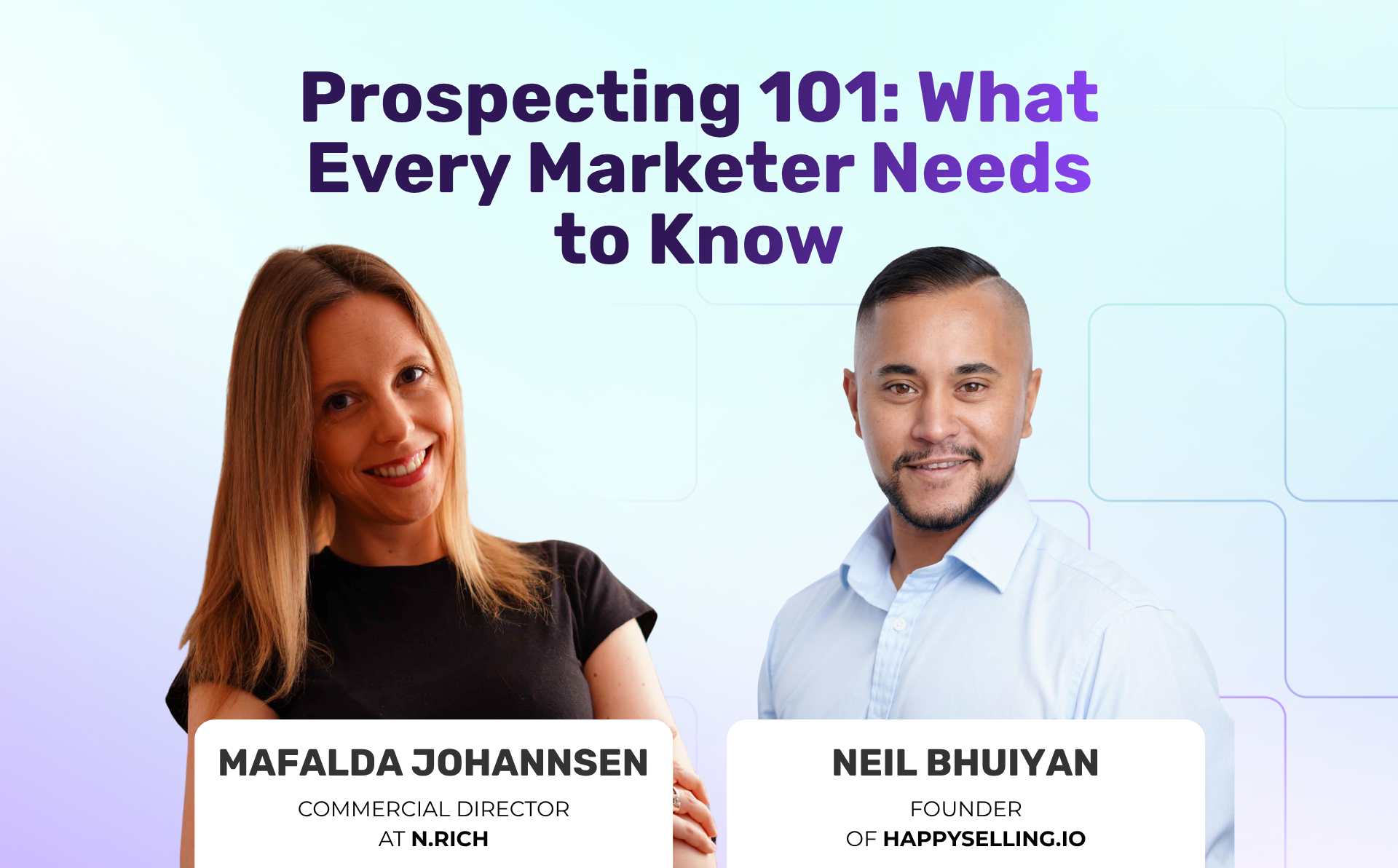
Prospecting 101: What Every Marketer Needs to Know
In this webinar session, Mafalda Johannsen and Neil Bhuiyan, founder of Happyselling.io and sales coach, discussed prospecting essentials for marketers. They covered the importance of understanding buyer personas, aligning sales and marketing efforts, and mastering cold and warm prospecting techniques to build effective pipeline strategies.
Viewers learned how to map decision-makers within accounts, tailor messaging by persona, interview customers for current pain points, and leverage content strategies for different organizational levels. Watch the full recording to master prospecting fundamentals and strengthen your sales-marketing partnership.
Transcript:
Speakers:
Mafalda Johannsen — VP Marketing at N.Rich
Neil Bhuiyan — Founder at Happyselling.io
Good morning everyone. Today's webinar will be about prospecting for marketers. The reason we've decided to cover this topic is that things are changing. Before, even though it wasn't ideal, we could afford misalignment. Many marketers want to understand cold prospecting and warm prospecting, but they don't have the knowledge because it's not their job. That said, it's useful to know what good prospecting looks like and the fundamentals of prospecting.
I cannot think of a better person to do this webinar with than Neil, because he's a certified coach and trainer who's been doing this for a long time. Neil, tell us more about yourself and what you do.
Thank you very much, Mafalda, and hello to all of our audience. I really appreciate you bringing me on for this. I've been doing this for a long time—a bit of a dinosaur in the industry, but I'm ready to help out the lovely marketers here. My name is Neil Bhuiyan, and I'm the founder of Happyselling.io. The best way to look at me is as a sales therapist. My role is to help sales reps build pipeline, book meetings, and build out their careers in sales.
That said, I've learned a lot from really great and successful marketers. I agree with Mafalda that sales and marketing are two different departments and functions, but we're working towards the same goal: to generate revenue. By working together in partnership, that's how we'll get there. I'm here today to share some best practices and inspire you marketers to have better alignment with your sales team.
Amazing intro. Before we go into that, a few housekeeping notes. Yes, the recording will be available, but we'd love you to stay until the end and feel free to ask us any questions. If the questions align with what we're saying, I'll answer right away. If we feel the question is a bit out of scope, we'll still answer it by the end of the webinar. I'm not going to ignore anything that comes from you.
Let us know in the chat where you're tuning in from and why you're here. The more you ask and comment, the better and more useful this webinar will be for you specifically. Feel free to help us shape the webinar as we go. If you enjoyed this webinar, I'm doing another one next week and the week after. We're doing a lot of webinars, so feel free to keep joining us. Neil, you also do some coaching, right?
Indeed I do. There are two ways you can learn from me for free. I run a sales podcast called the SDR Disco Call Podcast, designed for brand new salespeople. You can find it on Apple, Spotify, etc.—just search SDR Disco Call. Every Monday I run a free Zoom called Coach on Call, which is open to all commercial people where they can come in for an hour, ask a sales coach questions, and walk away with answers. Thank you for allowing me to share, Mafalda.
Absolutely. Super great resource. All right, let's dive into it because we only have an hour and it sounds like a lot, but we really will give you a full masterclass on prospecting. Neil, understanding the landscape and the buyer persona is the groundwork, right? Before we go into prospecting, this needs to be done. I'll ask you how.
Thank you, Mafalda. Before creating any sort of campaign, what we should understand is that in an average B2B sales cycle, there can be up to 5 to 11 decision makers and influencers within an account. But if we're sending the same message and same cold call script to all of these people, unfortunately we call that spray and pray in sales, and that doesn't work. Before you create any messaging, sequences, or campaigns, we should really be mapping out the personas within the account.
What we want to understand is what they care about from a business perspective, what pain points that persona is facing, and what type of questions we could be asking. For example, a CEO's wants and objectives can be very different from a CFO's. They may be working in the same business, but they care about their own business unit and have their own pains. While you're doing this exercise, it will help you understand the type of questions you could ask in your outreach.
For example, with a CEO, you might ask: "How aligned are your teams around your business goals?" Or if you're speaking to an HR manager: "What are the processes that reduce administrative burden?" If you know these questions to ask, this is what will aid you in your call to action at the end of your email or on a cold call. We're looking to sell to a company, but we need to understand individually what these people care about, what's of interest to them, and what are the right questions to ask them.
I agree. Before you continue, Neil, I'd like to highlight that this is really fundamental. Don't skip this part. This is a webinar for everyone, so nothing we cover will apply 100% to your use case. You—whether the head of business development, head of sales, or head of marketing—need to go interview your customers or the customers you just acquired. Understand what made them choose your solution, which problem led them to you, and why you and not others. Understand what challenges they have this year that they didn't have last year.
In many companies, this information is mapped out but it's from 5 years ago. I was once in a company where the last time they interviewed customers and had intel for prospecting was 2019. In the meantime, we had COVID, wars, and AI. None of that information is up to date in terms of priorities and challenges, yet you're still using the approach and messaging based on outdated data. I really recommend you understand what's going on right now about what they care about, their pain points, and which questions matter to them. And they should be up to date. The only way to do that is to actually ask your customers and do further research. Now, after this caveat, Neil, proceed.
To add to that, Mafalda, and validate what you're saying for our audience: I've been an account executive—the closer—but I've also worked in customer success post-sale. Here's what I know: most of your customers don't trust the salesperson. They're not forthcoming about their explicit pains or what they're trying to solve because they're looking for a solution. But here's the magical thing: once they've signed the contract and moved to customer success, when that success manager talks about a mutual success plan and asks what they're looking to achieve, they are more forthcoming.
As a marketer, if you could speak to your account management or customer success team, they're really going to know the voice of the customers and what they want. You'll be able to map out these problems and the things going on with your current customers to help you with your messaging. I think that's a valid point, Mafalda. Thank you for that.
Absolutely.
All right. When we think about the world of marketing and content, I love content and I create content myself. What we want to understand is what type of content is interesting for each persona on the hierarchy. Think about the top of the board—the C-level. Their job is to be the visionaries of the company, to steer them in a profitable, disruptive direction. They need to be kept up to date on what's going on in the industry and what's changing in the world. Things interesting to them are white papers and research reports—think like Deloitte, McKinsey, the Big Four. These types of information reports are what they like to consume.
If we come down a layer to the VP or director—perhaps the same person in a smaller company, but in enterprise you'll have this hierarchy—the VP's job is to take the vision from the top and create a strategic game plan. They're more interested in business cases, case studies, and ROI reports. They're looking for game plans from similar people or companies and how to make that vision a reality. When we come down another level to directors, these people are more operational. They take the strategic game plan and make strategic initiatives to execute it within the business. This is more about thought leadership: webinars like this one, case studies of how others overcome challenges and won—this is what's useful and relevant to them.
If we come down to a lower level, perhaps frontline managers, they may not care as much about white papers and case studies. Why? Because they're the people who will use your solution day to day with their frontline staff. What's more useful for them are how-to guides, quick explainers, or YouTube clips showing how to use your solution today with their team. This is all educational content, but each persona has different needs and wants.
Going back to my days of prospecting in enterprise, I had a problem as a sales rep. I would normally be speaking to managers and directors and going up the hill. Typical responses I'd hear were: "Sorry, it's not my decision, that's with my boss," "Sorry, we don't have a budget for this," "We're already in contracts with another vendor," or "Sorry, I can't speak to you about this," and they'd hang up.
We need to understand something in sales called above the line and below the line. Above the line has decision-making power and influence; people below that have influence but no decision-making power. When I was in one of my tech companies before they IPO'd, I went to my CEO in California and said, "I've got a problem. I'm trying to get into these accounts." He asked, "Who are you focusing on?" I said, "People below the line." He said, "You should be going above the line." I said, "But I'm only a BDR; I can't be speaking to the C-level." He said, "Neil, you are an extension of me in London. Act like it."
Here's how I did it. I would reach out to the CEO and say, "Hi Mafalda, my name's Neil, I'm calling from Zora. There's a massive shift happening in the world called the subscription economy. This is going to impact your business over the next 2 to 3 years. Can I share this research report to show you how? But could I ask who is in charge of your finance strategy?" They would say, "You need to speak to Ben, he's the VP of Finance." I'd say, "Okay, cool. If I hear anything, I'll let you know."
Then I'd reach out: "Hello, VP Ben. Your boss told me that you're the person I should be speaking to. I'd love to share a case study on how we're working with your competitor and 5x-ing their finance operations. But could I ask who looks after your finance operations?" He'd say, "You need to speak to Linda, Director of Finance." I'd say, "Okay, cool, Ben. If I hear anything, I'll come back and let you know."
Then: "Hello, Linda. Ben told me that I should be speaking to you. I'd love to introduce our solution." The reality was the C-levels or VPs might not be joining the demos, but the people below them couldn't ignore the email or cold call because it came from the top and I was given the referral below. In reality, Mafalda, we'd normally be doing pilots with the directors for about 4 to 6 weeks. When we finished, they'd come back to the C-level and say, "We've been running a pilot with your team. Here are the findings and reports. We're now having a commercial discussion and would like to loop you back in." This is how a top-down approach works. We can think about the type of content to spark the conversation. We can use the power above to get into the lower levels. This is how we multi-thread and include all stakeholders within a buying cycle.
Yeah, I think this is great, Neil. I especially think this is a good learning for understanding the roles of marketing and sales. Marketing is usually the department that produces white papers, business cases, and webinars. They have two functions: one is lead gen. Fantastic. People who download white papers, people who sign up for webinars. These are people showing intent, and yes, sales should go after them. But sales need to understand that that's not the only reason white papers exist.
White papers, business cases, everything on this slide—they're cards in a game. Use the card right. Don't wait for marketing to hand over the leads if you're an outbound BDR or a mixed-touch BDR. You're not an inbound BDR or a salesperson. All the marketing content that marketing produces is not only for lead gen; it's for you to add value to your outreach. We'll speak further about that, but that's why it's so important to understand buyer personas, their challenges, their priorities, how they think, and what the structure is. If you don't do this homework, there is no prospecting strategy that can save you. You need to invest 100% in this.
Couldn't have said it better myself. To take it just one step further: while working with a lot of sales teams and VPs of marketing, a best practice we used was this: every time marketing created a new piece of content, we would test our sales team to see if they were aware of it. We'd ask what the short story is and in what context it could be used in a sales discussion or prospecting.
But the key piece was, Mafalda: if I could share a case study of this customer, our marketing team would then ask, "What's the follow-up content you could also send after that?" How can content be connected together? If we're taking a customer through a journey to create awareness and show education about something that could help them, it's not just one piece of collateral. How are the collaterals connected as a nice follow-up piece as well?
Precisely. And speaking about the buyer journey, sometimes the prospect is not ready to buy. Most of the time, actually. That's welcome to the prospecting world.
Yes.
You got rejected—"not interested," "not the right time," "no budget," whatever. Cool. Send them something useful. Keep them in your pipeline because when the need arises, you'll be top of mind. You're building pipeline as well. The BDR team and sales team need to have both a short and long mindset. You need short-term to reach your target, but you need long-term to keep building pipeline for the future. I always recommend my BDR team: whenever they get a rejection, unless the person is really upset and swearing, tell them to go to hell—but otherwise—if the person says, "Sorry, no budget," "Sorry, not the right time," ask them, "Cool, is there anything I can help you with today?"
Many people in their position are interested in a webinar about prospecting masterclass, for example. Here's the link. You don't have to register. Whether they do or not, that's not your problem anymore. But it's also a way to nurture the relationship for the future. The best BDRs are the ones building pipeline they can close in the future. They don't start from zero every month. That would be insane. All right, Neil. Tell us what triggers are and why are they so important?
Happy to, Mafalda. What we've realized in sales is that we as salespeople cannot create urgency, because our urgency is the end of the month, quarter, or year. Our prospects don't care about our targets. What we want to be looking for are things called compelling events or trigger events taking place inside our prospect's company that could warrant us reaching out. By using their timelines, we can get an idea of whether now is a good time or when this sales cycle will continue.
The first trigger we look for is a new leader or someone who's been promoted. If I give you a real example: I'm a founder who prospects every day, looking for sales teams to coach. If I've seen that they've appointed a new VP of Sales or somebody's been promoted to Head of Sales Development, that triggers for me that this person potentially could use coaching. That's a reason I could reach out. Mafalda, I've seen you've been the new VP of Sales. Congratulations. What are your plans for coaching this team in the future?
Another trigger we see a lot on LinkedIn and announcements is funding. When they've raised funds or are going towards IPO. But I'll give you a fun fact about this: the struggle most salespeople have is that when a company announces they've just raised $50 million, hundreds of salespeople message them saying, "Hey, congrats on the funding." But here's the thing: you're probably 12 months late to the party. Why? Because when somebody goes through funding, it takes a couple of months for due diligence, investors, term sheets, and everything. When they've launched the funding announcement, they already knew as a company.
What Mafalda says is not everybody's ready to buy. But imagine I speak to Mafalda today and she's not interested in my solution. Cool, I'll check in in 3 months: "How's things going?" Still not interested. We catch up 9 months later, and I say, "Mafalda, something's changed within our business and our service offering. Just wanted to quickly share that with you." Mafalda might turn around and say, "Neil, don't tell anyone, but in a few months we're getting some funding. Now could be a good time to have this discussion." This is how we nurture but use funding as a trigger. Unless you're prospecting every month or quarter and checking in with those customers, you won't know and will be late to the party.
If we think about expansions: a business may be launching a new product or service, or perhaps they're launching into new regions. Maybe they have a business within DACH but are now launching in North America. These could warrant reaching out to support them with their product or service. From my point of view, if I was training a company's team in Germany and they've just launched a sales team in New York, I might say, "Hey, I've seen you've got more people. Do they need coaching as well?"
And the other trigger is bad reviews. I love this one. There's a company called G2—basically the TripAdvisor for software and services. I had a friend who worked at G2, and she gave me advice: when somebody posts something good online, people look at comments, but they're not looking for praising comments. They're looking for bad news. Everybody likes to see the drama. It's the same for me. When I'm looking at a new restaurant or tech, I look for bad comments. Rather than saying your competitor's bad—we don't want to crap on the competition.
No, please don't.
No, that's a big no-no in sales. But what we're looking for are gaps in the process they're experiencing. If your service plugs into those gaps, we can promote it by saying, "Hey, I checked out your reviews recently. I see you're looking to work on this piece and needing this piece. I'd love to share some content on how we could help with that." These triggers are things happening in your prospect's company—reasons we could be reaching out. Mafalda, do you have anything to add on triggers?
Yes, two things. These are generic triggers. This is a generic webinar to give you the mindset, but you need to understand what triggers are specific to your company. I can give you a specific example. I was working for a cloud company, and by speaking with customers—and that's why it's so important to find out from your customers which event led them to your solution—I discovered that any banking, fintech, or insurance company based in EMEA was affected by the DORA legislation. They had to have a European-compliant cloud, which was the USP of the company at the time. This is not on the generic list. That's why you need to do that homework. You really need to understand which trigger matters to you.
For example, when I used to sell app testing—testing apps to look for bugs—App Store reviews were crucial. Loads of reviews saying the app is buggy, the payment didn't go through—that's music to my ears. I know they need my solution. I know the engineering team and QA team are probably having a hard time that we can solve. That's why you need to understand the triggers and what matters to the person you're reaching out to. What added workload, what added stress, what KPIs are hard to reach because of this problem that you can solve? This is how you should frame all your prospecting.
The second thing I want to add: we at N.Rich are an ABM platform, so we have intent data. We obviously use it internally. What I tell my BDRs is: sure, it's awesome to know that Company ABC is hot and engaged, meaning they're interacting with us. But you need to understand why they're interacting with us.
Yeah.
And the why is the trigger. Intent helps you prioritize the accounts—the ones you should go after—but the triggers and understanding are what will make your messaging and prospecting actually relevant. That's what's going to make you book calls.
I'm actually speaking now. There are a couple of things about prospecting emails that are very counterintuitive. I've given these workshops to a lot of people and they're unsure. We as a society are used to marketing emails, which are very valuable and should stay that way. But prospecting emails are different from marketing emails. There are a couple of reasons.
First, with a marketing email, someone signed up for the newsletter or this webinar. They had consent and want to receive your content and educational material. With a prospecting email, no one asked for it. That's a huge difference in the rules that apply. For example, a marketing email usually lands in the inbox because someone signed up. A prospecting email only lands in the inbox if you don't make certain mistakes. It's very important to understand the concept of both.
The marketing email should have the voice of the company and brand—emojis, can be long, it's a newsletter. People want to read about topics, so they can be long, have links, have emojis, have big subject titles, do all of it. That's exactly what you shouldn't be doing on a prospecting email because no one wants to hear from you unless you say something relevant. This is really important to bear in mind. After this introduction, Neil, talk to us about prospecting emails.
I've coached around 4,500 salespeople and I look at new emails and prospecting emails every day. I get prospected myself. Team and audience, I'm not going to teach you how to write an email because you probably already know that. But I want to give you some structure to help create outreach emails that don't appear too salesy.
If we think about it, on the left-hand side is a typical email structure we all know: the subject line, what it's about; the salutation, how we greet that person; the main body or pitch or content; the CTA, which is the call to action or simply the ask; and the sign-off, which keeps it nice and simple. Fun fact: my sign-off is #HappySelling, Neil.
On the right-hand side is an example of a real cold email that one of my reps wrote when we worked in cybersecurity. Here's the issue I see whenever I look at cold emails. If I read this out loud, Mafalda, you'll hear what's going wrong. "Hi Mafalda, I wanted to get in touch to introduce our platform. We have been helping CISOs. We are the best at it. We have 100 customers using us to date." There's a lot of "I" and "we" statements, and it's all about us. To Mafalda's point, they really don't care about us.
The sooner you understand that, the easier your life will be.
Every time I open my inbox and look at cold emails sent to me, I see the I's and we's. What we should be doing is turning them into "you" and "them" statements to make them more customer-centric. The other thing I see in this email is weak language: "Maybe this is something you're working towards. Variations of this, perhaps you're thinking of this, potentially, this is on your radar." We're throwing everything at the wall and hoping it sticks. But if we're 100% confident we can help people like that and have the social proof, we should be confident but not arrogant.
The rep asked me, "Well, Neil, what's arrogant about my email?" When I read it back to them, I said, "We are the best at it. We have 100 customers today. That's arrogance." At the end of this email, the call to action is, "Would you be available for a call this week?" The reality is thousands of other salespeople are saturating inboxes with the same call to action. And we have not yet earned that right to time.
We're asking for the most valuable resource a human being has: time. We still don't know if the person actually has a problem. We have an assumption. Why would they give us time before confirming if that's an issue?
Exactly. With the time thing, we have not earned that right to time. But I've asked many BDRs and salespeople, "Why do we send emails in sales?" Most people might say to create brand awareness, to let people know that we're in the market. But get real with me: why are we sending these emails? To book meetings. I say no, that's not the point of a sales email. The point of a sales email is to get a dialogue going between somebody that doesn't know you yet. If there's a healthy exchange between you and them, then we suggest the meeting. But to Mafalda's point, we need to figure out: do they even have a problem? Is this relevant for you?
I want to share two frameworks to make your emails more customer-centric. The first is called the REQUEST method, or the Triple R, which stands for research and relevance, a reward using that beautiful marketing content, and a request to kick off the conversation. I'll break this down step by step.
If we look at the subject line, it should always relate to the homework or research you've done on that business or person. Mafalda, it could be your LinkedIn profile, your recent company announcement, or perhaps your annual report. Make it about them. The subject line should always relate to the first line of an email. Why? Because 80% of sales emails are read on phones. When they open the preview, if it looks like a sales blast or marketing blast, they'll probably delete it.
What we do is make it about them. So something like, "Keeping up to date with N.Rich, I see you're implementing a strategy for sales excellence in 2026 and looking for some onboarding or training." We're showing the research and homework we've done and aligning it to where we could potentially help them. This is the research piece. There's a contentious debate on LinkedIn about how much to balance personalization with relevance. In my honest opinion, we personalize 20% of it. The other 80% is templated either on the persona or the industry we're going after.
And that's why you need to do the foundational work I mentioned in the beginning.
Exactly right. In the middle part, which is the reward, rather than talking about how cool our company is because they don't care, we want to share a piece of content that could resonate with them. Something like, "Please find a case study here on how somebody's solving this." But here's the reality, marketers, and this might break a few hearts: if I send somebody a 5-page case study or a 15-minute video, the likelihood of them reading all of it or watching is very slim. But instead, if we flip the script and say, "Mafalda, skip to page 2, paragraph 3, or skip to 7 minutes 26 seconds into the webinar, that's the secret sauce." They may then be more open to reviewing that piece of content, but what we're helping them do is learn by showing them how to learn.
When it comes to the call to action, we're asking an open-ended question: "How does this resonate with your plans for this year?" or "What are your thoughts on this approach?" or "How would you see this working for you?" If we bring this all together, we're showing them we know them and have done homework. We're rewarding them with a piece of marketing content that could be relevant to their role. And we're asking an open-ended question to initiate the discussion.
But there's a little bit of risk with this email. If you're sending a cold email to an account you've never heard of before, did you know that if you have more than 2 hyperlinks in your cold email, it may be blocked by spam?
I'm so paranoid about it that I don't even want one sometimes. Or the beautiful signature. I'm like: plain text, plain text, plain text.
That's what we sometimes forget. In HubSpot or our signatures, we have links to our email, our website, our LinkedIn profile.
You are a BDR.
Yeah.
I'll take it. I'll do that. For your manager.
There's a really cool way to do a similar email without the links or attachments. It's a methodology created by Jason Bay from The Outbound Squad—a really cool guy based in the US. He uses what we call the reply method. It's very similar to the request method, but we're educating without content or links and using a little bit of human psychology at the end.
To break this down: the subject line is about them and what's caught your eye based on your research. The personalization is, "Hi Mafalda, keeping up to date with N.Rich. I see your focus on doing awesome webinars this year to help grow your pipeline." That's the research. But here comes the difference with the educate piece. I could then say, "Working with Justin from N.Rich's competitor who's been trying to streamline their sales process. They had a headcount save of 5 people taken off that project, a 25% increase in productivity, and 50 meetings booked month on month." In short, we're taking a snippet from the case study or testimonial and creating a mini story within the email.
What I like about this framework is that with dynamic fields, you can tweak this depending on who you're sending it to so it appears more personalized—this is how we personalize at scale. The difference in the reply method comes at the end, which is very similar to a marketing opt-in. We now ask our prospects, "Mafalda, would you like me to share the case study? Would you like me to share the 2-minute video? Would you like me to share the link?" We're getting an opt-in. At the end we say, "We look forward to your reply." Jason says that as people, whether we like something or not, we don't like leaving things unfinished if asked of us. This email typically instigates a reply of yes or no. I'd rather have a response that says no than be ghosted by the prospect. The cool thing here is if they say yes, send me more information, great, let's have a conversation. But if they say no, in future you can now send emails with links and content because they responded to the first email and you're not a threat on their spam folder anymore.
Exactly.
With both frameworks, what works for me may not work for you. Take the best bits and create your own style. But the average reply rate I'm seeing from my clients and people I coach is between 10 to 15%, which is super high.
Our north star—and I can say that because we've talked about it before—is John Barrows. John Barrows is the reason why you and I are still in our professions. John Barrows always says the best answer we can get is yes. The second best answer is no. No is so important. In the emails, as Neil just mentioned, if they reply to you, whatever outreach you do in the future won't land on spam. They're aware of your company, which is already something. And if it's not an angry response, you can try to understand why it's a no.
Objections are an amazing way to learn, to understand your market, to improve your approach, and to ditch maybe the trigger or hypothesis you had. A no is always an opportunity to learn and get you to a yes further down the line. That mentality helps your outreach and helps your fear of rejections. I don't have any issue with rejections in my life because I see them as a positive thing. Because as Neil mentioned, the worst thing that can happen is silence. That's the worst thing that can happen to someone doing this job.
Mindful of time. Neil, why is a multi-touch approach king or queen, depending if you find it male or female? Let's go.
Beautiful question. When we're talking about multi-channel, one thing we have to know as prospectors or sellers is that we cannot predict the channel people prefer to be contacted on. If you think about the audience, some prefer getting a phone call from friends. Some people like me prefer video calls with friends. Some prefer LinkedIn DMs because they don't want to go into their company email when looking for new software. But with what I've found with a lot of sellers: most salespeople use 2 channels at any given time—email and cold calling. But top salespeople use up to 5 different channels.
It could be email, cold calling, LinkedIn DMs and social selling, voice notes, and in recent times, physical mail. Physical mail campaigns are still valid today because most people expect bills and taxes in the post, but they're not expecting actual letters, handwritten letters, or physical campaigning. But again, we need a multi-channel approach because we can't predict what channel will be most successful. If we use more than one or two channels, we have a better chance of connecting with that person on their preferred channel to spark a conversation.
But also, some of this might be new for some people. Video prospecting is something I come across a lot with sales reps who've never tried it. Or perhaps, "Neil, I've never sent a LinkedIn voice note. Can you do that?" It's very similar to WhatsApp. For some prospects, it can be novelty. I've reached out to CEOs and sent them a quick voice note, and they played it and said, "Neil, I never knew you could do voice notes on LinkedIn. That's new to me." This is a way we can stand out amid all the noise. With video and voice notes, with AI slop appearing in a lot of inboxes, this is a way to humanize our approach—to show your tonality, your personality, and show that you are a real person.
And because of the whole AI slop.
Yes, exactly. Coming into the world of account-based sales development—very similar to account-based marketing—number one is looking at whole accounts from the C-level, VP, directors, and being selective as to who you go after. In my world, I have a 5x5 approach: I select 5 net new accounts every day, and per account I'm adding at least 3 to 5 different job titles. Because there are up to 5 to 11 decision makers in a B2B sales cycle, the more people I'm reaching out to, the better chance I have of booking a meeting.
The hyper-relevant messaging side: with the AI emails going out, we should be having relevant messaging tied to the pains the business is going through, the challenges that persona typically faces, what's happening within their industry, and how it relates to them and how you could potentially help. Again, I'm not a fan of spray and pray. I've worked on many projects where they said, "Neil, we've got a database of 5,000 contacts, we've got a mail merge and mail blast we're going to send on HubSpot and hope for the best." Most campaigns like that typically have a 0.1% reply rate. You get unsubscribed, you get hit with spam. And you have to be careful hitting up your cold database because if you're continuously flagged as spam, it creates problems. You can get CAN SPAM blacklisted from certain businesses and companies. You have to be very selective and careful.
Yes. And it's not only the BDR email that gets blacklisted—it's the whole company. Your customers won't be receiving your emails anymore. Your business partners won't either. It can be really business critical. You need to take this seriously. You cannot have a spam score more than 5%. I would say close to zero. If it's more than 5%, you need to take it seriously. Just a caveat here.
Exactly. And here's the other thing: most marketing campaigns have a nurture campaign. If the lead hasn't progressed, they get hit with marketing comms. But what I also encourage salespeople, and this is something to think about with your own sales teams, is for them to create their own nurture campaigns. Imagine it gets to 2 weeks at the end of prospecting and they haven't moved forward. We now have a sequence that runs over 53 days, but it's spaced out.
Exactly. One every 2 weeks with valuable content. And if it's valuable content—going back to the first slides—if it's valuable content, that's another way sales teams should be using whatever marketing produces. It's not only for lead gen, not only to grab attention, not only to deal with an objection. It's a way to keep your potential pipeline engaged in a way that's valuable for them, that won't block you forever.
Exactly. An example for the audience: imagine 2 weeks after the initial campaign, "Hey Mafalda, it looks like our company isn't a fit for you right now, but over the coming months I'm going to be your friendly neighborhood sales enabler and I'm going to share some best practices." Day 26: "Hey Mafalda, here's a webinar on how to do cold emails. Hope you enjoy it." There's no aggressive call to action.
At all. If they don't want to join the webinar, just ignore it.
Exactly. Or 3 weeks after that: "Hey Mafalda, here's a cool ebook on how to do cold calling with cold prospects. Free download." Then as we get towards the end, say day 56 or 63, it could say, "Hey Mafalda, here's a couple of resources and case studies of customers. P.S., if you want to talk about this more in depth, my meeting link is below my signature." Then when they come to the end of that campaign, we can band them back into the marketing mail mass that goes out as well.
Which goes to the last one, which I think is a great bridge for the next one. We should be mixing—even though marketing and sales are two separate departments, they should be mixed and blended as well.
Exactly. So to bring back the topics we've covered here: number one, with compelling events, look at time-based activities or things happening in your company accounts. You could even put this into ChatGPT or AI: "For N.Rich, could you tell me what big events are happening within their business? Are there any changes? Are there any launches?" These are pieces of intel we can get.
When it comes to intel, typically I would always say to a BDR: before you get on the phone, spend at least 3 to 5 minutes doing homework. Go on Google, go into Google News. Is there anything happening? Go into the company website—the about section, the blog. Look at LinkedIn, look at their personal pages, see their activities. Are they attending any events or promoting other industry events you should be part of? Go into their company LinkedIn page as well. Or perhaps if you're using a tool like N.Rich and getting intelligence for your prospects, look into these accounts.
Number 3 is my most favorite, but it's the least acted upon: did you know that 91% of happy customers are willing to give a referral, but only 11% of salespeople ask for the referral? Imagine if I'm prospecting Mafalda and she says, "No, not for us, we're not interested right now." Cool. "Do you know anybody else that could benefit from something like this?" Or perhaps if Mafalda is my existing customer, chat with customer success. "Who are our top 5 flagship customers? Why do they buy from us? Why do they renew?" And "Could we have a brief chat? Mafalda, you've seen value in N.Rich. Do you know anybody in your network that could also benefit?" If you don't ask, you don't get.
LinkedIn and social selling: I generate 90% of my business and pipeline through LinkedIn. This might sound controversial, but LinkedIn and social selling is not putting a post about your company and products and services. That's a billboard. Social selling is being the face of the company.
That's the voice of the company. The company N.Rich should be posting about N.Rich stuff.
Exactly right. But when it comes to LinkedIn social selling, the way I position it is your engagement on the platform with the community—sharing best practices, commenting, liking posts, giving educational content, having sometimes ungated content to help your audience learn. But with N.Rich, I saw recently that some of their BDRs had won Q1 winners from EMEA SDR leaders. I reached out to these people. This is what we need to do to create brand awareness. When it comes to personal brand, think about how you can enable your sales team with content they could put on their posts for LinkedIn that comes across in a personal way. You have oodles of content, but I meet a lot of sales reps saying, "I don't know what I can post on LinkedIn. I don't know what is safe." But I've seen some great sales and marketing teams where they enable salespeople with the right type of content and make sure it's on brand.
That brings me to my last point: brand. Personal brand, the way I look at it, is very similar to cattle ranching. When you had 100 cows, Mafalda, you don't need 100 Mafaldas. You just need one. Personal branding for me is: I have an interaction with you, a meeting, a discussion about N.Rich. Later that day, I go speak to my peer on my course and I say, "I met this really cool woman called Mafalda. She's super smart and knows a lot about prospecting." Perhaps I shared her content with my peer or friend. That is personal branding—how people talk about you when you're not in the room. How can you take your brand and be spoken about within your network and leverage your own company?
In my early days of prospecting, I did this many times. If Mafalda was my CEO and I'm struggling to get into an account, I'd say, "Hey, you're a CEO and I'm trying to speak to this CEO. Do you mind if I ghost draft an email or a DM and you send it on my behalf?" Mafalda would say, "Well, what work do I have to do?" Nothing. I'll create the message, and you just send it. But what happens if they reply to me? Well, then just introduce me at the bottom of the email, and then I'll take it off your plate. Let me get this straight: I don't have to do any work. If they ask for more information, I just hand it over to you. You do all the work. You just get me to send the email on your behalf. Yeah, no brainer.
And I think this is great. This is about multithreading. Many times people think multithreading is just mixing email with phone calls with LinkedIn, which is one way. But the other way of multithreading, especially in bigger accounts, is: you are a BDR, you have a manager, you have an account executive, you have a marketing person. They should all help you book the account. I do that with N.Rich whenever I have marketing or sales or business development say, "Hey, can you chat to that person, nudge?" Absolutely. I open my LinkedIn and say, "Hey, blah blah blah, sent you an email, not sure if you received it, cheers." Something really simple. This is also multithreading.
That's why it's so important to again work as a team: BDR, AE, marketing. We need to work together. We all have the same goals, which is bringing revenue. If at the end of the year we bring the revenue goals or exceed what the CEO and the revenue team proposed, we all did our jobs. It's the same goal, even if it's different departments. So act as one team.
Exactly. Love it. Couldn't put it better myself.
All right. If there are questions, feel free to drop them in the chat. Otherwise, Neil, what would be the main learnings or how would you like to wrap up the session today?
Good question. I think first and foremost, marketing, in my opinion, is one of the cohesions and most important parts for us salespeople. With most companies, if they don't have content, if they don't have case studies, if they don't have testimonials, if they don't have assets, then it's going to be very hard for me as a salesperson to help bring out that word. The other recommendation: if any salespeople are watching this, have regular syncs with your marketing team. What I would love to know is what does the marketing calendar look like? What events are happening? What campaigns can we work on together within our sequences and campaigns? What more pieces of content is going to help me as a seller? But marketers also want to know what's the ROI on that content creation because up to 70% of marketing content is never used. Sometimes the beautiful marketing content is passed aside by salespeople, and they create their own versions of it.
Things that have helped me as a BDR manager is sitting down with my VP of Marketing saying, "Dude, what new content is coming? What's the story behind this content? What's the follow-up?" A couple of weeks later, I then educate my team on really cool case studies within this industry and sector, really cool follow-up pieces of content. Then I coach and have competitions with my BDRs. Mafalda, let's say we're working in the world of HR. What piece of content is going to help an HR person when it comes to performance review? What type of content do we have? Okay, could you tell me why is that content good? What's a short summary? What's a good piece of follow-up content? By having these monthly quizzes with marketing, it brings that cohesion so we're aware what type of content is available and what we can use.
For marketing, sitting down with account management and understanding who your customers are and what's up-to-date information about the problems, as Mafalda said earlier. Sales and marketing working together—there are great companies that do this quite well. Even with us putting this on today, we've had beautiful support from the N.Rich marketing team. I'm a seller working with another seller, we're now helping marketers. This stuff works and it can definitely help drive that pipeline and ultimately bring in that revenue.
Yes, absolutely. I'd like to mention as well: when I was a BDR myself many years ago, when I was onboarding new BDRs, new colleagues, they would ask me, "What's one piece of advice you'd give me?" My piece of advice is: you need to be BFFs with your marketing team. Especially when you go after enterprise accounts. No one goes after enterprise accounts without the support of marketing. That's madness. And especially not nowadays. When I was a BDR, things were a bit easier. Sometimes I got away with things that nowadays I'd be like, "How?" So it's so important to have that open communication.
For the marketers, it's super important to understand which rejections the sales team is getting. Sometimes you can create materials that help and enable your BDRs to overcome objections. That's something worth discussing in alignment meetings. Do it regularly. And that's the—I think this is a good segue—that's the next webinar topic: how to align sales teams with marketing. I can already give that spoiler: the more prevention meetings and alignment you do, you won't have blaming sessions because you're tackling things when they come, not at the end of the quarter when we're all missing targets. This is really important.
We're also speaking about AI. We didn't mention much AI in this webinar, and I know it's a hot topic and very important. We're going to do that with our rockstar Demand Gen lead, Josh. He's such an AI geek. I really recommend you join. Yeah, Neil, thank you so much for joining me today. It was such a pleasure, and we've managed to do a masterclass on prospecting in one hour.
We did it, and I wouldn't think that I would be able to do it. But thank you to you, Mafalda, to the N.Rich team, and a massive thank you to the audience. It's been an absolute pleasure. And again, hope to see you guys in the future. Most importantly, happy selling and happy marketing.
Amazing. Happy, happy day to everyone. Bye-bye, Neil. Thank you so much.
Want to learn more about how N.Rich can help you?
Book a demoCreate more pipeline and prove where it came from
Book an N.Rich demo and see how it works on your own data.
Book a demo