
Table of contents
In most ABM programs, engagement is the first visible sign of progress. Buying committees interact with content. Target accounts spend more time on key pages. Intent signals increase. Sales conversations feel warmer and more informed. Marketing sees movement and momentum.
Then leadership asks the only question that truly matters.
Did it drive revenue?
Engagement shows up early because it is easier to activate campaigns than to align an entire revenue engine. Revenue requires time, orchestration, and discipline. It requires engagement to translate into opportunity progression, into stronger negotiation positioning, into faster closes, and into larger contracts.
The State of ABM Report confirms that this translation does happen when ABM is executed properly. More than half of respondents report higher win rates and nearly half report larger deal sizes. Win rate and deal size are not marketing indicators. They are revenue drivers. When win rates increase and average contract value expands, revenue scales even if overall pipeline volume remains flat.
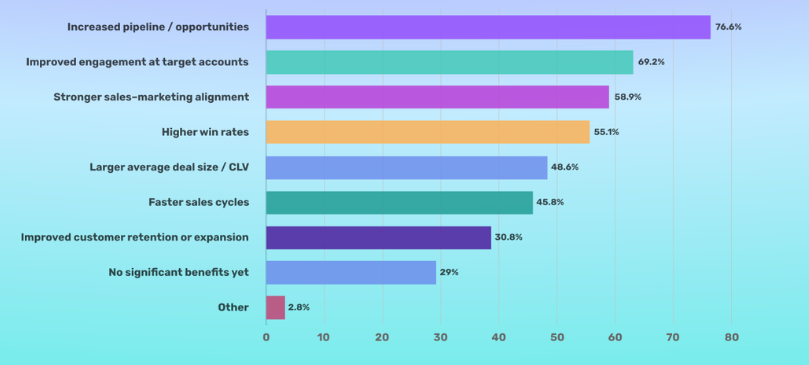
This is where confusion often arises. Many organizations stop reporting at engagement. They celebrate account reach, impressions, or meetings booked. But they fail to connect those signals to CRM stage progression, sales velocity, and closed won outcomes. Without that linkage, ABM appears to influence revenue rather than drive it.
ABM is designed for revenue efficiency, not awareness
The primary objectives in the State of ABM report make this clear. Ninety one percent of organizations use ABM to generate more qualified pipeline. Sixty six percent aim to improve win rates. Fifty nine percent focus on increasing deal size, and forty six percent seek to shorten sales cycles. These priorities reflect executive level concerns directly tied to predictable revenue growth.
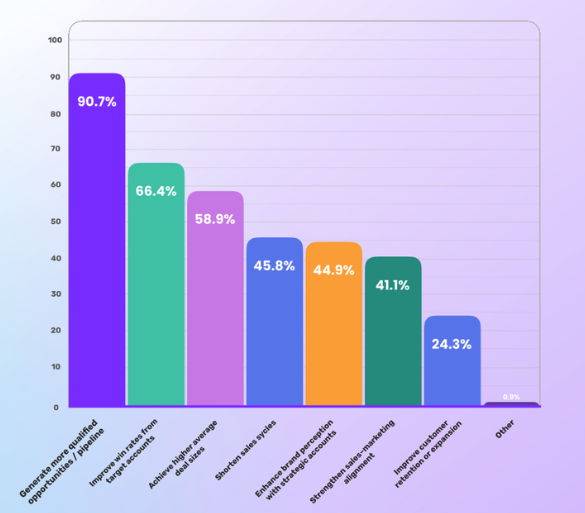
The most important shift ABM enables is from volume thinking to efficiency thinking. Traditional demand models focus on generating more leads. ABM focuses on converting the right accounts at higher rates. When conversion improves, revenue grows without requiring proportional increases in headcount or marketing spend.
If win rates increase and the average contract value nearly doubles on influenced deals, revenue density increases. If sales cycles shorten, forecasting becomes more accurate and cash flow improves.
Better conversion always outperforms more leads.
N.Rich’s case: how revenue impact becomes undeniable
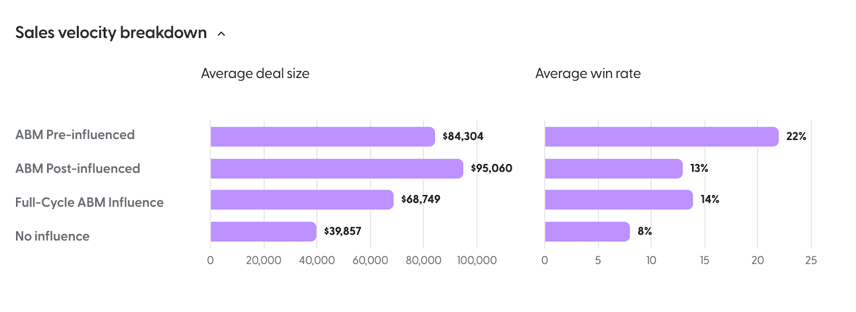
Across N.Rich’s own HubSpot dashboards, influenced closed won revenue reached 3.3 million dollars within a single year. That is tied directly to opportunities that experienced ABM engagement throughout the buying cycle.
Source: N.Rich (Sales Velocity Dashboard)
Sales velocity data consistently shows a clear pattern. Non influenced deals close at roughly 8 percent win rate with approximately 39 thousand dollars in average contract value. Full cycle ABM influenced deals close at 13 to 22 percent win rate with 68 to 95 thousand dollars in average contract value.
That represents 3.5 to 5 times better sales velocity.
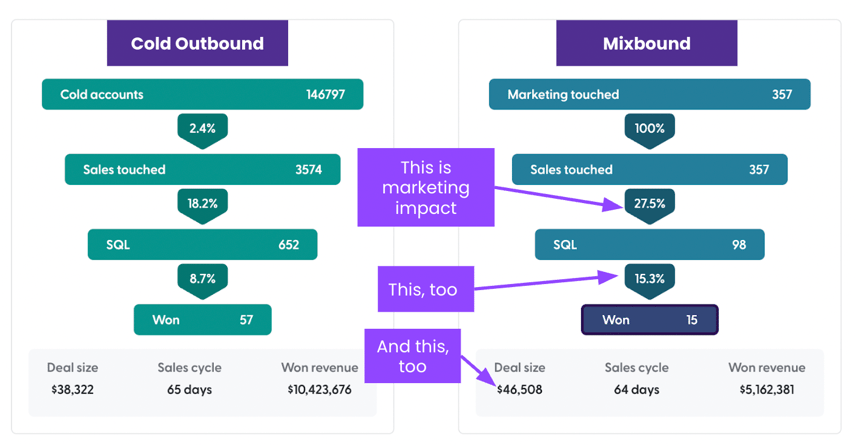
Across clients, similar patterns appear. Outbound conversion increases three to five times when accounts are warmed through coordinated ABM coverage. Win rates improve two to three times. Average contract value increases between 30 and 100 percent or more on influenced deals. In some cases, organizations have been able to attribute substantially more revenue to marketing once ABM touchpoints were aligned with CRM tracking.
Source: N.Rich’s Mixbound Playbook
The recurring proof pattern is always the same. Engagement is mapped against CRM stage progression. Influenced deals are compared against non influenced deals. Revenue differences become visible. The impact becomes measurable.
At that point, the debate ends.
ABM as a coordinated revenue motion
Does ABM drive revenue?
Yes.
When structured correctly, ABM improves pipeline quality, increases conversion efficiency, expands deal size, and accelerates sales velocity. It does not replace inbound or outbound. It enhances them. It warms accounts before and during pipeline progression, increasing the probability that opportunities convert at higher value.
You do not need 20 percent more sales representatives to grow revenue by 20 percent. You need higher win rates and larger deal sizes inside your existing pipeline. When win rates increase from 8 percent to 26 percent, revenue scales without proportional hiring. When average contract value grows from 33 thousand to 70 thousand on influenced deals, revenue compounds. When outbound conversion increases five times, productivity multiplies.
This is revenue efficiency at scale.
Create more pipeline and prove where it came from
Book an N.Rich demo and see how it works on your own data.
Book a demo
Table of contents
Stop building dashboards
N.Rich AI gives your team apps that answer the questions you actually ask.
Book a demo
![Step-by-Step ABM Workflow: How To Launch An ABM Marketing Pilot [Updated]](https://nrich.io/hubfs/abm-pilot-launch-hero.jpg)