Ready to become an N.Rich AI builder and get paid for it?
REPLAY
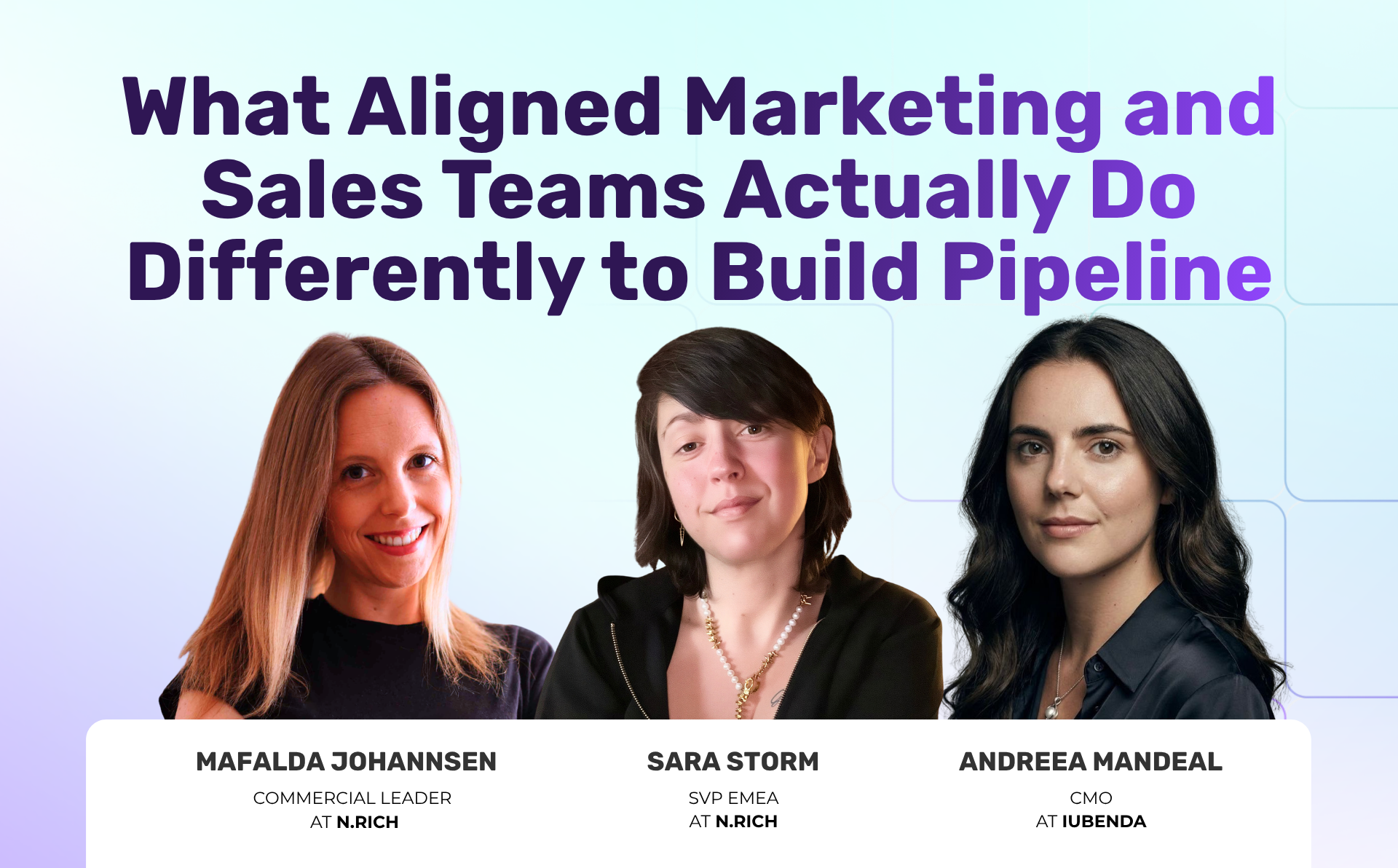
What Aligned Marketing and Sales Teams Actually Do Differently to Build Pipeline
In this fireside chat, Sara Storm moderated a discussion with Andreea Mandeal (CMO of Iubenda) and Mafalda Johannsen (N.Rich) on what aligned marketing and sales teams actually do differently to build pipeline. The panelists shared real-world insights on operationalizing alignment beyond theory.
They covered defining shared goals and KPIs, treating marketing as a partner function rather than support, and practical tips for diagnosing and fixing misalignment. Watch the full recording to learn actionable strategies for improving marketing and sales collaboration.
Transcript:
Speakers:
Sara Storm — SVP EMEA at N.Rich
Andreea Mandeal — CMO at Iubenda
Mafalda Johannsen — Team Member at N.Rich
And we are live. Welcome everyone who has already dropped into the attendee list. We are here today to run a super exciting fireside chat, and this chat will focus primarily on what aligned marketing and sales teams actually do differently to build pipeline. Sales and marketing alignment has been talked about, at least in my experience, for the last 15 years, yet we still seem to struggle with understanding how to operationalize this alignment. With us we have two very exciting guests.
I will be moderating the webinar, but let's start with our guests and getting them up on stage. I wanted to hand over first to Andreea Mandeal, who is here from Iubenda, to discuss this topic with us today. Andreea, can you give a short introduction to yourself and tell everyone what you're all about?
Hi everyone, thanks Sara. I'm the CMO of Iubenda. Iubenda is a digital compliance company. To put it simply, we do cookie banners, terms and conditions, accessibility—everything you need for a website or an app regardless of the size of your business. I've been working for the last 13 years in B2B SaaS for various startups and scale-ups such as Avanza, a Finnish unicorn, or Brighter AI, an AI compliance company that was bought by Milestone Systems. Yes, I'm very happy to be here with you today.
We're very happy you're with us too. And with that in mind, I will hand over to Mafalda to do her introduction. Mafalda is a known person for the N.Rich brand. Mafalda, go ahead and introduce yourself.
Thank you, Sara. Yes, I'm glad that I gave you the moderator role just for once. My name is Mafalda. I've been working in tech and business development and marketing for almost 15 years now. I'm super excited to be here today because I've worked with Andreea before, and this is going to be an amazing case study on proper alignment—not theory, but actual practice based on a real collaboration. That's why I'm super excited to be here with both of you.
Thank you so much, Mafalda. I'll do my short intro now too. My name is Sara Storm, and I am the SVP of EMEA for N.Rich. I run our EMEA go-to-market motion together with Mafalda, because alignment is key. My background is 23 years in revenue—I've done the entire journey from being a rep all the way up to leadership. I've worked in SaaS companies for the last 15 years on the marketing or sales technology side, so I've sat in a lot of therapy sessions between marketing and sales, both as a consultant, as a project owner, and as a rep and manager of reps.
The first time I was on stage talking about marketing and sales alignment was 2017 on the Microsoft Modern Marketing Day, so this seems to be a challenging situation for these teams to work as one. I'm really excited about this webinar today. Before we go into the housekeeping notes, I wanted to ask both of our panelists now, starting with you, Andreea, what is the one thing—if people will take one thing away from this webinar today, what do you want them to take away? What will we learn today?
For me, it's pretty simple. I believe that companies whose marketing and sales teams treat marketing as partners and not a support function tend to be much more successful. You often see this in companies where sales decides what they do and then marketing just executes on their ideas. I don't think that's the way to go. I'm a strong advocate for marketing and sales being partners, partners in crime, where they share their goals, they share their challenges, and together they thrive.
That's really good, because it's a mentality shift. It's about what we're looking at these departments for—their functions and how do we collaborate? Thank you so much. Mafalda, what is the one thing they will walk away with?
While I'm agreeing with Andreea, I think actually building on what she said, I would love people to get out of this webinar with a couple of tips—knowing how to make that shift. I really want people to think: okay, from now on we will do this part differently. It could be communication, it could be goal alignment, it could be whatever needs to be fixed in your alignment. I hope we can get some tips here that you can implement tomorrow or even today since it's still early in the day.
With the rest of the crowd, I'm here to learn everything about this too. Even though we work at N.Rich very aligned between marketing and sales, I've been in many organizations that are not, because this is an ongoing challenge. I am excited to ask you guys questions. The key takeaway I'm looking for is also how to diagnose where the problems are. When we see misalignment, there are so many pieces of the funnel where it can go wrong. Where are our problems and how can we then address them proactively?
Let's move over to some housekeeping notes. First of all, for people wondering, this webinar is always on demand. Our webinars are always available after the fact for watching as a recording or for sending to people if you want to share the amazing insights we share today. We also encourage an active conversation because we love slides, but we don't love slides more than conversations. We really want to have a conversation with people in the room today. Ask your questions—there's a Q&A box on the right side of your screen. If you put questions in the normal chat, I will try to moderate them into the conversation if they fit, otherwise I will save them for the end.
Also make sure that you follow us to join more of these webinars because we cover marketing and sales alignment in all different aspects because that's what our entire business is about. Feel free to tune in and follow us on LinkedIn and connect with me, Mafalda, and also with Andreea if you have any questions after the webinar. We will run for 60 minutes, so let's dive in. Since you guys collaborated and put some tips together on how to get here, let's move over to the first advice that we have from a team perspective. This is related to how to define shared goals and KPIs. I will start with you, Andreea, because you are all about this. Tell me a bit about how to look at defining shared goals and KPIs, because I'm sure there are marketing and sales people in here who are like, I don't know how we would even do that.
I think the most important thing to bring these teams together is to give them a shared goal. This is what unites people. Throughout my career, I worked for different companies that didn't have such goals, even though it seems super simple and common sense. Common sense is not that common. It's always about revenue growth. This is why you have marketing and sales. We both have the same purpose. I think this needs to be clearly stated. Sales needs to understand that we're in a team and we don't need conflicts because we want to go the same way.
That goal needs to be supported by KPIs that are clearly and transparently communicated and tracked. You need dashboards or whatever you have—you need to look at this over and over again. In terms of KPIs, I'm looking at pipeline—how much pipeline does marketing produce? But ultimately I care about how much pipeline we generate as a company regardless where it comes from. Nevertheless, you need to keep in mind how much sales generates on their own with SDRs, and how marketing partners with them. You need to have a clear picture.
The win rate is important—so if marketing brings in a deal, how likely are you to close? This also helps us forecast better. Average deal size is something I think is super important and I don't think a lot of teams look at. We focus a lot on number of SQLs, but identifying the right accounts and then delivering on that would increase your average deal size and would also lower your sales cycle. If you do ABM, I think the right way to do it is to make sure that you look at target account engagement to see if it works. If none of your target accounts engage, are you doing ABM at all? That's a clear indicator.
That's a good question. These five KPIs are super important to keep track of and to share across teams. It's a very interesting point too, because it addresses the different types of motion. If you're running SMB, ACV will be very much more stable. If you're doing ABM, which is more enterprise and mid-market motions, the KPIs need to be different because an enterprise and mid-market journey looks different. We're not looking at one conversion point or a deal closing within four weeks. We're looking at long engagement and being able to influence throughout the pipe.
So when it comes to those KPIs, can you repeat them again, like per stage?
Pipeline generated, win rate or conversion rate, average deal size, sales cycle length, and target account engagement.
These are all end-of-line metrics, which is something we discuss with customers a lot. Top funnel metrics that we normally would recommend tying to these would be target account coverage percentage very early in the funnel—how many decision makers and influencers are we engaging on each account? Qualified engaged account percentage, which is in the in-market to engage stage, and then discovery progression rates. These are more like early indicators, while your numbers are more like hardcore from a win rate, sales velocity perspective, ACV perspective—which is more end of funnel.
So I'm thinking, can sales and marketing agree on these as the primary metrics? What is your history of seeing that sort of land with the teams? Can you tell us a bit more about that?
They can't disagree on the main goal, which is revenue growth. There's nothing against that, but I think the priorities are different. Most people just look at pipeline generated and maybe win rate. I think this is also important for a lot of sales folks and sales managers. But where I feel like—and I'm not blaming sales for this, I think marketing also sometimes loses track of this—is the average deal size, the sales cycle length. But I've also seen the opposite where people care a lot about traffic and vanity metrics. They say, "They came to our website, okay, but did it convert?" You have to look across the entire buyer journey and identify the right signals, but for that you need the right infrastructure set up. It's not that easy.
Nevertheless, if you really need to choose from these five—maybe five is too much—then make sure you go for pipeline generated, win rate, and target account engagement. If you can do the other two, I honestly think it would help. Imagine instead of having to close 30 deals, you actually close 10. That's significant impact.
It's an interesting math problem to look at from a perspective of ACV versus smaller deals. I agree with that. Mafalda, I'm going to turn to you now because this is interesting from a line manager perspective. These metrics are something you can infuse into two teams when they are ready to measure the same way. But there is a step before that—it has to do with owning the pipeline as one team, the entire funnel. What would be your advice, Mafalda, to get the teams there? Because that's the first step before we go into what KPIs we should measure this new organization structure on.
That's a good question. It really adds up to what you both said. Something that worked—and I can give a real scenario because I used to be a BDR when Andreea was a marketing manager, and that's how we met. At every event—and event can mean a conference, a webinar, any lead gen event where marketing needed conversion—we would align on something specific. For example, okay, you're going to a conference. This is how many leads I expect you to bring, and this is the amount or percentage of qualified leads from that conference. Then these would be the opportunities.
We would both agree depending on how many logos the conference had, how targeted it would be, and how many days we would be there, right? Three days is not the same as one day. Me and Andreea would agree on those KPIs and something that would be comfortable for both sides. It's not us telling marketing what they should do, and it's not marketing telling us what we should do. Both of us working together with agreed KPIs for this conference that are comfortable for both of us.
If we both align on what good looks like and what's realistic for the company—because we both know our fundamentals—it's not that hard to understand how many leads, qualified leads, and meetings booked should come from a specific event, also based on history. Having that in mind, it's much easier conversation then, because I'm comfortable with what I'm going for. I plan accordingly as a salesperson and I make sure I squeeze as much as I can out of the marketing event. We are all happy because we are all getting into our goals. This is how, from top of funnel, I used to, and I still do, define the metrics before each event. It's also much easier to measure success or to understand why we didn't, because it happens that reality doesn't match, and that's okay. But then we need numbers to understand if we should invest next year or not.
That makes a lot of sense. Communication is one key element here. When you're telling the story about the collaboration, it's clear that communication and deciding what you're going to do together is foundational. The conclusion from this tip is that you need KPIs that are joint. That's the point. If you want the details, we will share this deck after, or reach out to Andreea on the KPI side, reach out to us if you want more details on how we operate.
Let's move over to tip 2 so we can maintain time. Ideal customer profile—the core fundamental for everything we do. Andreea, tell us about how the work looks like in your company and how it's been before related to agreeing on an ICP between sales and marketing and building it out.
The situation in Iubenda is a bit more complex because on one hand side we have a PLG motion—self-serve subscriptions—and the ICP is one thing. Then we have the enterprise motion, which is more complex. When you start at a company and you don't really understand ICP, it can be difficult. I think the easiest way to start is to look at the history—who did we close deals with. Everyone has a CRM, just dig into it and see what kind of deals we closed and with whom.
The issue there though is that you can't rely solely on that because often people mix up the user and the decision maker. You're going to see a lot of deals closed with users. They miss the first part where you talk to the decision maker—the person who actually said yes to the deal. That person was likely more junior and got passed the deal from someone else. Then that junior person becomes the person associated with the opportunity. Many companies make loads of mistakes here and then focus on these users, but they're really influencers if anything—they don't own the budget. I think it's important to understand the history by talking to sales and asking, "Is this really the decision maker? Did this person close the deal with us or was it their boss or their boss's boss? Who said yes to us first?"
Mafalda brought up trade shows, and I think that's a great way to validate if you're focusing on the right person because you're right there and you can talk to them. That's super important and people underestimate this. I've done tons of events and it's getting tiring with age to keep going, but I think it's important. It's also important for you as a marketer to validate your value proposition. Do they understand what I mean by cloud agnostic control plane, different abstraction layer? Do they get this? Because a lot of the time we just assume that people we're trying to sell our solution to are just as technical and knowledgeable as we are. A lot of SaaS companies sell solutions that aren't that exciting—they're just something you need for your business, but it's not something people will talk about over dinner. That's when you really need to make sure you express it the right way.
Going back to ICP, the core approaches are history, closed deals, trade show validation, and then interviews. If you have product marketing people in your team, great. If you don't, you have to do it yourself. But interviews and sales calls are essential.
I wanted to ask something because I think we have different levels of knowledge in the audience. Let's make sure we identify this first. ICP is ideal customer profile—that's a company layer. That's the company itself. Then we have the buyer persona layer, which is all the different groupings of people we need to either influence, create trust with, or drive if they are economic buyers or the people running the active buying committee.
I think one of the things I can see a lot is that ICP gets undefined pretty quickly when you talk to different people in the same company. Sales will have one idea about what their verticals are, what accounts they should target, and why they are interested. Marketing has a different view because they have a deeper understanding of buying personas and how they operate, even though sales is talking to these people day to day. You said we need to look at history data—that's one thing. The second thing is being clear about what motion it fits into. Enterprise and mid-market is different from PLG and SMB because you don't really have a buying committee in SMB. You have one to two people.
So doing your research on understanding the companies that have the best potential to create high average contract value while also staying, thriving, and potentially expanding—to look at ICP and tierings based on that is critical. You were also mentioning listening into sales calls to understand the buying persona committee members and what they need. We actually have a really good way of doing that. Do you guys do note takers and then collect that data to understand buyer persona committee discussions?
That's a great concrete tip for the audience. If you have note takers on the sales side, collect that data and analyze it to better understand what type of content we should put into our campaigns related to what is being asked for. Mafalda, your perspective here—when you look at ICP, you can talk about N.Rich if you want. When you look at ICP for us, what is your view? How do we define what type of deep criteria should be in an ICP to make it make sense?
I would start by saying that it's very common that marketing interviews customers, as Andreea mentioned. It's not as common that head of business development and other sales leadership actually interview customers on a deeper level. We do have a lot of knowledge as sales because we speak to prospects every day and week, and we start accumulating that knowledge, which is great and useful. But sometimes we really need to go deeper, and the only way is really through honest customer interviews—not just prospecting or discovery calls.
Another tip that I usually give is that as sales leadership, also interview customers even though we speak with them because it's not the same setting and you can get a lot more insight. Answering your question, the ICP really starts with basic technographics like region and industry, but what's really important for me is to understand which characteristics of those companies indicate that they have a problem that we might be able to solve. For example, with N.Rich, ad spending is one ICP criteria. That doesn't mean it's a criteria for Andreea's company—I'm sure it's not. That's the homework as GTM leadership, marketing leadership, sales leadership, or CEO—however your company is organized—to try to understand which criteria from a company perspective actually indicate that they might need your solution.
Then that's the foundation. You do the whole marketing, the whole sales messaging, the whole GTM strategy on top of that. But it's really important that you do that homework and you cannot skip it. Sometimes the things we think are not the things that are actually the reality. Going back to what Andreea said, which I really agree with, conferences are another way for you to actually check your hypothesis in an easy way. When you try to check hypothesis with a cold call, it's much harder because cold calling is already difficult. But in a personal setting like a conference, it's a fantastic way not only to get leads, but to validate our opinions. In my previous company, we didn't have a very defined ICP, which made my job as business development head very difficult because I need to first know who to target, why, and what messaging. An easy way I got that information was sending my BDRs to a couple of conferences. I really got a lot of useful information to build the ICP, the buyer persona, and the messaging.
I think it's super expensive to not do it. I remember at Brighter.ai, we were investing a lot in healthcare as a vertical. It took us one conference to figure out that there's absolutely no way we can do business there. Just talking to a few people, they said, "Yeah, your product is interesting, but I would never pay for it." I think sometimes even though you feel like you shouldn't be investing in a conference when you don't have paying customers, it's worth it because you can invest a lot in content, the website, and so on and devote a lot of time to these campaigns. It's easy to validate if you're there talking to them and they tell you, "No, I would never pay for it. It's nice, it's interesting, but no." Then you know to move on to the new vertical.
Just disqualify early.
That's a great idea. First of all, understand that this is the foundation where everything should be built on. We need to throw out our assumptions, go on data, and validate from the market. You can do this pretty quickly—one conference or we have a few customers who do this type of probing into a vertical by running campaigns with messaging they believe resonates. To judge that ICP's willingness to engage and urgency is how we judge from a digital marketing perspective whether this is a vertical we should go to an event for or address more proactively.
When you work with campaigns that aren't being paid per view, you can actually operate that way. This is one of those ways where you can test, especially if you're going into a new vertical and maybe at the same time going into new territories. You might not want to send people to the event—you want to test the narratives before you go into more sales-led work together with marketing. The summary is that you need to understand the foundation, validate, and use events as a great way to do that. Digital can also be a great way to do it. But without this foundation, if you build your house on grass, it's going to fall apart. You need this to be in place first.
Let's move over to tip number 3: consistent feedback loop. This is one of those things that we've talked about and talked about and talked about. No one has a good operating system for making it work. Sales complains about having to fill out evaluations or communicate to marketing. Marketing is saying, "Please, can you just inform me on what is the problem with this lead or what is the problem with this signal?" Andreea, how do you fix that?
Well, I'm trying. For the enterprise SLG motion—I'm not going to talk about PLG right now—what I'm trying to do is have the field marketing manager or ABM person have a weekly meeting with the entire sales team. This is for them to share updates and get feedback from sales. I think this is the right beginning.
I also want to make sure they have face time one-on-one. For instance, when we run LinkedIn campaigns for specific target accounts from specific account executives, that AE and the field marketing manager will actually look at it together, make sure the targeting is right, and also just communicate the angle we're going for on this specific target account. So first: team weekly meeting. Second: very recurrent one-on-ones with salespeople. In this way, they also feel involved, they see what we're working on, and this is how you gain trust. You're showing, "This is what I'm working on. This is what's not working. I'm planning on doing this and this." Just communicate.
Then common dashboards that I'm working on will actually show the activities of everyone. Salespeople shouldn't have to ask the field marketing manager, "What are you working on?" The dashboards show what's happening and what the results are, because ultimately that's what salespeople care about. They want to hit quota and they want to see how we're helping them do that. This is what we're working on now. We're still in the early stages—we started last quarter actually—so we still need a little bit of time to make it better. But I think this is the direction.
So facilitating the bridge by having actually joint touchpoints where you're ongoing with speaking, and what you describe as dashboards, I call alignment by force or alignment by data. If we have one dashboard that keeps everyone accountable for their own parts of this funnel, it's going to be a lot easier to have discussions because we're talking around the same reality snapshot—data from CRM, different campaigns, et cetera—which most companies struggle to create actually. Let me go to Mafalda first on this tip specifically related to feedback loop, and then I will jump in to talk about one feedback loop that does this a bit more automatically so we can have good conversations together.
Absolutely. First of all, I've seen a bad attitude from head of business development leaders and sales leaders. What I always encourage in my business development department is a mentality of constructive feedback—yes—and no blaming. And no blaming before you actually give constructive feedback. It's also important because what I've seen a lot is marketing leaders like Andreea trying to build those bridges and trying to do their best to communicate. But then sales has a chaotic situation because we are responsible for very hard KPIs. We have this pressure of closing or booking meetings, and sometimes we are in our own bubble because we are stressed and have the pressure. I understand that because I've been there my whole life, but I think we shouldn't get too caught on that. Sometimes it's better to pause five minutes than to keep this motion going.
I think it's really important for the manager of that business development department to have that attitude and promote it. Say, "Hey team, how were the webinar leads? What worked, what didn't?" Then somebody says, "The leads were not good," and you look at the leads and actually this one is good. Enforce them. Show them how to treat each lead, show them how to give feedback. There is still a lot of work we can do to improve the communication.
What Andreea said—weekly or biweekly—is also giving our team feedback. We can say, "Hey, we are struggling with these objections. Every time I get on a phone call, this is the objection I get. Could you make some content marketing material on that?" The marketing departments would most likely do it because they understand they need that feedback from us too. They don't know the daily struggles we have, which rejections, what resonates on a phone call, at a conference. We also need to feed them constantly and not at the end of the quarter.
So rolling feedback. This is one of the challenges I think too. A lot of companies try to do this very manually. We have all the meeting recordings now. We have AI. If you haven't started utilizing whatever platforms you need to get your business to run, then it is time. One of the things that I see, and that we're looking to implement with us now, is so all of this data—notes from phone calls where the BDRs note down what they do, meetings from customers that you're meeting with, prospects, in some countries you can record a conversation and have transcripts. All of this data can be compiled into: this is what should feed into the next marketing campaign for the next quarter. This is what should be fed into the new narratives for the outreach.
Mafalda and I were at an event four weeks ago. We built an analysis of what should go into the next level of our outreach in 10 minutes in a cloud tool, based on data from CRM and from note-takers and from all of these sources. I think to build a feedback loop that will work in the current climate, we need to utilize the data in an efficient way. This is one of the things that I want the audience to walk away with for this specific tip: what can you automate so you can have relevant conversations in these meetings? Because then you can make decisions based on what's actually going on in the market.
We have a question in the chat here. One of our customers, Andreea, asked a question related to defining and maintaining the ICP. The question is: who should manage it? Should it be marketing, sales, RevOps? Which team should set the frontier of the ICP definition and then move it over to sales? If it's marketing, how should that look? And then how often should the definition be reviewed?
As long as marketing and sales collaborate—which I suggested—I'm not sure if it matters. If it's sales, they'll be aligned with marketing because they wouldn't be talking all the time if it's marketing. Well, someone needs to own it. Doesn't matter if it's sales or marketing, someone needs to own it. I've seen marketing do it in the past and that worked, but I'm pretty sure it works the other way around as well because salespeople are closer to the prospects than marketing. I don't see that as being an issue.
When it comes to how often it needs to be refined, it really depends on how complex your product is and how easy it is to sell. This is case by case. For instance, in the past, I had companies where the ICP was picture clear. I'm not sure we ever actually refined that. I know we moved from SMB to enterprise because it just made more sense business-wise. The small SMBs were getting a lot of tickets, they weren't producing much, and it was just tedious. We moved to enterprise and it worked much better. When it comes to the actual ICP, we didn't change that much. We identified the new ones, when you—Mafalda—went to the gaming conference. It's not like we got rid of others. There was still e-commerce, still retail. So it depends on the business.
For instance, where I'm now, I would like to do this on a quarterly basis. It's a bit more complex. We have a few different personas—not necessarily industry, but the industry verticals are pretty clear. When it comes to the buyer persona, I think we need to experiment a little bit more and revise this on a quarterly basis. I would do it quarterly. More than that, I think it's overkill.
That's a really good point because it's also moving a lot faster on the market when it comes to competitors. ICP is one fixed structure—these are the things that need to fit for a company to pick us. But we might also see very fast now that a new vendor shows up on the market, suddenly taking pieces of your ICP and leading that part of the vertical. Then suddenly we might want to move our efforts to the part of the vertical where they don't win as often. So we usually talk about fixed and sliding ICPs. ICP is the fixed account list. Then in that account list, you have companies who will buy this year and companies that won't buy until next year because they're in contract and aren't as proactively outreached to.
We also have certain verticals where the sub-vertical in that vertical will be taken by competitors. The competitive landscape is changing so fast now with AI-built products and solutions that you need to run competitive analysis every four weeks, comparatively to before where you did it two times a year. So I think there's a reason for refining the parts of the ICP that are more motion-driven when it comes to certain verticals. And then you have other verticals that can be your ICP 2—that can be manufacturing—that changes very slowly. You can be more static in your list and review less often. Does that make sense for both of you? This is a very fluid motion, I think.
I would also add to that: after major events, you need to review your ICP. You can have everything defined, but if something like COVID comes, you need to review your ICP. What does this new major event mean to your customers, to your business? Even if you did your ICP two months ago and everyone was happy with that, if there is a major event, you need to do the homework.
And we've had like five black swan events the last six years, so there is major things going on all the time.
Yeah, every quarter.
Since 2020.
Okay, guys, just to finish what Andreea said, when I and Andreea worked together before COVID, the company had a pretty defined ICP and that really helped our collaboration. That's why defining ICP is so important because that was one of the reasons why communication was so easy between me and her.
So it's very hard when you have the same account list that you're both working on to go to Andreea and be like, "Hey, this lead is bad." She's like, "But it's in the ICP account list. What do you mean?" It's a much easier conversation when you have that defined ICP, right? And I think that's really good advice. Are they on the account list of this ICP? If it fits, it's a qualified account, which means that when we get engagement from people inside that account, that's good. It might not be a buy-ready lead, but at least it is a lead that counts towards this account list. That makes a lot of sense.
I am monitoring time. We have 20 more minutes of this webinar. Let's move over to tip number 4: understanding both departments' responsibilities. Mafalda, what does this mean in practicality?
There's a mentality from business development or from AE, depending on how your company is structured, where they think that the marketing job is to hand all perfect leads to you ready to be closed. That's not marketing's job responsibility. It would be great in the ideal world, and I'm sure the marketing departments would love if they could do that, but that's not how it works. It's very important to understand from the business development department that marketing's responsibility is to generate leads. Not all of them will be equally good for different reasons. It's not their job to hand them on a silver plate. That's why we have salespeople doing top of funnel. Otherwise we would only have closers.
I always say to business development people—it's a joke, but also serious—"Hey, if that would be marketing's job, you wouldn't need a job. You would just be closing and that's an AE." So it's really important to understand the roles. Then on the marketing side, there's also something important. Even if they hand over a good lead, sometimes for other reasons, the BDR doesn't close it. Maybe it's within the ICP, but there was no interest, or maybe they cut budget, or maybe the person signed up to the webinar—perfect buyer persona, perfect company—but they're leaving the company and moving to another one. So we also need to understand that yes, just because the lead looks good in practice, it doesn't mean that the BDR can close it. And even if the BDR is super competent and doing everything right. So it's really important to also have better communication, understand both responsibilities, priorities, and challenges, and be open about it together. It's easier to be in each other's shoes.
So understanding and empathy, and also being able to deep dive a bit more into what the other departments around you are actually doing. That sounds like solid advice to me. Andreea, do you have anything to add to that point of view that Mafalda has about collaboration?
I think it's also about respect, and first of all trust, and then respect. To be honest, I'm not sure if I would go to an account executive and tell him how to sell necessarily. Of course, we can talk about ICP and there are shared responsibilities, but at the end I think you need to trust that the marketing team is trying to help you. This doesn't mean that you can't come up with ideas as a salesperson. Please do. Just keep in mind that honestly, everyone in every company I work for thinks they know marketing. I think this is the department that gets the most ideas, and especially now that everyone has AI, this amplified this.
Every idea that you need to validate takes time. So sometimes like, yeah, but there's nothing wrong with more ideas. Well, if you need to validate, that takes time for things that you know work. So there's an opportunity cost to bombarding your marketer with new ideas. Also, I think ideas are great, but execution is what matters. Take this in mind. Like I said, I think trust and respect work both ways.
I think that's a really interesting point of view with the trust and respect. I've been on the sales side forever, and I personally believe that sales has no idea what marketing is, and they should understand that and work from there. This is one of my pet peeves with sales teams. As a sales leader, it's my responsibility to be the bridge. It shouldn't be AE to marketing, it should be leader to leader, peer. That's where we're trying to create the alignment. Then my job is to push whatever we agree down to my organization.
I think this is one of the things that is lacking, because if marketing has to go to an AE to follow up, then that AE's leader is not doing their job. That's my POV. I'm pretty harsh on this, and I think it's super important for this collaboration to work because we need to be accountable for our teams. I also believe that in this day and age, there is a way to validate marketing ideas or narrative ideas on sales on their own.
Let me give an example. When I have a rep who comes to me like, "Oh, we should do personalized landing pages per account. I really want to get into these five accounts," I could go to marketing and be like, "Can we do a personalized campaign towards these five accounts?" Or I can say, "Great, go to Loppable, build a landing page, do outreach and test it. Does it work? Great. Let's do it on scale. If it doesn't, don't come to me again." This is—I'm serious. Because I feel like there is also this job on marketing shoulders that I think is unfair. It has to do with educating sales, and we've been educating and educating. I'm talking about marketing side in these therapy sessions with sales and marketing leaders. When are you going to take your responsibility, dear sales leader, to get your team in shape? Because something here is breaking. And unfortunately, you and the CMO are the ones that want to fix this breaking. It's not up to reps, it's not up to a marketing team member who wants to educate because marketing should do marketing. They shouldn't do internal education programs. That's not their job. Andreea, what do you think about my POV since you're on the marketing side?
The example you just gave with the landing pages, that would be amazing. I haven't seen that in my experience. I think it's fantastic if every time you come up with an idea, you think a little bit about execution and not just the idea, and if you can test it, that's fantastic.
I want them to execute. A Loppable webpage takes two minutes to build if it's for one account. It's specific. You do the research on the account, you build it, you ship it. Once you start doing these things, because then you test it in outreach only going to that account. You're not going to test it wide. You're not going to mess up the ongoing flow that marketing provides because that's just as important to keep safe in the marketing team who actually knows marketing. But testing these ideas and then being able to validate to scale them, then we can go to marketing through Mafalda and say, guys, we found this thing, we have this data now, how about we run a personalized campaign towards 200 accounts? How about we do this mail campaign? How about we do this?
But I really believe that we in this day and age need to understand that marketing is running always-on type of marketing flows. It's not that you can just whip up a landing page for something when you already have all your projects running, because you're doing marketing for the overarching company. Then we need to discuss how can we validate and how can sales support that. We are a support organization to marketing too. We should operate like one. This is one of those things where the leader of the sales teams needs to run this motion. It shouldn't be up to marketing to say, maybe you can do this or build a landing page, because we don't need that anymore. Right now we can test by just building and executing and testing in small scale. Then we can go to marketing with a really good business case for why you should stop spending time here and do this instead. And then there's a discussion to be had, but I really believe that there is a point in time now where we need to just take our accountability as leaders. On the sales side, I'm talking to you guys—this is the time for you guys to step up because marketing is doing everything they can. I haven't been in a single company where marketing hasn't worked their asses off while they complain about leads. This is not a dynamic that works, speaking of respect and trust. But that's just my highly personal POV, not N.Rich's POV.
And mine as well. That's why I always collaborated so well with marketing. I was always trying to help and to make the most out of it. Going back to the gaming conference that I did with Andreea at the time, that's what we did. Me and my other colleague, another BDR, we had a hint from our prospecting that maybe gambling and iGaming could be a good vertical for us. So what we did was we went to Andreea, we said we have this suspicion. There is a free conference in Amsterdam. We just need to cover the flights and the hotels. Can we go there and test the hypothesis? Guess what? We were right. We booked lots of meetings, we closed deals, and from then on, Andreea and the team invested in case studies for customers. They started the investment because we tested it first.
Sales validated, and then marketing could have that validation. It's amazing. It's exactly what I'm talking about.
Very easy conversation.
Perfect. We have 10 more minutes. Let's see if we can wrap up the last couple of tips. Tip 5: prioritize leads strategically. I want to do a caveat on this question. Since leads is not the primary measurement point for enterprise marketing, Andreea, maybe you can speak about the difference because I can't. Prioritize leads versus lead conversion, which is going down ongoing nowadays. Prioritize leads can mean both prioritizing engagement and prioritizing conversions. So strategically, not perfectly. What does that mean for you, Andreea? How do you prioritize leads or accounts or just strategically and not perfectly? What does that mean?
Well, not all leads are born equally. In an ideal world you'd have some sort of scoring that would tell you this is a better lead, much more likely to close than this other lead. If you don't have that, to be honest, manually is a bit difficult, I believe. It depends on the amount of leads you're talking about. But you go to the OMR, you come home with 400 leads, where do you start? You could send the same cadence to all, but that's not really how you should take this, especially if the leads are from different verticals, different personas. It's hard.
So I think you need to match these leads against the ICP. Based on that, you'd have a score and then that would help you prioritize. And not perfectly. Maybe you don't have that infrastructure in place yet. That's totally fine—work towards it. But if sales and marketing, if everyone understands what the ICP is, you can also do it manually. I'm not really sure how great this works, but I think most of the time the timing is more important than the perfection of your email. So I don't know if you have to wait for a month to follow up after an event or a campaign. I think it's a burnt lead in a way. Timing is super important.
The money for the event and the campaign is wasted. Like at the end of the day, if you're waiting a month, we shouldn't have done the event. From a conclusion perspective, the response rate will be shitty, to be fair. Mafalda, I know that we are working hard on prioritizing for our events. Do you want to tell us a bit more about how we're hunting strategically, not perfectly?
Absolutely. Not every lead is equally good, unfortunately for all of us. We also need to check. I usually check if the lead is ICP and the right buyer persona. That's the lead you want. Perfect. That's ideal world. Not all of them will be like that.
Then you have a different one—the right buyer persona in the non-ICP account. Still, you need to look as a business development person. Even though it's not ICP, but it's the right buyer persona, maybe it's worth going after for some reasons, for some criteria. You need to decide if your time is worth it or not. You should know that as a business development person.
Then you have another one: wrong persona in the right ICP account. That lead, you're not going to book a meeting with that person. You're going to get information that's relevant from that person to actually contact the right buyer persona in the ICP. That's what that lead is for.
And then you have wrong ICP, wrong buyer persona. Fine. Marketing will nurture them. It's not your business. It's not your job, but you have to treat each lead differently according to the criteria. You should know that criteria and you should act accordingly. It's not everything is the same. So that's my take on prioritize leads strategically, not perfectly.
Sounds like foundational work—matching towards those ICPs and buyer personas. And once you do that, it's pretty simple to figure out. The system or orchestration around it is a different story because you need a tech stack to support this. Doing it manually, if you have five leads, is fine. If you come from an event and you've talked to 200 people because you were five reps there, very different story. Manually will not cut it. So then you need to build towards that.
Thank you so much, guys. Let's move over to the last tip of the day. We have now six minutes left of this webinar, so let's try to keep ourselves concise. Tip number 6 is leverage marketing all the time. I love this, Andreea. What does this mean in practice for you guys?
Do you remember at the beginning we talked about the KPIs? One of them, one of the things I'm looking at, is sales cycle—how long does it last? Well, if you leverage marketing all the time—maybe "all the time" in caps is a bit—but if you leverage marketing, not just to bring you the lead, but also to help you close faster, grab their attention, this is going to help you shorten the sales cycle.
So I think we're trying to do this at Iubenda and we're getting started and it's great. We've been at the OMR event and there are quite a few leads that are really banked, perfect ICP. For those leads, we're going to send some direct mail—just to remind them who we are, but also capture their attention and help them convert more. But also, once you close the deal, you shouldn't forget about it. There's a thing called customer marketing that would help you renew easier next time. If you have a good relationship with the customer you just closed, make sure maybe you do an introduction to marketing, maybe do a case study together, or invite them to a customer event or just a roundtable that we organize.
So I think there are ways of involving marketing more across the entire funnel, and the funnel doesn't end when you just signed a deal—it continues. This is what I would advise people to do. By the way, marketers are delighted to do these sorts of things.
If they have budget to do it on the other side of the sign, because this is always a budget question and a resource question. I think we normally work with customers who are doing top funnel very heavy, which is where the KPIs we talked about came in, the ICP build. Land and expand is something that is very much not really done properly, and marketing can also support a lot with land and expand if we have expansion opportunities in an account. So open pipe marketing is gold. You mentioned ACV, right? Because trust builds inside the procurement committee. You mentioned win rate, you mentioned sales velocity. All of these things, if you let marketing run campaigns when they are in pipe, can be improved and impacted. Mafalda, your take on this sort of always-on type of marketing for all stages. How do you see that in your experience?
I agree with everything what you both said. Also, from the business development perspective, sure lead gen is great. If Andreea gives me a list of companies that sign up for a webinar, fantastic, I will work on that. But for example, last week my BDRs at N.Rich booked meetings because of a webinar, but they were not webinar leads. Why? This is just a very practical tip. I've organized these webinars. They had people who said reach out to me in a couple of months or not the right timing, so they invited them for the webinar. Very soft approach. And they said, "Actually, oh, good that you invited me. I actually am looking for ABM platforms now." They didn't sign up for this webinar, but the webinar was the reason why they booked because it was a nice way to get in touch without being annoying.
So this is what marketing is for. It's not only lead gen. You in business development, in sales, in customer success—it's a way to create value all the time for your customers and for your prospects. We are here to help, we are here to solve the challenges, can be also via content marketing, like this webinar right here. So that's my take.
That's a great take. We were talking before, right, about marketing's role, and this is the active sales role that many companies struggle to do because infusing content in your outreach is something that most sales teams don't do. Again, it's a managerial problem because this needs to be pushed like all other changes in behavior. This is one of those challenges where if the sales lead or the CRO or the VP sales doesn't understand what the point is with putting a webinar link in an outreach—because your goal is not to book the meeting, it is to get them engaged with what we're doing because it's a long game—then sales reps won't do it on their own. It needs to be convinced or forced from their leader, not from marketing. Marketing can provide all the content, then sales needs to activate, and that's the leader's job to get them to activate.
We have one more minute. Questions have come in. We have already addressed them. If there are any more questions, feel free to put them in the chat now and we will spend like 30 seconds to answer. But I think the questions that were coming have sort of already been answered.
So with that in mind, unless something shows up now, thank you so much for this conversation. How do people in the chat get in touch with you guys? What is the best channel?
LinkedIn.
Yeah, perfect. Thank you so much. If they have questions, they will just LinkedIn you and ask them. Perfect. Thank you everyone for joining. We really appreciated this conversation and we will wrap on time right now. Appreciate everyone joining. Have a good afternoon, guys.
Thank you. Thank you.
Want to learn more about how N.Rich can help you?
Book a demoCreate more pipeline and prove where it came from
Book an N.Rich demo and see how it works on your own data.
Book a demo