Ready to become an N.Rich AI builder and get paid for it?
REPLAY
GTM is changing. Are you? Part two
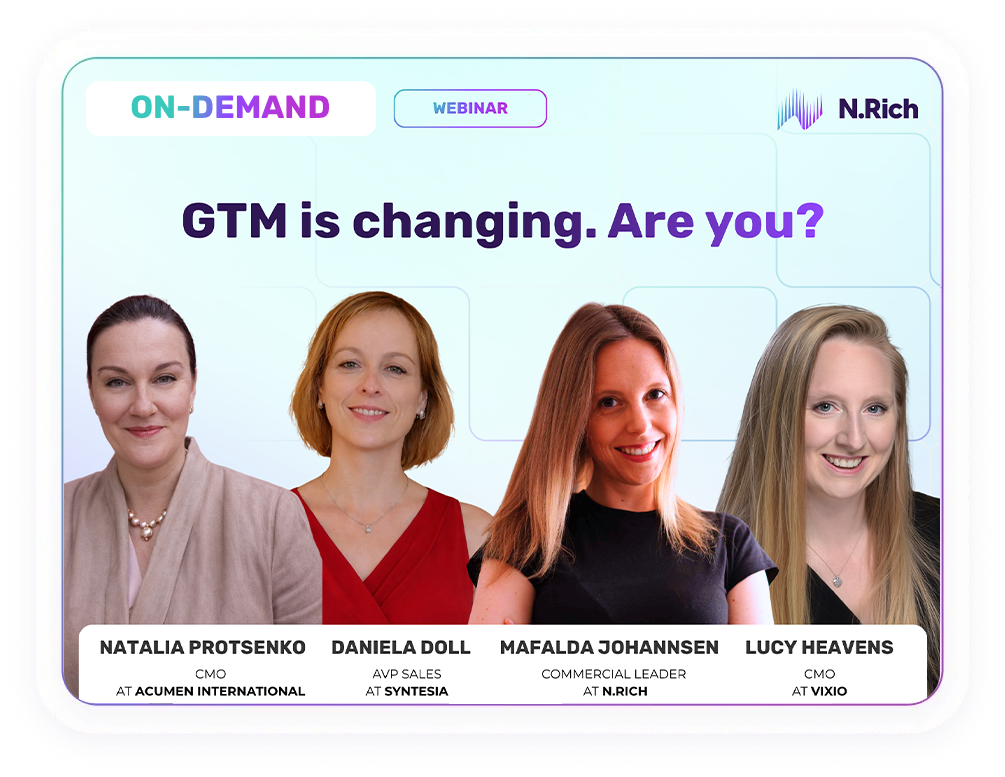
In this webinar session, Mafalda Johannsen, commercial director at N.Rich, moderated a conversation with three award-winning women GTM leaders: Daniela Ciordi-Adol from Synthesia, Natalia Protsenko from Acumen International, and Lucy Heavens, CMO at Vixio. They discussed how go-to-market strategy is evolving and the critical role of women in leadership driving change forward.
The speakers covered the collapse of traditional silos between sales and marketing teams, the importance of cross-functional alignment powered by data and CRM systems, and how companies with strong GTM alignment outperform competitors. Watch the full recording to hear insights on navigating the evolving GTM landscape.
Transcript:
Speakers:
Mafalda Johannsen — Commercial Director at N.Rich
Daniela Ciordi-Adol — Head of European Sales at Synthesia
Natalia Protsenko — Marketing Director at Acumen International
Lucy Heavens — Chief Marketing Officer at Vixio
Good morning, good afternoon everyone. I'm super excited to be here today because this webinar is about GTM and how it's changing, but it's also about the role of women in leadership in GTM. My guest speakers today won the GTM Women Voices Awards that we held in April, which celebrates women in leadership in GTM moving the needle forward. At the dinner we hosted in London with around 70 people, we had conversations about how GTM is changing, the role of AI, the role of marketing and revenue teams, and how everything is evolving. We thought it would be interesting to bring those conversations to a wider audience, and that's why we're here.
My name is Mafalda, and I'm the commercial director of N.Rich. I'll be moderating the session today. The session will be recorded, and we'd love for this conversation to be as useful as possible. Feel free to ask questions whenever something comes to mind—just write in the chat. I'll be happy to either accommodate the question throughout the conversation or address it during Q&A if it's off-topic. Let us know where you're tuning in from and what roles you're working in. I'd love each of my guests to introduce themselves. Let's start with you, Daniela. Tell us who you are and what you do.
Hi everybody, my name is Daniela Ciordi-Adol. I lead the European sales team for an AI-native scale-up called Synthesia. We are an AI text-to-video platform used by many large companies to upskill and reskill their workforce. My role involves a lot of hiring at the moment as we're scaling our go-to-market team, but also setting the strategic direction together with the other functions I work very closely with, such as marketing.
Amazing. So if anyone would like to apply for a sales role, they know where to find you. If you're looking for a new challenge, here's an option. Natalia, who are you? What do you do?
Thank you. I'm Natalia Protsenko. I'm marketing director at Acumen International, which is a global employer of record company. We act as a legal employer when you need to hire talent all over the world and don't have your own established legal entities on the ground in your target country. That's where Acumen International helps. My role is strategic and operational at the same time because our teams are well aligned and we work together closely.
I'm responsible for all marketing strategy, communications, and execution-level alignment with sales, operations, and other departments. The client journey can't be split into separate parts—it's holistic. That's what I'm doing.
Amazing, and I think we're going to touch upon that point throughout the conversation. Lucy, last but not least, tell us who you are, what you do, and what your podcast is about.
Thank you, Mafalda. My name is Lucy Heavens. I am Chief Marketing Officer at a company called Vixio. They are a technology provider of a regulatory change management platform that helps regulated firms like financial services and gambling firms comply with regulations or understand what regulations they need to comply with. We basically help compliance leaders stop crying into their coffee every morning.
I've always worked on the tech side, working for technology companies selling into financial services. I've been in the financial services market for 25 years, and more recently the last 7 or 8 years in the regtech market, which is a real passion of mine around regulatory technology and compliance. As you mentioned, I am also host of a podcast called CMO Therapy, which is about 18 months old. It's aimed at marketing leaders who are also crying into their coffee every morning to help them with support, knowing that there are other marketing leaders out there going through similar challenges.
Aren't we all crying over our coffee? That's a great intro. Lucy, since you speak with CMOs every week, let's start with you. How do you think the traditional CMO and CRO roles are fading or evolving? What's your opinion on what's going on in the market?
There's a statistic I found that pretty much sums this up for me: 82% of C-level executives believe that their sales and marketing teams are working together effectively. However, 65% of the people actually doing the work say that the alignment doesn't exist. That gap basically tells you everything you need to know about the problem and why it never gets fixed. The people with the budget don't think there's a problem.
From what I hear and experience, I think the silos aren't fading—they're actually being forced to collapse. When a CFO can sit down with you and see the pipeline attribution in real time with numbers, that old story about marketing generating awareness and sales closing doesn't hold up anymore. So the shift I'm seeing is that marketing is really starting to understand that the commercial stakes are real and we have involvement in that.
There's another statistic I found: companies with strong GTM alignment grow 19% faster and hit 15% higher profitability. That's not a culture problem—it's a competitive one.
Daniela, what's your take from the sales side here?
I love all the stats you brought to the table, Lucy. They really speak to me. What I'm seeing from a sales perspective is that sales is getting much more involved in what marketing is doing because if that collaboration isn't effective, we're trying to sell into a very cold market because folks have never heard of us. We are a scale-up, a startup. People haven't heard of us. It's a new category, and people are still curious how to actually use AI. Then we come with a very specific message: "Did you know you could build onboarding videos with it?" That close marketing collaboration is extremely important for us to get the message out there.
What I'm learning is that we actually need to bring finance on board, bring the CFO on board with what is needed and how things are actually working, so that whatever is planned is rooted in realities and in the signals from the market that we're seeing and how they're changing. I think that's probably new for many go-to-market teams.
Natalia, I saw you're nodding a lot. What's your take here?
I very much agree with Lucy and Daniela. At Acumen, we had the privilege of working very early, back in 2022, with a very powerful Zoho CRM, which is our single source of truth. Throughout this time as the company evolved, our clients, communications, and data amplified. This is where we found alignment—the entire company, including the management board, finance department, operations, sales, and marketing, from the outset to the bottom of the funnel, can work together.
When we see the same data, operate from the same data, and see the input and output of our efforts together as a team, it helps tremendously. It doesn't carry avoidable commercial, professional, or personal contradictions because there is data—objective reality that we share—and we work together as a team, all departments, to ensure everything flows through the central piece, which is Zoho CRM. So this helps a lot. I can't really complain about alignment, but I have to say it was quite a journey to achieve that.
I think you are one of the few people I know who actually says they cannot complain about alignment. CRM plays a huge part, which makes sense, and data alignment. What else are you doing to make this work? What's your secret sauce that you can share with the audience?
I don't think I have a secret sauce, but the approach we apply and I would evangelize for is being consistent. As marketing, we communicate in one-to-many or many-to-many mode—mass communications. There's no room for error. The messaging, positioning, and how we say things to what audience means consistency and well-thought-through thinking on every facet of our marketing communication.
When it comes to the sales department, they translate the same value, the same messaging, the same positioning, the same transparency in one-to-one or one-to-few communications. There's no contradiction for me. If we're aligned, honest, transparent, understanding the value, translating the value to the market, and staying true to it as a team, there's no conflict. We're doing the same job, just with different audiences in terms of size.
As marketing, we don't have much time that our clients and potential prospects spend with our marketing assets. They see for a second, and the sales team has all the time with a client to listen to them and give them attention. Do we have 1 hour of attention in marketing? No.
Daniela, would you like to object? I would.
If you ask my sellers how much time they're spending in front of the customer, it's becoming really challenging. One of the shifts we're seeing is that we all love these calls when you can position the company and deliver the pitch. But getting the right people in the room is much more the challenge. For us, sellers are drowning in noise and lead qualification. Getting to that point where you have the right stakeholders in a room to have a conversation about their business challenge and how we could potentially help them takes so much effort.
The funnel is also changing dramatically. That's where the alignment piece is really important because it is easy, at least from an AI perspective, to get people to talk about AI, but getting the right people in the room is an entirely different challenge. That's where my people are spending too much time—filtering. We have a lot of leads coming in, a lot of it is noise. That's where alignment is needed to actually filter this out and protect sellers' time to have those wonderful conversations we love so much. Right now, it's a real challenge.
Lucy, building on what Daniela and Natalia said, what do you think are the new skills, or which skills are becoming very critical to achieve alignment and revenue success?
I'm going to be diplomatic and say that I sit somewhere very nicely in the middle of these two. I really do see both sides. Marketing has the job of trying to reach a much larger audience, but what we don't get to have is the depth of conversations. That's always the struggle for us. Sales, once you are in front of someone, you do have the opportunity to really try and extract the right questions and get those answers. For marketing, it's always a bit of trial and error in the content we put in front of them, then looking for that engagement—how they're reacting. We have to make assumptions about their level of intent. We can't just ask them, "Do you have budget? Are you actually looking to buy? Do you have a project sponsor?" That's what we really want to do and filter all those off.
What I find interesting is that marketing really does want to make it more highly targeted, ensure we're not just passing hundreds of leads that the sales team then has to filter and qualify. We want to pass exactly the right ones. But I've been in situations where we've applied that, started passing only the ones showing really high intent and matching our exact ICP, and then we get told, "We're not seeing enough leads. We want to see more."
To answer your question on new skills, I think it's about AI and data fluency. It's about having a real grasp of your tech stack to enable you to measure all of those things and pass quality leads over.
We're seeing the same on the sales side. Tech literacy and AI literacy are super important just to make sense of all the leads and signals coming in and use the tools available to translate that. The leads coming in need to have a point of view on how you—what the likely challenges are, a hypothesis to take to a conversation, to be really a trusted advisor and not just coming and saying, "Hey, do you have budget?" The answer is no. I can tell you that. I don't have to ask that question. Nobody has budget, right? But I have a problem that I need to solve.
I think sellers that are highly data literate understand and read the signals better as to which companies are actually in the market and are at that spot in the funnel where a conversation with a salesperson is timely. They can also pull together the things that are relevant to form that point of view.
That's a really good point. I think the other skill I would add, more of a soft skill, is actually curiosity. We have all the tools at our disposal, but AI isn't at the point yet where Claude is suddenly going to message me on a Monday morning and say, "Hey Lucy, maybe you should look at this" or "Maybe you should do this." But you've got to have that hypothesis and that curiosity to start querying it, digging into these numbers, looking at those trends, and saying, "Well, where is this coming from?" to try and find the answer.
Actually, Claude can do that. There are other models out there, but I think that's part of how the role is changing and how you can leverage AI within that flow to tell you which accounts and what messaging could resonate, which case studies could be relevant—all of these things are there. But it's not at the point that you just blindly use that because that's the part that could be automated. You're supposed to be the trusted advisor. It's a conversation understanding what the implication is for the individual, their team, and their function that you're actually speaking to. That's the added value of having that in-person conversation.
Amazing. I think you already answered like all of the questions I had prepared for today. Natalia, what would you add here? Which other skills would you add that are really relevant?
We work in trusted advisory, very complex, regulated business, global business, and it's very human. Employer of record is about people, hiring people, de-risking their global mobility, de-risking their family, preventing failure points. This is a very personal decision for people who decide to join companies elsewhere. For us, because employer of record is a model of third-party employment where we take responsibility and full liability and local liability, we have to be both human and law-abiding, whatever the local law is.
We have very long and complex sales cycles. We're not speaking with clients asking, "Do you have a budget? Can we sell you our product?" There's no product because we're not selling off-shelf solutions. We're selling solutions tailored to each individual situation of a company and personalized to each role scenario that we're working with. For us, given Lucy's comment about real challenges in filtering out noise and cutting through demand, and Daniela's opinion on qualifying leads and not overwhelming sales with leads—providing the sales team with genuinely valuable, convertible leads that will stay long with the company—I think we took the risk a couple of years ago of showing lower traffic, showing fewer leads, but high quality leads. And that played out.
I deliberately decided in marketing communications that I don't want newbies. I don't want any shoppers around. I don't want to speak plain language. I don't want to simplify anything. I want to speak to people who understand us, who understand the value, who understand and value the complexity because there's nothing simple about our job. This translates to their attitude. They're not looking to save $50 because we're about people's lives and people's careers. And it's worked magically.
It's funny you say that, staying true to your audience. It's interesting.
When you think about who your ideal client is in terms of a company or team on the client side, as marketers we're pretty clear about that. It's just we don't take the risk of staying true to that ideal one. But it's like marrying. We can date many people, but we marry one. You don't need thousands of clients. You need 10 good ones that will stay with you for a long time, and you'll both be happy. That's the point.
And it leads me to the next conversation point: AI. I don't think we have ever lacked tools at any stage. What we still lack—we've been fighting for attention since the first silly digital ads, and we're still fighting for attention. Some time ago I went to Morocco and didn't speak French or the local dialect. I learned a few words with the dictionary, but it didn't help me understand what was said to me because I wasn't fluent in French or Arabic. The same with AI. We can produce at scale a lot of content, a lot of data, a lot of everything. It doesn't increase the human capacity to process this thing.
If AI is now the writer, the sender, the data analyst, and so on, why do we expect humans—still human—to read it? I was thinking, okay, I'll make some GPT agent to read all my inboxes and answer them. So we're entering the era when machines will be talking to machines, and we will be deprecated if we don't value and understand and cherish our relationships with few clients—ideal clients that bring business to us, that pay us, that are happy with us. We're human. Otherwise, we start believing in superhumans or AI or whatever, and then why us? What is the value of us if machines are talking to machines and we're just struggling to understand that huge amount of data they're producing?
That's a very good segue for my next question. Daniela, where do you think AI is delivering real impact and what should remain human-led, so we don't go to the scenario that Natalia is describing, which I agree with—if we're not careful, we can go down that rabbit hole?
I think we still have a way to go. These tools can assist particularly in situations where we have data overload, to help us structure and cut through the noise. But they don't pick up on signals the way humans do. They don't pick up on emotional signals, on body language. They don't have the same type of holistic partnership approach.
For us, the way we look at this, even as an AI company, our core mission is to help people work better. We think people will stay at the heart of how companies operate, how organizations function, how strategies get developed and implemented, and how deals get done. But AI can help us get to a more well-informed view on the basis of data and also accelerate routine tasks that neither sellers nor customers really need to do in a meeting and need to be doing manually. That saves us time.
We're quite convinced that's the direction. When you watch a video showing you exactly how it's done and have a coaching or informative conversation about what you should be saying in this meeting, what you can be learning, how you can get through a difficult conversation—that's where AI is going: being that helpful assistant while humans stay in control so it doesn't go off the rails and is actually genuinely helpful. It's not about just saying you are absolutely right and changing their opinion every 5 minutes, but genuinely helpful and valuable.
It's about having that mindset as you use tools and set them up for your team. You want to have editorial control over what's being taught and what the messaging is. That remains very important. So it's not just about blindly rolling out some model or tool. It's actually thinking about what we're trying to accomplish, what are the jobs to be done, and how exactly do we want to leverage AI versus where do we want the human in the loop or in the lead.
Lucy, what's your take? What should be human? What should be done by AI? What's your take here?
I totally agree with you, Daniela. The biggest impact I'm seeing is how AI can support marketing teams. Not do their job, but support them. The biggest way and the biggest impact I'm seeing is speed to insights. We didn't know in the past about intent—we had to just guess. We have so much of that data at our disposal, but it's almost too much. That's the problem now: too much data. We used to spend weeks digging around, trying to find a needle in a haystack, pulling together all of these pieces of data. Now we can use AI to do market research, look at competitor analysis really quickly, pull together a campaign brief based on all these different data points. That's the biggest key—AI has reduced the timeline for those sorts of things dramatically.
What that does is free up the marketing professionals and team to give them space to think for a minute, think a little bit more strategically, so they're not spending time gathering all of that data. They've got all of the data together a lot quicker. Regarding content, this is always a little bit of a sore subject when it comes to AI because many people are using AI in the wrong way and churning out loads of really bad quality. Where I've seen it used best is where AI almost gives you a kickstart, a head start. It takes the bare bones of something and turns it into a rough idea, and then you have the more creative people in the team—the content people, the writers, the creative people—actually turning that into something that can be read by humans. That's where it's more of a quality going up rather than quantity.
You mentioned that with AI we have more time to think, but I've heard from some marketers that everything is so fast because of AI they don't have time to think anymore. Where do you think that comes from? It goes a bit against what you just mentioned, which I agree with, but I've heard the opposite.
I've heard that as well, to be honest. We may be shifting from drowning in data to drowning in insights. But I think this comes back to marketing leadership and strategy all the time. It's about knowing where your focus is. It can throw all of these different insights at you, but sometimes you've just got to say, "Well, that's interesting, but is it taking my focus away from here?"
The other trick I've found to be quite successful is making sure that you carve out, as part of your strategy, 10% of your time for that kind of AI exploration. One of my team members, or the product team, actually calls it "the fairy dust"—how can you carve out 10% for those little insights you're looking at that have sprinkled something on, you're quite sure what it is, but it looks really pretty. Is there anything I can do with that? If you just make sure you're only spending 10% of your time there, then you can pick the bits you want and put them into your strategy.
According to the poll we just launched, we asked the audience what feels like the biggest shift in GTM right now. 50% say buyers are harder to reach and engage. Would you agree with this, Daniela?
Yes, I think that's definitely the case. Buyers are harder to reach because they are overwhelmed with signals, with marketers trying to get their attention. But they're also overwhelmed by the changes to their own roles and in their companies. When you ask if there's a budget, a timeline, or a sponsor, honestly, most of the companies we speak to have none of these things clear. A lot of things are in flux. A lot of things are new, or they're just building a new strategy, or they're just setting up their perspective on how they want to use AI. Everything is a working progress.
It's harder than ever before to actually figure out when is the right moment to start a conversation. Many folks want to have their problem solved, but they don't necessarily want to sit through longer conversations unless the problem is big enough. We see a lot of buyers with small problems who lack the capacity to say, "Okay, I'm going to go and solve it now with everything else that's going on." That's definitely something we see. The way we solve that is by involving way more stakeholders in our conversations.
A couple of years ago, you might have had like 3 people involved in the conversation dedicating time and figuring out the process. Now we find ourselves speaking to more than 30 people in an organization for two reasons. One is to make sure we have a problem that is big enough and addresses the challenges across enough teams. But also because the process of bringing a new solution on board now has so many more players involved. It's not just procurement anymore. There is IT, security, AI governance, data privacy, different legal teams, branding, and so on. It's becoming much harder to actually bring everybody on the same page and on the same timeline. So definitely, that's what I see as the challenge from a sales perspective. Even if I might have had one lead in the beginning, that doesn't help me at all. I need about 30 others to actually get this partnership off the ground.
Natalia, what's your perspective from the marketing side?
I fully agree with Daniela. The degree of complexity and interdependency between teams and third parties is enormous, and we have to manage that complexity for very simple results we want to achieve. The underlying complexity is unimaginable. That's what we come across in our company as well.
On one point, AI or tools help individuals understand and structure their processes better. But in order to bring all of these together, there's an old saying: the speed of the caravan equates the slowest camel. That's what we're dealing with.
We've talked about too many insights, too much noise, too much of everything. Since N.Rich is an ABM platform, it makes sense that we ask: how do you see strategic ABM trying to actually solve this noise and overload of insights? Where do you see the role of more strategic and modern ABM? Anyone would like to start? Lucy, Natalia?
I don't mind. There are two things for me on ABM. The first thing is that real ABM is about being completely ruthless with your account selection. I mean ruthless—not "Oh, we'd love to work with these guys," but "Here is exactly the right fit account that is ready right now for what we do." I see so many ABM campaigns with hundreds of accounts, and this is not ABM.
That brings me to the second bit, which is something I get on a bit of a hobby horse about. It's the term ABM that bothers me because it's account-based marketing, which implies it's a marketing motion. When it's done properly, it spans sales, marketing, customer success, product. Everybody is involved. So when I'm talking about account-based targeting, I always call it ABX, which is account-based experience, meaning everybody is involved. It's not just a marketing motion, and I think that's where it becomes really successful.
So there are two things: make sure you're really ruthless with account selection so you're targeting the right person and the right company at the right time. And secondly, it's ABX—a motion where everybody is involved.
Coming from an ABM company, I totally agree with you, Lucy, on both points. Natalia, what's your take here?
I agree with Lucy. You have to be picky—ruthlessly picky. And on that foundation, you have to be a strong believer in your own capability to win that account. Because if you're working with just a few and you've cut and filtered out everything else, your stakes are pretty clear and your risks are there. You have to stay true to yourself and work in depth, not broadly. Yes, I agree.
Daniela, from the sales side, what's your opinion on how modern ABX should go?
It's always something I struggle with because the idea is splendid. I love the idea of it. I've been in several organizations where we've tried to get it off the ground. I've just never seen an actual impact of it. It could be because of a lack of focus, but it's definitely got to do with the internal alignment and then also the toolkit we're putting together for ABX and how that actually needs to evolve for the modern era.
I'm seeing that it's a lot more about signals and pre-packaged things. I don't know whether that's really ABM enough to move the needle. It's like, "We do a direct mail campaign to these 50 customers instead of everybody else," and then I think, "How's that going to move the needle?" If it's for a select few accounts, it requires really a lot of alignment and a lot of insight into that particular account. And very often I think we don't have the patience to invest in that and spend all of that effort, which may or may not work. There's a risk aversion as well to put all of your eggs in a very small basket of like 5 accounts.
I really respect you for saying that, Daniela, because when you first started talking and said that you kind of never really seen that ABM or ABX motion work, it made me a little sad. But then when you said the reason why—that it needs a lot of effort to be put into it—actually my spirits kind of lifted again because I thought, "Well, actually this is great because you really do understand where ABX motion works best." Obviously for you at this point in time it doesn't work, so that's great. It's not a magic wand for everybody. I love that.
There's some unit economics at play as well, right? Because the effort that you put in also needs to be in line with the size of the opportunity. And I think that's where it falls down.
Still, with the complexity of decision-making we mentioned, even within our organization, thinking of collective sales and collective purchase, we have the entire team involved, lots of departments, and it mirrors their side as well. So just like two big divisions are trying to talk together and find the common ground. The sales are more complex and harder to win.
I agree with all of you. I've been in organizations where ABM and ABX didn't work at all for many reasons. One was what Lucy mentioned: the ICP was not well defined. If you're not ruthless, you're putting a lot of effort and resources on something that won't work. Then there's that patience, right? Things take time. Many times, we need to do strategy, right? That's our job. But things change at such a pace that maybe the strategy you define today won't be the right one in 3 months. Which, let me know if you disagree, seems like something that's kind of new at this rate and pace. How are you dealing with or managing the long strategy that you need to put in place with the short one that you need to actually tweak in a very short loop? Daniela, I can start with you.
Honestly, in the AI space, I don't know what you mean with long-term strategy. The environment is changing so fast that we're currently debating whether we need to change a strategy we put in place 6 weeks ago. We have a general direction as to where we think we're well positioned and what areas we're investing in. But we review even the bigger strategies every quarter and validate whether we're still on track. We're actually making constant small tweaks. That also means we need that communication flow and constant alignment between teams. Signals are changing, and here's something changing—how do we react? We do that almost on a weekly basis.
I wouldn't hold on too tightly to plans. Plans are made to be changed. You have a strong point of view as to what's going to make you successful and what is needed, but also what are the signals whether it's working or not. If you're seeing you're off track, you need to change your plan.
Lucy, what's your opinion here?
I really agree. I think communication is the key thing here. Plans do change. We live in a world where it's more like sprints—projects we're working on—like go-to-market sprints all the time. We test the sprint out. Does it work? If not, we try again. But I think overall, this is where I've seen it fail most. I'll be totally honest and hold my hands up and say that's where maybe I've failed in the past because of that lack of communication.
I think when we have a little project or something we're working on, sometimes there's that tendency I call "mole mode," where a mole goes underground and builds all the tunnels, and above, the rest of the company is looking at the ground saying, "I don't see anything. What are you doing?" Yet underneath, this beautiful network of tunnels and everything has been built, but you just haven't been communicating it up. I've been known sometimes to go into mole mode and build all of these things and not communicate it.
The last thing I would say is that I think the struggle has always been between sales and marketing. I get asked by family and friends what the difference is between sales and marketing, like "Isn't marketing just sales anyway?" My answer is actually yes, it is. We're all in sales—the whole go-to-market team. But I think the difference is that marketing is long-term sales, and sales is like short-term sales. That's probably the better way to understand it. But what's happening is there's a lot of pressure at the moment for marketing to think like short-term sales, and that's the struggle I find where communication often breaks down. Because as marketing leaders and CMOs, we have to be bold enough to say, "Hold your horses. We're implementing this strategy. We're looking at SEO and all of these things, and it takes time. ABX takes time—it's not something that's going to bring in 100 leads tomorrow." So that's my view.
Natalia, to close the loop, what's your opinion here?
We're planting trees. We're growing trees that will at some point come to fruition. In terms of long-term and short-term plans, sometimes your destination is some beacon—something unattainable and unachievable at some point, like a very ambitious goal. In very many situations we go through jungles. We get wounded. We get experience. Learning comes from failing, not from doing, but from really failing. But if you know what your target destination is, there can be a thousand ways to reach it. The prize we sought might be even better. We have to be resilient, creative, have stamina, have the will to keep experimenting, and just keep the beacon—the goal—in mind. That's my take.
Amazing. I think that's a great way to finish the webinar. We don't have any questions from the audience yet, so I would like to take this time to thank each one of you and congratulate you again for winning the GTM Women Awards and for making the difference in the GTM space. Daniela, Lucy, and Natalia, thank you so much for the conversation we had today. It's always nice to see perspectives from both the marketing and sales sides of things.
There's a lot more alignment than I thought. It was good. There were no arguments.
It was great. I was looking for blood. No, it was super insightful. For the audience, we will have more webinars in July. We are not taking the summer break. We will have one on the 2nd, one on the 15th, and one on the 22nd about the dark funnel, about how the marketing role is evolving, and about marketing mistakes to be avoided. So tune in for next webinars. We will be here, and if questions arise, you know where to find us. We are all on LinkedIn. So if you have any questions from the webinar today, feel free to reach out to us.
We still have time for one question. For ABX marketing, wouldn't you say it's different for industries? Lucy, you came up with the term ABX. What's your take here?
It's a tough one for me to answer because, as I said in my introduction, I've been in the same industry in financial services for 25 years. So maybe I'm not best placed to answer that. But what I would say is that marketing ABX strategy is better for those longer sales cycle situations—bigger, more enterprise deals—where, like Daniela was saying, you have multiple stakeholders and longer sales cycles where you've got to convince people and build up that trust over a longer space of time. I think that's probably a better way to put it.
We have one more question from the same person. Lucy, why is marketing long-term sales in Europe? Why do you say that?
Thank you for asking that. It's a really good question. To back up, there are short-term plays or ways that marketing can support with short-term sales. Especially if we do know a bunch of accounts that we want to reach, we can maybe take a list of prospects that sales are already talking to and host a particular roundtable or something like that to help warm them even more. So there are some short-term plays that we can do.
But what I meant by that is that if you think about SEO and AEO and GEO now, conversion rate optimization—all of those sorts of things—they don't happen overnight. You have to look at your search terms and the different keywords you're targeting. You've got to publish the content. You've then got to distribute that content. You've then got to wait and see what the reaction is. So when I say long-term, I'm not talking 6, 9, 12 months. I'm just saying it's not something that's going to get you from A to B, from this month to next month. It's not a quick answer. So I hope that answers your question.
Thank you so much, Lucy. Thank you so much everyone for tuning in, for participating in the poll, and for asking questions. Thank you to all three of you—Natalia, Daniela, and Lucy—for being here with me today. I wish you all a fantastic end of the quarter. Good luck out there.
Thank you.
Thank you. Bye-bye.
Create more pipeline and prove where it came from
Book an N.Rich demo and see how it works on your own data.
Book a demo