Ready to become an N.Rich AI builder and get paid for it?
REPLAY
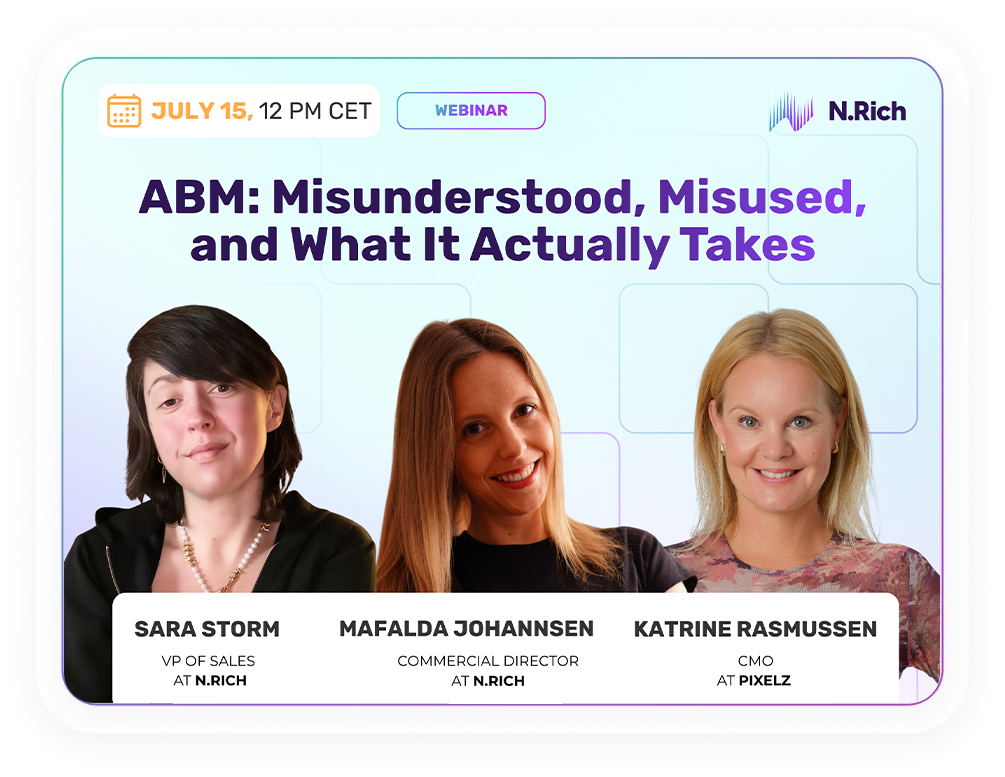
ABM: Misunderstood, Misused, and What It Actually Takes
In this webinar session, Mafalda Johannsen from N.Rich sat down with Katrine Rasmussen, CMO at Pixelz, and Sara Storm, VP of Sales EMEA at N.Rich, to explore account-based marketing. They discussed why ABM has become such a buzzword, when it actually makes sense, and the critical role of product-market fit in determining ABM success.
The speakers covered the real reasons to adopt ABM, how data reveals your true customer segments, and why sales and marketing alignment matters. They explained ABX, the evolution beyond traditional ABM, and shared insights from their own experiences scaling account-based strategies.
Transcript:
Speakers:
Mafalda Johannsen, VP of Sales EMEA at N.Rich
Katrine Rasmussen, CMO at Pixelz
Sara Storm, VP of Sales EMEA at N.Rich
Hey everyone, welcome to another webinar from N.Rich. We have one today and another one next week. We are very excited because we have an amazing guest today, Katrine, who is the CMO at Pixelz. Before we do that, I would like to do some housekeeping. If you've been in our webinars before, you will get the recording. The more you ask, the more tailored to your needs this webinar is. Don't be shy, feel free to write your questions on the chat. I might not address your question right away, but I'll definitely do it in the Q&A depending on whether the question makes sense in the flow. All questions will be addressed, I promise you.
I would love to know where you are tuning from. Are you in sales? Are you in marketing? Feel free to share on the chat, whatever you like. Let's keep the conversation open and I'll do my best to moderate the conversations going on in the chat and with my amazing guests today. With no further ado, I'm going to ask our guest, Katrine, to introduce herself.
Well, thank you very much, Mafalda. It's great to be here, even though it feels like half of the world has already gone on vacation. My name is Katrine. I am the CMO at Pixelz and I've been with Pixelz for almost 6 years now. If you've never heard about Pixelz before, we are the one place to scale your e-commerce content. If you go to a website like Zalando, Mango, or Asics, big e-commerce players, the images and assets that you see on the website have probably been either retouched or maybe even generated by us.
What we do is retouching and post-production. That's our traditional business. But recently, we've also started generating a lot of AI content for e-commerce players out there. So that was a little bit about me and just a tiny bit about Pixelz and what we do.
Amazing.
I love that elevator pitch, straight to it. That's amazing.
Straight to the point and very easy to understand what you guys do. Amazing, 5 out of 5. Sara, what about you? Who are you and what is N.Rich?
I'm the VP of Sales EMEA here at N.Rich, and N.Rich is an account-based marketing platform with amazing analytics abilities to prove marketing's ROI towards pipeline and revenue. Since we are here to talk about ABM, how it's so misunderstood, defined per person with a thousand different definitions, and misused, and what it takes to actually do account-based marketing, I needed to tell you about how I met Katrine, because we met at a dinner at one of the dinners that N.Rich arranges. If you want an invite to one, everyone listening, please feel free to touch base with Mafalda. I sat down at the table and she turned to me and said, "Hey, what you guys do is not ABM. I have a so different definition of ABM." I was like, "You're doing a webinar with me, let's discuss this." It turned out that we had similar ideas. ABM is such a wide spectrum of different types of motions, which is the point of this webinar.
The goal here is to understand when does ABM fit, what type of versions of ABM are there, what is the upside and downside of ABM, and how does sales play into this. Because ABX is the concept we're trying to evolve into, since sales and marketing need to work together. So ABM plus ABS becomes ABX. I'm super excited to be here, and I told you immediately that we're doing a webinar on this topic and it's going to be amazing.
I've been running webinars at N.Rich for 3 months now, once every week, so I've done a lot of them. My guests are always agreeing with me and with each other.
I would love to see some different perspectives.
I like some drama on the table. So let's start with the very first question. Katrine, why did you start working with ABM?
I think this is really where we need to start. ABM has become such a buzzword and everyone wants to do ABM. But just because something is trendy or popular doesn't necessarily mean that we should all do it. Also, just because you work in B2B doesn't mean that ABM is for you. Let me give you a bit of background on why we started with ABM. Sara, to your point, we actually don't call it ABM internally at Pixelz. We call it ABX for that very same reason. This is not a marketing play. ABM should not be an interesting new idea coming from the marketing team just because it's popular. Whether ABM makes sense, whether it's right for you, it all boils down to product-market fit, the type of products or services that you sell, and what does that look like? What's your ICP?
For us, Pixelz is about 16 years old now. When we first started, our founders thought they were building a self-serve tool for small and medium-sized businesses who needed to clean up their product imagery on their websites. They thought they were building a tool for product-led growth that would sort of sell itself. Fast forward to about 6 years ago when I first started. We took a real hard look at our data. At that point, I think we were at about 2,000 customers. Looking at our data, we realized that about 1% of our customers drove around 70% of our revenue.
What that means is that the self-serve small-medium business volume tool that we thought we'd been building is not actually what we built. We figured out that our biggest product-market fit was the big enterprise customers, the ones that have thousands of product images that they need retouching. From our perspective, our main point was that we're able to scale this up and down. We've implemented basically the majority of our editing with AI. We've been building AI for probably close to 11 years, meaning that we're able to scale volumes up and down. Our biggest product-market fit was big enterprise customers.
Looking at our data, if we want to grow our business, we realized we need to go out and land a few more of those whales, not focus on the smaller ones. The big enterprise customers drive volume where we have great product-market fit. The smaller ones like the Shopify segment churn all the time and they take up a lot of time. With the big enterprise ones, they don't churn. We have great relationships with them and they'll stay customers more or less forever. It was basically that realization from looking at our data, our revenue, and where the majority of our revenue is coming from. That's why we figured out ABM makes sense for us.
This was a realization that came out of a C-level strategy workshop where we said we need to go out and land the big whales. It's that shift from high volume to enterprise focus, and it came from looking at our data, looking at our product, and realizing product-market fit. This wasn't some kind of idea that came from marketing one day. The ABM switch was very much based on this C-level strategy workshop. That's why.
Amazing.
That's super cool.
Besides working in an ABM company, why did you start working with ABM?
ABM is something that I worked with way before N.Rich. When I hit management in enterprise, because I started as a rep. I have 23 years in sales and I've been on the revenue side forever. I started as a rep and moved from SMB to mid-market to enterprise as a rep, and then I went into leadership where mid-market and enterprise were my sectors. I enjoyed working with teams to build towards these named accounts and big, high average contract value contracts.
When I started utilizing ABM, I had been running it sales-led before. I've had a lot of sales teams in the enterprise space that did all the heavy lifting themselves. They marked the entire buying committee with no support from marketing, just ongoing lunches with them and events on a one-to-one basis, doing group sessions with a few customers. This was manual sales network with no real support from marketing. In a lot of companies I've been in, we had companies working in SMB, mid-market, and enterprise, but marketing wasn't ready to do anything more than the operational model for SMB. The enterprise sales teams had to do it themselves to close 4 logos a year with huge contracts.
I started working with ABM in different platforms, different channels, and different structures with events and everything that comes into that play probably 9 years ago. The reason it makes so much sense for me, even though I come from sales, is that if I can minimize churn so that my portfolio of existing happy customers grows, if I can be part of projects where I learn things that I can infuse for the sales team in their conversations, if my team can close 4 deals a year instead of 2,000 deals a year, then I will be able to spend my time really getting to know the team and the customers. We get to really know the customer. We basically know at the end of the day more about their business than any individual person in the company.
ABM was not new to me when I joined N.Rich. That was why I joined N.Rich because the concept was so well established for me. Since that was always driven with sales teams in these cases actually driving up to marketing to tell them this is the type of campaigns we want running for these specific accounts, this is the type of content. We knew so much about the segments we were working towards. It was the sales-driven motion into marketing where we basically had to educate marketing about how to do this. Once they understood the impact on what this means for their pipe generation and their pipe influence, they suddenly realized we can spend a lot more money to generate these account searches and these deals. We can really pour in money and the business case is so clear for our leadership group. All of these things just made sense.
This leads me over to what the foundation of doing ABM is, if it's going to be a fit for your business. Katrine, you're right, this is something that really is a hot topic. People look at it and think, we should do an ABM campaign. Then they try and ignore the fact that enterprise sales takes 8 to 12 to 14 to 24 months, and they do a campaign on LinkedIn for 3 months and they're like, it didn't give us anything. People, this is a long-term, long tail investment to win deals at the end of 2027, not something that will generate a deal in 3 months.
There are a few criteria for you to look at your company, the structure you have, what you're hunting after, and the strategic priorities coming from your leadership group. If you are a VP Marketing, first, you need the math to work. If you are going to do this, you need money. You can't get pocket change from the marketing side to create multimillion dollar contracts or even lower, say €300,000 contracts. You need the math of how much this will cost. You need to understand the floor of average contract value. When you sign a contract with a new customer, you can either have a high contract start value or, like Pixelz does, a high consumer value at the end of the first or second year where consumption goes up over time. This is how credit consumption works with Claude where consumption goes through the roof and suddenly you're stuck with a huge bill. This is very similar to how you can look at lifetime value of a customer or first year value of a customer. You need to make at least €10,000, preferably a lot more, on every contract for ABM to make sense. If you're under that, you're doing short transactional sales with short sales cycles and one buyer in the committee. Then this is high volume inbound that you should work on from a strategy perspective or PLG, which is product-led growth, which Katrine thought her company was building product for.
You can still do different segments. You can have SMB run as one operating model and then run enterprise and mid-market with ABM influence or ABM only as a strategy across the board for these named accounts. This is also related to the fit. You need to go towards enterprise and upper mid-market. There need to be buying committees. There need to be deals worth a strategy per account and per deal. This is where ABM and ABX sort of earn out to make sure it's worth it.
It.
And then we have a fourth part that Katrine didn't mention before that I think is crucial. This decision was made on a leadership level for you. We need to go in this direction and then everyone is aligned. Then questions related to should we really blah blah go away. You need alignment very much often already from your board because it's investment versus output next year or the end of next year. The board and leadership need to be in line. Getting pocket change to generate millions of euros in deals is not doable. If you don't have support for this, leave the company and get a new job. If you want to work with ABM and become successful, you need to be in a company that gets that. So, Katrine, you guys are working with this ongoing. Is this reasonable criteria? What do we need in place? Would you add anything or withdraw something?
Well, there are also different ways of doing ABM, but at least the way we work with ABM, we work very much one-to-one or one-to-few. When you do that, you have the €10,000 deal size as Sarah mentioned. For us, €10,000 deal size means our sales reps don't even really want to touch that. When we go all in on a one-to-one ABM account or one-to-few, I would say the deal size of maybe $50,000 USD, that's on the lower end. Preferably, if we are going to go all in, it's got to be much larger than that. We're talking $100,000 plus and for us to even put them on the list.
Preconditions, Sarah, and you're spot on, this is not a marketing initiative. If that's where you're going to start, if it's marketing that's going to drive this, it's bound to fail. This is a much bigger thing and you have it right here. It's a perfect segue to this slide right here. It's not a campaign, it's not a tool, it's really the operating model or the entire go-to-market motion where especially sales, marketing, CS need to agree on this is what we're doing. Because if there's not a common understanding about this, it's like, it's uphill to go do something else.
Agreed. That's also what will drive the budget you get access to. Because if this is a marketing initiative, then the budget assigned to this doesn't connect to strategic goals. It doesn't connect to lowering churn across the portfolio. It doesn't connect to increasing win rate, velocity, all of these things that are driven traditionally by sales. When we look at this, when we come into customers, a lot of them have tried ABM. What that means when they come to us is we've run a few campaigns at account-based level on LinkedIn, because in Europe that's the only contact layer you have access to. We do Google with keyword capture on everything and all companies. We look at companies coming to our website, but there isn't a clear handover.
I sat with a customer a couple of days ago where they said, so we have this platform on the website and I send these high-intent accounts that are coming to our brand engaging to sales and nothing happens. We need to make a strategic decision, overarching, that we're doing this and the end goal is this over here. Because if you're expecting ABX to pay off immediately, you don't understand long sales cycles. You don't understand buying window. Sales and marketing need to pick up the account that matters, work together in parallel on these accounts with marketing air support, while sales are also doing their expansion and penetration of the account. Then run one coordinated revenue motion to create demand, progress demand, and progress into pipeline, and then ongoing through the pipeline support the sales motion that is happening.
Yes, I think that's a great segue for this slide. Yes, absolutely.
We actually look at ABM as something you can utilize across the funnel all the way to renewal and expansion, land and expand. This is the net new journey. If you go back, yes, this is the net new journey, which is typically accounts that are cold versus in-market, which means that they're looking at solutions on third-party data, other websites than your own.
Our job from marketing is to move accounts from cold on our target account list to in-market, then over to engaged. Engaged for us at N.Rich means that they're engaging with our brand. They're engaging in ads, they're engaging on our website, they're showing high intent from a perspective of being in contact with our brand. Then we move them over to hot when they reach thresholds of scoring related to, okay, so now we see that sales should be more aggressive in their hunt for an exploration. And then we have pipeline, which is something that most of our customers run campaigns for, because in pipeline we have a bunch of different stages. Early stage when you do discovery and exploration, we need different messaging than what we do at the end of the journey where we need to build trust and feel like we are the safe choice. I think that this is what most companies look at when they start. Katrine, is this where you guys started from a perspective of ABM to drive more net new logos into pipe? Or did you guys start on the existing customer base?
We didn't start in the existing customer base because when we first started, we didn't actually have a lot of add-on products to sell to the existing customer base. That's something we've started more recently after we created more products to sell to existing customers.
I do want to mention on this slide right here, we try to do account selection with each one of our sales reps every 6 months. When we do that, we try to make sure that each sales rep in the tier 1 accounts has a selection of accounts that are in every single one of these stages. So if one account maybe moves from engaged or hot into pipeline, then we'll make sure that we'll move new cold accounts into the account list. When we do account selection with the reps, we want to make sure that they have accounts on their list that are in each one of these stages and then move them forward continuously.
That's extremely interesting because we have a different version of this, but we do one-to-one and then we do one-to-few. We will get to the definition in a moment. For us, when it comes to named accounts, because every rep I have in my territory gets to select 50 inbound accounts every quarter.
How many?
They get to select 50. So we look at how, and what we do then is we do a review of how many of them are in cold and then we replace them. Because cold means if we're going towards this account with the sales effort, we will need to educate them. It's going to take longer and we want to create pipeline exploration at least by the end of next quarter. That's the goal. So then we look at how many of these are in market and beyond, and then they replace the cold accounts. They select, and then we look at engagement levels, and at this point we have everything in our CRM, so they can actually take that into account when they select already, because we know what stage they're in based on the other platforms of data and enrichment we have.
The goal here is to go after the accounts that are already warming up. If they're in engaged or hot, they get prioritized, obviously, especially if we haven't had as much previous conversation. We leave the cold to in-market to marketing standalone. That's one of the things we're doing. We have a bit bigger group of accounts than you guys do. That's one of the reasons. If we want a rep to handle and do well in engaging and penetrating an account, we can't have too many, but we also can't have 4 accounts. We have an ACV of €160,000, so maybe we could actually do a lot more one-to-one now that I'm thinking about it out loud in this webinar that's being recorded. That's a discussion I probably need to have in the fall with our marketing and sales teams. That's the difference in how we approach it because of size of account list and ICP. Our target account list across EMEA is about 8,000 accounts, tier 3 up to tier 1. We don't focus a lot of efforts on tier 3. We have that list for more cold outreach when we don't warm them. We don't spend as much marketing money on them because of the challenges that you just brought up because they don't become profitable over time. The effort required is heavy lifting the first 6 months of working with a prospect. If they churn, it just isn't worth the effort we make all the way from marketing into CS and project lead and everything like that. But we have a different variation of this because we do one-to-many.
Ah.
And one-to-few to a certain extent. Okay, good. So you guys just started looking at how to land and expand. Let's move over to that slide to give an understanding of how we can work with existing portfolio. We actually do this pretty heavily because we're just launching a new product. We're also launching updates in our platform a lot, and we also have a lot of customers spread over US and EMEA where EMEA is utilizing N.Rich. In the US, they're utilizing a competitor that is US-based. That's very common, which means that the different units are utilizing two different systems, which is unnecessary. We use only us because we have good spread of data in both territories.
That's a typical land and expand that we operate on. Once we have signed the contract, we go through onboarding, we get the results, we get them engaged to a point where we can prove ROI, and then we go into an expansion-ready phase. This is supported by marketing across the board for the US committee. If we have the customer in EMEA and then we look at how to drive a sales process that comes in between expansion-ready and expansion contract signed, the goal is to get them into one platform instead of two. That's something where very often the US group doesn't know what they're using in EMEA. So it's a brand exercise. We're going through basically the same motion to wake them up from a marketing perspective. Then we look at getting to a point where it's time to, and then we can send them use cases from their own company in EMEA, which makes a lot stronger sales play. So this is how we utilize it now. We're also launching a new product, GTMOS, fully in August. That will also be part of the land and expand for existing customers. We also did a very similar cleanup that you guys did, 2,000 customers down to a core base of customers. We did that cleanup at the beginning of last year because we had a lot of ill-fitted accounts. This is very common in software because of product-market fit, because of us taking whatever we can in the beginning of the journey, and then we keep some of those even though they're way too much work and it doesn't bring them the value that we can actually bring if you have the budget to spend in our channel. So that leads to us having a lot smaller portfolio, but a lot more projects inside the portfolio, inside these accounts, which is both much more fun and much more valuable for the customer. But you guys are in the beginning. What's your plan then when it comes to this, Katrine?
As we're rolling out more and more new products, of course we want to get these in front of our existing customers. I think probably the main difference here in the way we work is the people that we work closer with are obviously our CSMs. They're the ones who know these customers extremely well. We do have probably about 50 large enterprise customers that we have strong relationships with and that we know really well, or at least the CS teams know very, very well.
This is where, of course, the benefit is that we already have a ton of knowledge about the customers because we already work with them. We know which products they already use. We know what type of products they have on the website and what they're planning. So when we can, we try to do much more personalized campaigns. When I say campaigns here, we do run sometimes even one-to-one campaigns on LinkedIn to just one specific customer if they're large enough. Of course there's a minimum audience of 300. I love that when we can get as small an audience as possible, because then we know we hit the right people within the right companies. Sometimes we can even just launch a campaign to one particular company. I love that.
Our main way of working with this is basically through our events and through webinars, especially events. We do customer sessions where we get 5 to 10 customers in an area into a room with us and with each other. Then of course we spend that time talking to them, talking about the industry, what's coming, but also of course showing them the new stuff in our platform and our new products.
But this is the thing, that's a marketing effort. We work together with CSM and AM if we have that, we work with our CSM a lot. They dig up needs and then we go in commercially and discuss them. It's not that we don't do that too, but events, group sessions, dinners for customers, all of these things are event and marketing related. So this is how we can run marketing through this expansion too.
I also see this coming much more into play for SaaS right now for one specific problematic challenge we have in front of us, and that challenge, I can give you the clear realization we had probably 4 months ago when we started seeing net new pipe and churn coming from the entire buying committee that we had good relationships with being fired. So we're in an environment right now where a lot of the people that we have these good relationships with, even on net new where we have expanded and penetrated the people, if they go away, especially if it's a customer, then our relationship is dead. The problem is that even if you multi-thread today, this will still happen. I had a customer in the US who lost 25% of their entire staff. Everyone above my champion got cut. I was just lucky that she remained.
When we are in situations like this, and this will happen more and more, like the tech layoffs is one thing and we're probably all aware of that if we are in the tech industry, but outside the tech industry, this will catch up to the manufacturing industry and other industries that are more traditional, because we have an environment where buyers are risk-averse to any cost right now. This leads to us having less revenue coming in, which leads to us having challenges with how to maintain project lines of cost. It comes down to P&L. What will be cut? If what you're selling is one of these easy-to-cut solutions, you need a clear strategy for existing accounts because otherwise at the end of the year when it's time to renew, none of the people that you had relationships with might not be there anymore. I'm sure this is related to industry. Katrine, do you see this for your side as well, or is it a more stable environment for now for what you guys deliver?
Well, to some extent. We are definitely seeing a big disruption within the industry from AI, of course. But the thing is, every single image that you see online has been retouched. So we're not part of something they can just cut. Of course they can cut, but then they would go to someone else.
And if they cut, they might actually end up losing money on that. So you are a revenue driver. That's the difference. I think for us it's the same, but when that new, it still presents a problem. If you prove your ROI times 5, times 10, because if you don't retouch and edit images on your e-commerce, you won't sell as much. So eventually that will lead to money drainage, which is a risk that especially now, putting a new vendor in, if you don't feel like it's tested and proven. So you are sort of in a safe space because you guys are generating revenue. At the end of the day. And this I think will be a fair question to ask internally in your company, are we really that important? If you're not, time to pivot. We built a new product to meet this. We changed our commercial models at N.Rich and went from contracting ad spend into not contracting ad spend. This was a way to meet a risk-averse market. We need to adapt to be able to survive these coming years and to be able to thrive in this environment. But that's super interesting to hear. I get what you mean. I see it.
Let's move to the 3 ways because we've mentioned these already a couple of times in the first half hour. The one-to-one, one-to-few, one-to-many. Let's dig deeper into this topic. Let's start maybe in the one-to-one. Katrine, you're the one doing one-to-one.
Yes. I think this is probably something, Sara, you touched upon in the beginning. How I barely think that one-to-many can be called ABM, at least the way a lot of companies are approaching it. For me, and it's something Sara said, you said the word relationship a million times on the last slide. I actually think relationship is probably maybe, at least for us, the way we're running ABM, the most important word here, because for the type of sales cycles that we have, for the type of deal values that we are looking at, just proving that we are the best platform with the best features or the cheapest one, usually that's not enough.
What we have continuously found over the years of doing this is if we want to close those very large deals, I'm talking a couple of hundred thousand deal value deals, the platform, the price, it's usually not enough. Often what it comes down to is the relationships. That's where the one-to-one really comes into play, because for a lot of the stuff that we do in marketing, a lot of the stuff that we help support with, is being able to build personal relationships with these people. When we work with one-to-one, our reps usually have, we do account selection once every 6 months. Some will stay on the list, some new ones will move in, some will move out for different reasons, could be close won or close lost. Anyway, the sales rep might have somewhere between 10 and 15 accounts on his list for that period on the tier 1 list. They will also have a tier 2 list that works in a different way.
On the tier 1 list, there might be somewhere between 10 and 15 accounts and each one of them, because they're in different stages of the sales cycle, will have a different goal. The goal is not just to close that business or to win that business, because that's not going to happen for a lot of the ones in the earlier stages. The real goal for a lot of these accounts is to get in front of them, to meet face to face, to build that initial relationship, to actually get to know them on a personal level, the main decision makers. That comes back to a lot of the things we talked about before. It's actually a lot, we call it ABM. A lot of this is like good old-fashioned enterprise sales. A lot of the tactics we're using are not necessarily new and fancy or anything. But we did wrap them into a package that we like to call ABX, because it's not only sales-driven. We've added marketing, we've added maybe CS, we've added new things on top of this, but all of those things we've added is really just to help that sales rep build those relationships. When we build those relationships, that will help the sales rep with the ability to book a demo, to do a pilot, to do these things. That's really to speed up that process and build the trust, build the thought leadership, build all of those things. That's how we like to work with ABM.
For us, it's about the relationships. It's about getting to know the person. So when I hear people launching campaigns to thousands of companies and calling it ABM, I'm like, that's not ABM, that's just targeted marketing. It's just good old targeted marketing. Because for us, it's a much more personalized approach. We'll actually sit down with the sales rep at the beginning of this process. We talk through each one of the accounts. We expect both the sales rep and someone from marketing to have done a little bit of research. For some of them, we don't know very much. Some of them will just have signals. A signal could be a job ad for a retoucher and that's all we know. But for some of them, we've met them before, we got to know them before, we know what their pain points are. Based off of that knowledge, we'll build out customized account plans for each one of these accounts with different goals. Goals could be like I said, an opened email, a call. A goal could be get them to an event. The goal could be get them out for lunch. A goal could be start a pilot. A goal could be add them to pipeline. A goal could be to actually win that business, depending on where they are in the sales cycle. But it'll be customized on an account basis. That's how we work.
And I think, yes, go ahead, Mafalda.
My follow-up question is, so we talked about one-to-one and we also have one-to-few, Katrine. What's the main difference between the one-to-one and one-to-few?
For the one-to-fews, we don't talk through each one of these accounts. We don't do personalized account plans for the one-to-fews. I think right now in the one-to-fews, each sales rep probably has maybe 50 or something accounts. What we will do though is they will be invited to the events. We will do maybe personalized sequences for the webinars. We will do stuff that we still really actually want to build those relationships. They could be a bit warmer, but we don't do personalized account plans for each one of them.
For the one-to-ones, we might actually fly them into an event. We might pay for their flights, their tickets. We might invite them on as a speaker. We might get them on a webinar. Again, it's that thing about like personalizing, like getting that relationship. For the one-to-few, the one-to-few could also be based off things like industry. Most of ours are within the same industry, but it could also be based on where they are in the sales cycle. We could launch different campaigns based on that. But for the one-to-few, what we do is we do launch thought leader ads on LinkedIn, where those ads are coming from their sales rep, the person that we want them to get to know. So that's a bit also more personalized approach when it comes to the marketing. For the wider one-to-many, we also run campaigns, but it's not personalized like that. So it's a bit different.
I love that. I love that. I just sat here thinking about our model internally at N.Rich because why wouldn't we share about how we work too. Now that I think about it, we actually do one-to-few and one-to-one too, but we do it sales-led, we do it sales-led besides the thought leadership ads, because those we do as well. Those are very tailored to specific individuals that already have a reach inside the accounts. Because this is a great way for us to start engaging them. I think that the relevance here is that you can do several motions. You can look at stage of buying committee journey, where they are, and you can decide. So we have 50 target accounts or named accounts for each of our reps in Europe, while we also have 8,000 accounts that are in the total target list. When they move in the journey, we can move over to a more sales-led one-to-few or one-to-one type of approach. I don't mean sequences. I will explain a bit more on the sales day what I mean, because sequences is overused and underdeveloped and horrible. Most sequences coming to me are just, I want to die when I look at it.
I don't even open them.
I do because I'm trying to understand the market situation on the sales side, because I'm like, what is happening? We have a new role and everyone did. I now have 16 emails related to my new role even though I just started it and I have no idea what we need yet. So moving over to the one-to-many, guys, I have a poll now that you can look at under the poll section about what type of ABM you do. There is an option that says all of the ABM versions. There's also one that says no ABM efforts like now for now. Please feel free to fill that out because I'm super curious. It looks like 67% so far, 50% so far do ABM one-to-many. We went down to 44 now. Okay, so 44% does ABM one-to-many, 22% does ABM one-to-few, 20% does all of the ABM versions, and 0% does one-to-one. Let's see if that changes when we go into the structure of Salesforce.
One-to-many is just to talk about the upsides and downsides because there are both. ABM one-to-many is something we do on our entire target companies. So 8,000 accounts across Europe, based on tiering, we do different messaging based on stages. We do different messaging and we feed that with third-party and first-party intent, both from the DSP that N.Rich has, but also other sources because we have 13 intent providers of different kinds because they're coming with different information. The goal is to personalize at segment level, like industry segment, and looking at the stage they're in, and then in the content we work with, we base it on buyer persona clusters. If I do an ad for you, Katrine, I would not talk about the operational layer of running campaigns. I would talk about the ROI of running one-to-many ABM campaigns. This would be my conversation, how to manage leadership delivery, ROI, money on the table, all of these things that probably matters to you a lot more than it does for a marketing manager who's doing operational stuff, who has the KPI of how many clicks we generated. It's a different level. Then we also do for the team. We have 12, 13 people often involved in our buying committee. We have the CRO cluster and the CMO cluster, which is C-level. We have the VP cluster for both sales and marketing. Then we have performance marketing, campaign managers, all of these people who are running the more operational, the end users basically. We do ad campaigns with ads addressing different people because it's account level, because we're in Europe and we're all compliant and stuff. Both on outreach and LinkedIn, again, the only channel we can utilize on a detailed level. This is an extra channel that we need to be able to use or whatever other channels you find. Maybe you do display on chosen publications, whatever you do.
So the upside is that this scales a lot across these accounts. It's a very low cost per account. We can live with €15,000 in deal size. That's okay because we're spending less. It's also built for demand creation. We need to move these accounts and we're not only capturing. It's about capturing and creating across a bigger list. It also surfaces in-market accounts for our salespeople to prioritize. The downside is that this is the least personalized of all three versions. The effort we put in is a lot less comparatively to one-to-one, where we need to know the account, we have an account plan, we know their strategic priorities, we know how to connect with different buyer personas, we can talk about specific campaigns for each of them. It's only as good as your data and your list. If the list sucks, you will go back into spray and pray, or if you say targeted marketing. This is a very common trap, which is where content, ad content, really matters. Landing pages per industry vertical really matters. Where are we sending them? Because ad delivery is only as good as the ad content and where it, at the end of the day. You need to actually have a strategy. There needs to be a plan here. We can't just run LinkedIn campaign and hope for the best and be like, oh, in 2 months we will have money. It's not going to work like that. That's the framework of one-to-many. But again, I think we're doing all 3 of these. When it comes to these channels, I think that's the next discussion, Katrine. How do we work with this as an ABX ecosystem? This I know you are all on board with. You guys are running events and webinars, you guys are running all of this. Let's talk about how you guys run and then I can come with input because we have 12 minutes left. Go ahead.
Yes. Sara, just back to your, to sort of like the title of this webinar, that's probably like the one-to-many. If all you're doing is running digital campaigns, even if it's uploaded to with a list, that's probably where I'd argue you're not really doing ABM. That's just marketing. I'm not saying it's wrong. I mean, it's probably the right choice for a ton of companies who don't run enterprise motion. I'm sure it's effective and it works. But if that's all what you're doing, it's not, that's just where I'm like, that's not actually ABM. That's just marketing. Anyway, looking at some of the tactics here, sure, digital media spend. We do that a lot and of course we utilize LinkedIn a lot for that, just to be able to personalize and target it as much as we can.
I think thought leader ads are especially useful, at least from my point of view. When I look at LinkedIn, when I judge the campaigns and whether they're working or not, I don't really look at LinkedIn as a lead factory or really expecting LinkedIn to bring a lot of leads through. For me, it's very much a brand awareness, thought leadership channel. Then of course, I'll go into my attribution tools and see if LinkedIn played a role in the buying journey, even if that was 2 years ago. That's fine. Even if the link didn't come directly from there. As long as we get in front of the right people, that's my main objective when it comes to LinkedIn. It's not actually to drive leads. Physical and online events, that's where we spend a large part of our budget and time and resources. It's basically just because we need those. We really want those face-to-face touch points because we want to build those relationships. That's one of the places that we do that at our events, the physical events. We'll do a couple each quarter and we'll be very, very, it's invite only. We approve everyone who comes there. It's more important that it is the right people, the companies that we fill them up. Super important.
We also spend a lot of time before the events to go through, we literally create decks where we'll go through each one of the accounts attending, who's coming, who are they, what do we know about them. We'll sit 15 people from Pixelz down and we'll do quizzes on these. We'll have a plan for who talks to who at the events. It's not just throwing off on events. It's like strategically making sure it's the right people there. We get the right people in front of the right people at the events and we do a lot of follow-ups as well. Very, very strategic approach to the accounts in terms of both customers and target accounts.
I think accidentally that's how you ended up at a table with me in one of our events, just to be clear. So this is, Katrine is now in the flow of eventually, because I need to get into Pixelz eventually. It will happen even if it's not this year. This is one of the, like, just to give a concrete example. We have invite-only events too. I approve, I put together the guest list and who has assignments in my team to talk to who, and then I place based on role and interest level. We have our CRO joining our CEO, we have the CMO people who are on the CMO level, they're often sitting with me, and then we have our reps in different tables. We do small events, 15 to 20 people. You are a perfect example of how this operates, because suddenly we've had a relationship before we didn't. That's how we build, and the steps that take or that come after is a different thing. And before that and after that, we continue doing marketing because we have this, and this is again, we have our 50 named accounts. When we do events, we look at them, which is one-to-few as I see it. We look at them to get them in. We personalize our invites, we do a lot of follow-up, we make sure that we continue the relationship, even if it doesn't lead to anything this year, because again, sales cycles, maturity, where the company is at, are they ready, are they not ready, which are all fine things if you have agreed on leadership level that you're doing this. If you haven't, the expectation is 3 months in will be where is the results? That's a problem for running ABX.
The account landing pages and the content and sales place and stuff, you addressed the sales place a bit, like from account owner, doing the efforts of actually talking to this account, building the relationship one-to-one. Have you guys gotten to the account landing pages yet, or how does that look for you guys?
We don't actually work with that, but I think that's also because our, we do very much one-to-one and personal relationships. How, yeah, but what we do do though on the website is that we have, depending on whether you're a target account or not, you'll get routed completely differently through our website and you have completely different availabilities in terms of like booking meetings and our sales rep calendars and stuff like that. We do treat target accounts very differently from just any visitor to the website, but that's more in terms of what are they allowed to do on the website? Are they allowed access to the sales rep, direct access to the sales reps? But no, we don't do account landing pages. Do you do that?
We do. We do. And it started as a sales play in the funnel to support our ABM motion. You don't need to go forward because I don't think we should only address this as an example. So when an account hits engaged for us and they are on the named account, we will go into Lovable. The reps do this, go into Lovable, put your research into all of the things we normally prompt in Claude, and then we get research and put it in Lovable. The sales rep does this on their own for their account that they own. They put all the research in, they create a tailored landing page calling out the company. In your case, it would be, hey, Pixelz. Then we have segments for each buyer persona that we're looking to target with callout of their titles. The goal at the end of that is a calendar booking to book a working session with the rep to run through what is your current state, how can we support, here are a few of the ideas we have. We share the POV we have based on the research. This is something that we have as a sales play. We're now looking to implement this at scale through the marketing so we can run marketing campaigns that leads them to a specific landing page for buyer persona cluster based on the ad content and the ability to book straight through. Because our goal at the end of the day is to have marketing own the entire bucket all the way to booking. That's our goal on these accounts. This is something that we're doing and testing now. The result of these things are incredible. People feel so special and they feel so related to the actual connection to our company, our brand, which is the first step, and also to this rep because we have an intro of the rep and the background. We only have senior reps. We have reps in my team that are as senior as me. We're GTM seniority people. We're not reps. We're actually like, we could go in and consult on a company level. I think this is super important if we're going to have like one-to-one and want a few, we need to offer competence to the table. We need to be able to have a POV, built on that competence when we do research. This is super interesting and I think you guys should definitely do that as a test for the salespeople to actually run. But we have 5 more minutes now and I want to ask.
5 minutes, so let's wrap up.
Yes.
Yes. Katrine, this one is for you. If you were to talk to a CMO now who's like, oh, I want to do ABX, they have never done ABX before, they've done a few campaigns, but they don't even fully understand the concept besides watching this webinar, what would you advise them if they're building, they're starting in H2 this year, they're trying to build foundation until 2027 to run this fully? What would you advise?
This is probably a bit of a boring one, but when I look at this and I think about this, it's really I would have to go take 3 steps back and say, look at your product-market fit. Start with your product-market fit. Don't start with ABX. Look at your product-market fit, your product, your data. Does ABX make sense for you? That's where I would start. If the answer is yes, what if they're looking to go upstream?
Let's say they have no customers in their portfolio that are a good fit for it, but they're looking to go upstream to higher contract value. They're looking to build product as they go to fit this new market. Would you still give the same advice since if they don't have it in the portfolio, because it's very common for our customers to want to go upstream even though they haven't before? If there is a foundational product fit, they can build the product out fitting these customers as they go through projects with customers, as they bring them in and like, you're a design partner, let's build to fit you. We will launch into other customers as we go. Would you still have the same advice? Or would you advise something else?
If they already decided there's product-market fit, that ABX makes sense, then my next advice would be have patience and make sure that everyone on your team, leadership, even the board level, understand what are the sales cycles we actually looking at here and have an understanding of that. This is a fun little anecdote. The first time we ran one of our bigger events, that was like a couple of days before COVID came, shut the entire world down, meant that we could not run a single event for a year and a half. That year and a half gave us the time that we needed to actually evaluate that event and the ROI on that event. If we'd gone back and looked at that event after 3 months or 6 months, we would probably have concluded, oh, events, they don't work for us. But you need patience. You need faith that in maybe a year or a year and a half, you'd be able to see the outcome of your efforts. If you have a new CMO every 12 months, if you change your ABX or your strategy, your go-to-market strategy every 12 months because you become impatient, then you might not even want to go down this route from the get-go.
People are doing this per quarter, right? People are doing this changes review per quarter now. I think the CMO stays for 14 months on average. You can't succeed if you're in a company where you're looking to build foundation. You won't succeed with your KPIs in that short of a time. It's so interesting. We did a revenue review on our events the last 2 years now, like I got it yesterday, and our events influence 80% of our pipeline. Are they the only attribution point? Absolutely not. Because ABX is also about a combination of signals floating into the account over months and months, right? And eventually, like with you guys, 20 to 27, the customer is ready to buy. This is where we get to, because otherwise we won't be able to prove ROI. So 3 months after an event, the only thing we can look at is how much extra engagement did we get on the accounts? How much more did they start engaging with our apps? How much more did they start engaging with our content? How much more did they start downloading potentially of the content? How good was the follow-up? How much conversations did we get from that? But we cannot judge pipeline quality or pipeline close-to-one on this. That's it. Set the expectations and make sure we're all aligned. Otherwise, leave the company. That's what we agreed before. But make yourself able to succeed.
Yeah.
I think that's a great way to finish this webinar on a very high note. Thank you so much everyone who joined. Katrine, thank you for joining us, Sara for speaking once again. As I mentioned at the beginning, we have another webinar next week, so we are not going on holiday yet. I hope you join us there. If you have questions that you haven't asked us, you can find Katrine on LinkedIn, you can find me on LinkedIn, you can find Sara on LinkedIn. Don't be a stranger, we are super happy to answer any questions that you thought about after this webinar. There was a lot of information, so I understand if you need to digest and then come back to us. Don't be a stranger and do so. Sara and Katrine, thank you so much for your input today.
Thank you very much. Thank you so much.
Thank you.
Want to learn more about how N.Rich can help you?
Book a demoCreate more pipeline and prove where it came from
Book an N.Rich demo and see how it works on your own data.
Book a demo