Ready to become an N.Rich AI builder and get paid for it?
Replay
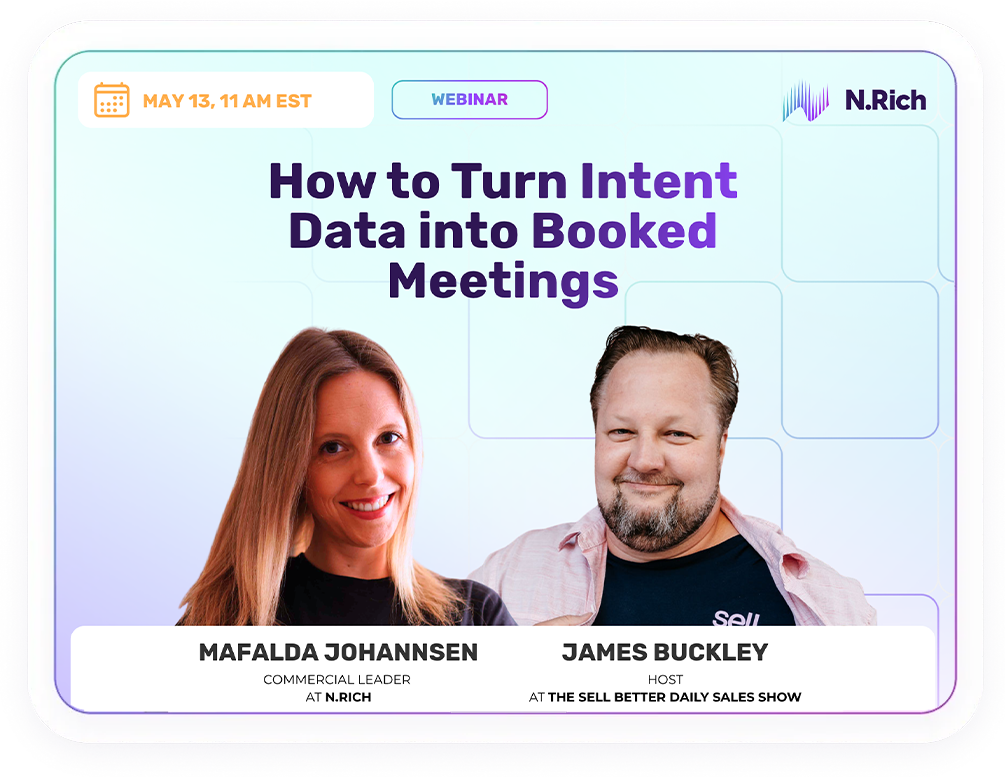
Webinar: How to Turn Intent Data into Booked Meetings
In this webinar session, Mafalda Johannsen and James Buckley discussed how to effectively turn intent data into booked meetings. They explored intent signals across different platforms, how to identify engagement patterns, and the critical messaging frameworks sales teams need to convert prospects into pipeline.
They covered the common mistakes salespeople and marketers make when pursuing intent signals, including missing the "so what" in messaging, overlooking engaged prospects, and failing to differentiate messaging strategies. Watch the full recording for actionable tips to implement immediately.
Transcript:
Speakers:
Mafalda Johannsen — Commercial Director at N.Rich
James Buckley — Host, Sell Better Daily Sales Show
Good morning, good afternoon, good evening everyone. I'm so happy today because I'm joined with an old friend. Before introducing myself, I want to do some housekeeping. Feel free to let us know where you are from and see if we have some matches here. My name is Mafalda. I am from Portugal but I live in Germany. I've joined N.Rich a month ago as the Commercial Director, and I'm super happy to be here speaking about prospecting and ABM.
James, we've known each other for a long time and it's been a while. Super excited. I remember there was a year that our first ever meeting on the 2nd of January was both of us. Remember that?
I do.
Tell us more. I know a lot of people know you, but how are you? Who are you? Where are you?
I'm doing well. I'm in the US. Shout out to everybody from East Tennessee or the Great Smoky Mountains National Park. It's definitely not the bedrock of technology and software—a little bit more rednecks and hillbillies—and I love it here. It's a very slow lifestyle. I'm originally from Miami, Florida.
Thank you, South Miami.
Huge culture shock when I moved here. But I will say that it definitely was a needed culture shock. I'm glad to be here in this slow lifestyle compared to the big city of Miami. Always a hustle down there. I don't miss it. I host the Sell Better Daily Sales Show. What we do is bring in sales practitioners and sales leaders to share their best tactics—what's working for them, the mistakes they've made. Folks come to the show every day to learn how to be a better salesperson, hit the leaderboard for the first time, figure out a new tactic that helps them book more meetings or close more deals. If you're interested, check it out at sellbetter.xyz. It's totally free for anybody that wants to come.
I really recommend that show. I've been following Sell Better for many years and it really helped me as a seller. If you want to improve your sales skills and marketing skills, definitely follow the show because it truly helped me. Speaking about cultural shock, I lived in Florida for 2.5 years. I did my master's at UCF.
Go Gators.
Coming from Europe to Florida, you can imagine my cultural shock.
Florida is like another country all by itself. They say that when you go far enough south in the US, you wind up back up north.
Thinking about north, we have Fabien from Toronto, up north, and Mia from Finland, also up north in Europe. I think we are going indeed up north in this webinar. Before we start, James, I'm doing what you usually do at the Sell Better Show, so rest because I'm doing your job today. The recording will be available after if you have to jump earlier, but I hope you don't because we also need your questions. We have an agenda and will talk about hopefully a lot of insightful things, but the more you ask, the more interesting and tailored it will be for you. We will address questions during the webinar or at the end if they don't match the flow, but I promise we will go through all of them. If we don't reply right away to your question, it doesn't mean I'm ignoring you. We're going to take care of it at the end. I'll show you our next webinars at the end, but follow N.Rich and follow me because we are doing webinars quite often. Like Sell Better, they're all free. Bring questions, bring your energy. We are here to help.
Today we will talk briefly about intent signals because each person has a different understanding. The first part, I won't spend much time in case it's too basic for some of the audience, but I still want to make a short refresher on what intent signals are. Then we will go through the common mistakes that salespeople and marketing make when going after these signals, making sure that all the money and energy that we are putting into warming up accounts turn into pipeline that turns into deals. James will give you a lot of small tips and nuggets that you can apply tomorrow or Monday morning. We have Rafael from Montreal, and you have a Portuguese-sounding name, Rafael. Very nice mix. I'm not going to spend a lot of time on definitions, but I want to recap what intent signals are.
Intent signals depend on which platform you're using. I'm basing my explanation on the N.Rich platform, but basically you have different kinds of engagement. You have people visiting your website and articles. You have people researching you, your competitors, or topics related to your company and the problems the company solves. You can get signals on where these people are researching from. You also have engagement with your ads, articles, and videos. Each one of them shows some sort of interest in whatever your company solves.
When you mix it all together—visiting the website or researching topics—it gives you a score for the company and shows how hot or cold they are. Cold means they have no interest in such topics, or at least they don't show it yet. In-market means there are early signals, they're maybe looking for something related. Engaged and hot means the depth and level of interaction they have with your website, content, and topics. James, what are the main mistakes you see when intent is generated? The salespeople know more or less which companies are going after the topic. What's the first mistake you see?
There are a couple of important things to note when we talk about cold. Let's run through a couple of points. Sellers today often don't realize that most things are not 100% cold. You call it cold because it's their first message. That's the real definition of cold—they're not expecting to hear from you, but it's not totally cold if you're using intent signals or some trigger that's relevant. There's a thing causing you to send the message. The mistake we make in those true cold first messages is saying "I saw, I noticed, I've been watching," but we leave out the so what. If one of your triggers is funding, you might say, "Hey, I saw you got that funding. Congratulations on that round." But then immediately you pivot to, "We do the following thing and this is how you should spend that money." This is a very common message from a new SDR or less experienced SDR, or even an AI-driven message that doesn't have years of experience or training or context to not start a message this way. We have to train our AI solutions to not write like a newbie.
In market, I've heard it said that only about 3% of your total addressable market is actively looking for a solution like yours. That means you've got to be listening and socially listening for those triggers and using messaging that actually encompasses those triggers. Don't leave out the so what that I mentioned earlier. Engaged is probably the lowest hanging fruit for sellers that's often overlooked. The reason it's overlooked is because almost every real leading seller at companies is a content creator at this point. We write posts, create videos, do little webinars like this one. We do all types of things to get attention from our buyers, but then we don't go mine that information. We don't look for people we're not currently connected to. Are they leaving comments? Is this a person I can sell to? That's the first real interaction we can use to our advantage. They know me, they're familiar with me. I can't tell you how many cold calls I've made where people say, "Oh my gosh, I've been to your show. How can I help you?" This is why we have engaged prospects.
Then there's the lowest hanging fruit, which is the hot ones. These are form fills, people visiting a website. The mistake we make with the hot ones is that we don't know the difference in messaging between somebody that visits our website and somebody that visits our pricing page. Those are very different messages. If we're not self-aware enough to know that messaging has to change, the mistake is that we have this blanket message we want to use, thinking it will work at 70%. If you're lucky, you're getting a 30% reply rate with any canned message at this point, and that's top performer status. I'm seeing reply rates that are 1% to 3% to 5%, and people are ecstatic about this depending on their average contract value.
That's a good summary. How would you then approach it generically? If you see someone researching, for example, ABM platforms or some topic related to your company, and in Europe, as you know, because of GDPR, the company is looking for it but not who that is because that would be super non-compliant. How would you go about it generically, without speaking about triggers yet?
First of all, depending on where you are—lots of people joining from different countries and locations—it does make a difference. You need to know your spam laws. There's the CAN-SPAM Act in the US, CASL, GDPR, and so many different spam acts you need to know. There are solutions out there that will show you exactly who's visiting your website and allow you to reach out to them directly. Go use those if you're not violating any compliance issues. But let's say that you have this generic website visit. You should know the ideal personas that you sell well to. For me, a generic message looks something like this: "Hi CMO, CRO, demand person name. It seems like lots of folks are visiting our website from your company, and someone at X company has been visiting our website and even gone as far as to visit our pricing page. I think there's a conversation to be had. What problem are you looking to solve?" That's my call to action in my first message. It's small enough to fit on my phone where most people are answering emails. It's going to be one of many messages. I'm not trying to sell them in my first cold message. I'm trying to identify a qualified prospect.
That's a great point. I see even experienced BDRs and salespeople making the mistake of trying to sell in the first message, and worse, sometimes they try to sell in the subject line.
CEOs tell their reps to do it. It's amazing how many CEOs or leaders will hop on a call where cold messaging is happening frequently—every 2 days—and they want to criticize it, saying, "You're not talking enough about our product." But we haven't even had a conversation. I haven't even gotten a reply yet. It's like asking: do people buy directly from the guy standing outside of the comic book store swinging the sign saying, "Come on in, 20% off today"? No, they don't buy from that person. They go in, they enter the threshold, they actually engage. I'm passionate about this because it's frustrating.
That's the same sentiment. This is something we could touch on for another webinar, but a lot of leadership—people giving directions—don't know that things have changed since they were individual contributors. They are giving directions that are completely wrong. We have a question from Raissa: "I have responded to one cold message in the last 3 years. Would this still work in B2B?" James.
Raissa, you represent the norm. Most people do not respond to cold messages. If you look at any leader's inbox right now, it's littered with AI-written messaging and automated messaging that contains triggers and signals. AI has taken big leaps forward to a point where leaders are actively avoiding their inbox. Raissa, she doesn't want to spend all day answering cold emails. If every leader entertained every call from every seller, answered every email, responded via LinkedIn DMs, they would never actually lead anything. No actual leadership or work would ever be done. It's unreasonable for us to believe that our canned message is going to make it through, that our generic template is going to make it through. Raissa, I'm curious to know what cold email did you receive that got your attention?
I was about to ask. I'm quite curious what it was.
That's the thing, right? That's why intent signals are so important. Instead of going after companies that we don't know if they are looking or not, how about we prioritize the ones that showed some type of engagement, even low to medium, not just pricing, which is a high one, but maybe just engaging with one of our ads. James, why do you think salespeople are sometimes not prioritizing these accounts? What is going on there?
What's the signal that's tying you to that account? I want to make sure I understand the question correctly. Yes. Prioritizing signals works like this: data collectors win the day. If you have a list of signals that you know are active signals that lead to conversion—whether that's conversion to booked meetings or conversion to momentum in an existing deal—then you should be looking at the data. What message did I use that referenced which trigger that led me to get the response, the desired result, the forward momentum? If you're an account executive trying to move existing deals forward towards closing, and if you're an SDR looking at signals to book meetings, you're looking at the ones that are most successful. You're scoring the ones that are most successful by giving them points. It's as simple as using a spreadsheet. If you want, you can write agents that do this. We can talk about agentic AI if you like. There are 1,000 ways to become a data scientist and leverage the right signals at the right time. I want to point to Raissa's response here.
I was about to say that. Would you like to comment on Raissa's response?
Raissa responded and wanted to let us know what it was that got her attention in the one email she responded to in 3 years. Canva reached out and said that 75 people from her company were signed up and only had their marketing and recruiting team's seats procured. They got in touch with the CIO and might have been free accounts, but it got them the meeting and they were likely to move to Canva Enterprise as a result. The trigger they used was that 75 people from her company were actually signed up. That got her attention. If you guys are creating content out there and you're seeing the same company's people jumping in, and you know you sell well to the CIOs at that company, that's the trigger. You would reach out and your email would begin with, "75 people from your company have come to my XYZ. I think there's a conversation to be had here. Let's talk about the existing account and what we can do to expand, or let's talk about getting a meeting on the books to talk about how we can impact X, Y, and Z." This is trigger-based selling at its finest. Raissa, thank you for playing.
That's a fantastic bridge to our next topic. But before we go into that, I have one remark. It goes back to why it's so important to warm up accounts and have brand awareness for when you book meetings. Canva, everyone knows Canva, right? Not only do you have the excellent trigger, but you also have strong brand awareness behind it. Imagine if it would be a competitor of Canva that you never heard of. Maybe you'd be even concerned that so many people would be there because of privacy concerns. But we never know because we cannot have two realities at the same time. This is also why it's so important to have marketing warm accounts because there's a huge difference between prospecting someone who never heard of your company before or someone that maybe saw an ad that the person interacted with and doesn't remember anymore, but it sticks there.
Marketing teams that are winning right now are finding ways to serve up triggers on a silver platter to their salespeople. Never before has it been easier to build systems that feed triggers over to your sales team. What do salespeople often struggle with the most? A reason to talk to a stranger. That's it. If marketing teams are out there collecting with lead magnets and all these things and you're not feeding that down to your salespeople—"Hey, this person downloaded this whitepaper, this person came to this webinar, this person engaged with our social post, this person is a qualified prospect at X company and they left this comment"—if you're not doing this, your sales and marketing alignment is probably still like 2019. It's time to step forward and create the system that feeds over to the other side. Otherwise, what are you doing? You're generating meaningful interaction that doesn't lead to revenue. The salesperson has to be the finishing part. It's an incomplete equation if that's not happening.
Before we go into triggers, which is the part I personally like, there is a very interesting question from Rafael: "How do you manage automated processes for personalized messages?" One-on-one approaches are easy for that, and we've been talking and will be talking more about one-on-one approaches. But before we do that with triggers, do you have any tips for this, James?
I actually have a person you can go follow that talks about this regularly and does real walkthroughs of how to build this type of stuff. It's Jed Marley. Jed Marley is probably the king of practical application for building automated systems that go from A to B to C in front of a sales human. That guy just understands the game. Can I drop Jed's LinkedIn in this chat?
Everybody should be following Jed to learn from him for his newsletter, which is Prospecting.
Jed, I call him the young phenom because he totally skipped the standard education that we're all familiar with and went right into SaaS sales. I'm dropping his LinkedIn right now for everybody to follow. Definitely check this guy out. He does so much content around building these systems, and now that's his actual business—helping people build this stuff. Please go follow and connect with Jed.
I mentioned Jed in the introduction of my prospecting book in Portuguese, and I tell this story because he's really someone you should follow. A remarkable young man who impresses me every day. Before we go into triggers, there's another really good question here: "Most intent signals today are noisy or too broad. How do you distinguish between research intent and actual buying intent that's worth SDR engaging?" That's a fantastic question. I love this question.
There's never a more pertinent question to ask at a show like this that's about signals. Here's the key: once again, become a data scientist. You want to prioritize the things that get the desired outcomes, not just for you, but for the people you're trying to help, the people you're selling to. Build your system. If it's a spreadsheet, fine. If you're of the new age, build an agent that will collect the signals and triggers you're using and filter out the noise. Anybody that's ever cooked—I cooked for 15 years for a living—a strainer is what's needed here. If you've ever made something that has a lot of chunks in it and you need to get it out, you pour it through a strainer. That's basically what you're doing here. There's a lot coming in. What you need to know is the stuff that matters. You need that to be the stuff that makes it through. You can make agents with things like Agent AI, Claude, ChatGPT. These types of things are what you can build. I'm not throwing shade at ChatGPT. I use it every day. But like there are systems you can build these agents with and you can collect the data and you'll know which signals to let go because it's kind of a signal rather than a trigger or a trigger rather than a signal. You should know the difference between those things. A trigger is something that gives me a reason to reach out. A signal is something that tells me that this is moving forward. Intent is not the same as a signal or a trigger. Intent means something a little deeper. There are variables here to be considered.
I would add to that, and hopefully—and I say hopefully because unfortunately it's not the rule—but hopefully your company has an ICP defined with tiers. From all the signals and intents you receive, which ones are your tier 1? I can assure you it's not even half of them. Right there you have a reason and a way to prioritize.
It's going to be different for everybody. One trigger that works for somebody that sells in construction, for example, is not going to be the same trigger that sells well in finance. It's hard to say in a general sense how to prioritize. We have to find the ones that work and prioritize those, and that takes trial and error, A/B testing, and then measuring the results. We have to become data scientists to figure that out.
That's a great way, and I think that's the shift. This is a bit out of topic but within the topic. Sales, BDRs, and whoever you'd like to call it depending on your organization who goes after opening new business—unfortunately or fortunately—we need to start being data scientists and engineers. That's a new skill or a perfected skill that we need to have in order to be good at our jobs in this noisy AI world.
We also have to be ready to understand the shifts that are happening and pivot if we're able to. I'll give a good example about listening to the market. SMBs, mid-markets, and enterprises often function in very different ways. If you're an SMB, you can shift very quickly. For example, we're seeing a lot of companies in the SaaS world pivot to selling to RevOps. That's the title that people are coming to. So now we're asking ourselves, well, how are we serving the RevOps community? Because that's the community we need to attract. If that's who our people are selling to, we can be very reactive. Mid-market, not so easy. It takes longer. It takes a slower movement for that shift to take place. In an enterprise level, you might as well crawl in a hole and die before that kind of change happens because there's too much bureaucracy and too many decision makers for that to be a quick transition. You've got to know where you sit on that. The same thing is true about using these triggers.
Let's start there. New leader trigger. Let's go, James.
With new leaders, this is one of the key things to recognize. A smarter new leader will get on board and not announce their addition to the team or the change right away. The moment you become a new leader on LinkedIn specifically, everybody starts heading your way. If I just became the VP of Sales at company XYZ, everyone trying to sell to that company comes at me saying, "Congratulations, we have automated messaging. Congratulations, we do the following thing for VPs of Sales." My title now fits their ICP. They wait. They don't immediately announce that change. They onboard first and then announce it formally and the company backs it. This is very common right now. It's an important thing to know. A new leader or a promotion doesn't immediately say you should go sell to this person. Here's probably the thing that I'm going to use both funding and new leader for. John Barrows, my good friend and somebody I've learned a lot from over the years, said to me this is how he responds to funding and how he reaches out cold about funding, new leaders, and promotions. "Congratulations on funding or promotion. What does it mean to you professionally and personally?" Amazed how many people respond. Thanks, John. I'm excited because—and they give this whole explanation of what they're looking to bring to the table. He gets to decide at that moment, is that something I can help this person with? Is the timing right? Should we set up a call? Are they responding in a way that says this is worth talking about right now or later? You get to use that trigger in a generic way, but that is relevant to the human being that's achieved the goal, not necessarily your value proposition. And that circles full circle, right back to mistakes. "Hi, person. I saw you got this or I saw you were promoted. Let me tell you how we can take your money." That's the general message, especially when you get that message from a leader. Anybody in this room, let us know in the comments, do you get templates handed to you from leaders? Oftentimes we do. Those templates are usually like, "I don't talk to anyone this way."
That's exactly it. In every BDR team I've managed, coached, and trained—from the worst to the best, the medium BDR salesperson—their challenge many times is they start talking like robots. Stop talking like robots, start talking like people. You know how to talk, right? You're a very approachable person. Why do you shift to this weird personality that isn't bringing you meetings? You'd have more meetings if you were just being yourself, right?
This exists at every level of sales, and I am floored. I once had a guy—let's call him Bill—who used to have this really deep voice. If you know anything about having that deep voice, many men would kill to have this deep, soulful voice. That was his normal speaking voice. But when you gave him the phone and had him dialing, he turned into a different guy. He'd get really loud and super soft, and I couldn't figure it out for the life of me. I was like, "Who is this person on the phone?" Because that's not the person I've known for 9 years. We eventually had to work through it and break him of that habit. But as he got more comfortable, his deeper voice began to come through, and that became so much more authoritative.
That's it. I do an exercise when there might be artists involved. "Okay, what challenges do we solve?" And if you struggle, I say, "Explain to your grandmother what challenges you solve." Because you cannot explain with the weird jargon that we use. That's exactly the mindset that you should have. We have another question here before we go into the next triggers. I freaking love this audience, by the way. Great questions. Amazing questions, first of all, and I hope we are giving you the answers you're looking for. Ylva, hi Ylva, we know each other already, so it's nice to see you here. "If you see an account visit our pricing page and customer cases, what exactly would you do and what you say or write?" She's being very precise here.
I have a couple different approaches here. First of all, I mentioned earlier, there's a very big difference between a website page visit and a pricing page visit. If it's a pricing page visit, I go right to who they're comparing us to. Normally when they're at the pricing page, they've already decided they need a solution and they've got you and two others in the running for their pick. That's where they've come to. I've heard this statistic for many years: buyers that are informed, buyers that create momentum and run with it, 10-day closes, they're extremely researched. They use ChatGPT to tell about problems they're solving and ask it what the best solutions are. They use their own intuition and go to websites. They talk to people that have used products before they ever speak to a salesperson once.
If that's true, you can go right for what you're comparing to. Most people have no problem telling you that information when they're visiting the pricing page. If you're smart, the key is not to trash the other products and services that they're looking at. It's actually to support them. It's to go the opposite direction. Counterintuitive, right? Instead of saying well, they're either talking about us and these other two companies and let me tell you why those companies are bad, stop this. Instead, you say, "What do you like about those other two?" And they're like, "Well, it does this, this, and this." And you're like, "That's great. The reason I ask is because most people end up in this situation. What are you planning to do to solve for that?" And you can get right to where the hole is in your competitors' offerings in that response. That's the thing that you might even be educating them on. There's a moment where they're like, "Oh, I didn't think of that, right?" You've already won the deal there. It's just a matter of positioning yourself consistently over the next 30, 60, or 90 days and getting through legal and procurement and all that stuff.
That's great that you mentioned that because we talk about it a lot at N.Rich, which is winning the first day battle. Usually when prospects start looking for a solution, they already have at least top 3 brands in their minds. The battle is being there, right? Whenever they feel the problem, are we one of the vendors of their choice? Because they will be looking for the vendors of their choice. That's why it's super important—well, the whole marketing job, but also the signals—so whenever they start looking for it, we should know and we should go after that in a meaningful way. Usually, people looking for our solution are also looking for these and these, the other two out of the list. Is that your case?
You can call them out early in advance if you want to. Normally when people are visiting your pricing page, they've also visited the following pages. Have you seen those yet? You might say, well, I don't want to educate them on competitors. Yes, you do. You want to be the trusted advisor that's not afraid of the challenge. That's what you want to appear as. Let me give one more quick tip since we're talking about signals. The signal is when they said no to you. Let's say you had a good run and they went with the competitor. That's the signal of all signals because in 30 days you can set a task and reach out. This is the email: "How's it going with X competitor?" You name the competitor, and so many people will get back to you with a bad onboarding experience, a bad customer journey, and they go with you instead. You can win that budget right back. And they're like, "Oh, we're waiting on the refund. How do I go with you guys?" This happened to me twice in my career. You might say, "Well, twice isn't enough in your 20-year career," but they were big deals. Not everybody's going to deliver that great customer experience after the closed deal. Most account executives get the signature and vanish. What happens after that is not their concern. They already got paid, right? Be the difference.
We have one from the audience. Before we go back to the audience, let's talk about expansion first. So we have intent signals. We know that a certain company is researching or is interacting with us on our website, and then we see they are expanding to a new territory. How would you go about that, James?
This is a great case study opportunity. When you've got experience with other companies expanding into new territories, there's almost always a story there. When you're reaching out—and remember, this is not 100% cold—when you're reaching out about expansion, there's a transition that you can make in your messaging about that particular company that you worked with. Now, here's one of the keys: that company has to be kind of like the company you're reaching out to. If I'm reaching out to a small SMB SaaS company out of Ireland and there are 10 people that work at that company, I can't tell them all about how we help Salesforce become successful. They're not going to resonate with that. They're a team of 10. They don't have thousands of dollars to throw at my investment. I have to use another SMB that's a similar size, similar value, and talk about how I help them to be successful.
Expansion comes with this opportunity for us to say, "Hey, I saw or I noticed you guys are opening an office in X company or you're targeting. I saw that you posted about targeting in North America. My audience is based out of North America, so we should partner up." This is what my messaging might sound like, right? "I could put you in front of thousands of salespeople every week if you're interested in driving pipeline through this way. And if your product and your service is selling into sales, why wouldn't you sign up for that? Why wouldn't you have that conversation, right?" If I know that that's your trigger and I can point to how that's relevant if we work together. And then I could say, "I worked with this company. Here's another company that we worked with. Here's the show they sponsored. You know what? Let me send you a great list of the folks that were in that room. You know, and they've all agreed to hear from your sponsors because that's our audience. They trust us, they love us, and they want to come and learn from us, learn about new tech, learn about solutions that can help them book more meetings, close more deals." I'm literally telling them I can help you accomplish your goal. My go-to with trigger-based outreach is that I'm constantly like, "No rush. Whenever you're ready, I'm ready, right?" My final sign-off is "I'll follow up." Talk soon. I don't do "regards," "best," "sincerely." I don't do any of this. It's always, "I'll follow up. Talk soon." My assumption is that I will eventually have this conversation. Even if they don't get back to me, they do later. Months later, I'll get messages from people I totally forgot about. And they're like, "Hey, sorry, this fell off my radar, right?" The trigger about expansion will always be the thing they circle back to. They go to that top thread and they're like, "Oh, that's right. That's what this is about." The way that we position how we can help them do this, that's the thing that's going to capture their attention. Look at what happened with Raissa. 75 people. That's the trigger that got their attention. But so what? Well, so what? We can expand into this account very easily because only a fraction of you guys are using Canva. And that's them expanding. That's a whole different meaning of expansion.
Expansion is such an interesting trigger. Let's go back to the audience questions. Another great question. "How do you balance personalization with scale once multiple intent signals start triggering simultaneously across accounts?" I'll point to Jed Marley on this one.
Jed has taught me a lot about using products like Clay to be able to capture these triggers and then work them into trigger templates, messaging, and so on. I would definitely start personalization at scale by investigating solutions like Clay and figuring out how they work with your existing tech stack. There's also a few interesting solutions like Zapier and products that will—Claude is really big right now for using AI to look across all of your software and your solutions. Imagine Claude being able to look at your CRM, your email inbox, your past meetings on your calendar, and tell you all the signals at the same time for companies that you've already got past experiences with.
First of all, be careful with "at scale." This is like a dirty word in our space because people believe at scale means set it and forget it, build a system that you can hit the button and then just walk away and deals will happen. Stop this madness. This is not real. You're going to have to do the work. Personalization at scale is basically you test driving different templates and different messaging, plugging and playing all of the different signals into these messages at an A/B test level. And again, we're back to collecting the data. Personalization at scale means nothing if you're not scaling the things that work. Pragmatism is the religion of sales. I've said this for 10 years. The stuff that works is the stuff you have to plug in there. Personalization at scale and multiple intent signals are all wonderful things. But if we're just plugging and playing and not capturing the data and eliminating the things that don't land responses, meetings, momentum, then we're just doing it to do it and not really focusing on the systematic changes and process changes that we can make to really capitalize on it and see a bigger percentage of closed won opportunities. That's the goal. Get the most out of the least amount of accounts because you want to burn your TAM with all this crazy personalization going out randomly and you don't even know if the accounts that you're sending this to are qualified. You don't even know. You have to have that part in place first.
That goes back to what we've mentioned: we have multiple signals, multiple accounts, a lot of noise, and prioritization is super important. From all the noise and signals you get, which ones are your tier 1 accounts? Why are they most likely to buy? I'm also very careful with the word "at scale" for the same reasons as James. There are a couple of things you can do at scale to make your life easier, even nowadays. Having templates ready that you customize the interesting part saves a lot of money and time. Making sure that you divide your sequences and strategy by either industry and trigger, for example, right? This is the trigger, so this new person in this industry at this time might have these challenges. The challenges are common, so you can divide your target market, your buyer persona into different categories and you can pre-write and pre-prepare a lot of things. But you still need to put an input. Then you're already saving a lot of time, but it's not like just clicking the button and hoping for the best. Also, if it was like that, you wouldn't be needed. An AI can do that.
Not only can AI do it, but it can do it better than you many times. It is 2026.
Before we wrap up—we're almost there—but I love this interaction and interest. Let's go to new product, better views, and a couple of triggers that are not on this slide that you'd like to touch upon before we wrap up.
New product is probably one that a media company like myself might reach out about. Most of the time, reach, awareness, and education for an audience and community is the best way to position this. If somebody is launching a new product and you do something that impacts the reach and awareness of that particular new product being available, that is the win. When somebody is launching a new product or a company is born and launches for the very first time, the idea is to get in front of the people that are most likely to purchase from them, but also create awareness that they exist. I don't think that we give this enough oomph in our messaging. We don't ask the right questions that are around this. Instead, we want to talk about how we can help them to save time, make more money. That's great and all, but if you ask a question that's relevant to those things, you're going to get more flies with that honey than you are with that other vinegar that nobody likes to taste, which is basically buy from me, buy from me, buy from me.
That's what I do with my BDR team. Less statements, more questions.
Make a statement, ask a question is a pattern that every salesperson needs to adapt, especially on calls. The written word is a little bit different on that front, but when you're in a new product conversation, you've got to be able to ask a question, get a response, actively listen, respond and acknowledge, and then ask another relevant question. That pattern, that arc of conversation has got to be second nature for sellers in 2026 and beyond. New products are the perfect place for that pattern.
Bad reviews. Either your competitor has bad reviews or you have bad reviews. This is a very tricky trigger. I'd love to hear your perspective on this one.
First of all, if you're finding bad reviews and telling people about that bad review, chances are good it's going to come off kind of negative at first. The way that you phrase this particular trigger is extremely important. If you have bad reviews, that's great. Best to talk about how you make better reviews instead of, "Hey, I saw this terrible review." That conversation is going to come on the call, not in the message. You want to sell in the meeting, not in the message. We have this terrible habit of selling in the messages, and it's very easy for people to say no thanks or we're good or things like that when you're trying to sell in the message. It's harder for them to say that when you're on a call or in a Zoom room or on a show like this. When you're in the same room looking at somebody eye to eye, it's much more difficult for them to give you that brush off.
Bad reviews are something that every company is probably getting, right? It's very few companies that are out there on Glassdoor that don't have a leader that's been trashed by some jaded employee. You can always find a bad review about something, but how you position and how you help might be a little bit different. If that's a trigger for you, then the way to phrase it would be: "Reviews drive X, Y, and Z business, top of the funnel, drive better employee engagement. We help companies to improve the reviews online that they currently have. Would you like to have a conversation about this?" That's as simple as that first message needs to be. Remember, don't get caught up trying to sell in the message. You're looking for interest at this point. There's no links to send in this message. There's no collateral. There's no "here's my calendar." You're not there yet. The value prop has been delivered. You are telling them you help companies get better reviews than the ones they currently have. That's a simple statement. Is that interesting to you?
Typically, you're probably reaching out to a CMO. You might even be reaching out to a hiring manager depending on where this review is found. If that's true, then you need to be actively writing and talking in that particular realm in the message. Employees often look to Glassdoor and other review places to decide whether a place is somewhere they want to hang their hat. Let's talk about how we can improve your Glassdoor reviews in the future so that other employees can see better reviews and want to work with you. That's a great message. If it's a bad review about a product, you might say something like, "Your competitor, ex-competitor, is way ahead of you in reviews. I want to talk about how we can catch you guys up because I think your product is just as good, if not better. Don't you?" Big question.
This is a very tricky trigger because it's a negative trigger, and obviously there are cultural nuances. You should know your market better. This is one where we can give you as much advice as we can, but depending on your culture, this can come out very rude or not. Really make sure that for these tricky triggers, you have the cultural nuance of your market into account. James, before we go to the last question from the audience, do you have one or two triggers that you'd like to talk about that are not on the slide?
First of all, I don't know how many people in this audience are selling into SaaS and technology. One trigger is becoming very obvious to me. Almost every software solution on the planet is now AI-driven. If that's true, almost everybody in this room should be leveraging the trigger of "I saw that you pivoted to an AI core-focused mode, an AI-driven model. I saw on the website it's completely been redone and AI-focused. I want to talk about why you made that shift." Because they're going to tell you on that meeting, or they're going to say, "We don't have time for that right now. We're still in the process of this shift. Thank you for noticing the difference." Something like that. That's okay. That's a not now. That's not a no. That's a not now. They're not ready yet. That's okay. I'm fine with that. It's as simple as setting a task and coming back to them and saying, "Last time we talked, you guys had just made that shift. I want to talk about why you made that shift." It's the same message. They're not going to remember you. You're a blip on the screen for them.
Here's another trigger to look at: any leadership change. Any leadership change that's taken place, have they posted about it yet? Don't reach out until they post about it. When they post about it, that's the trigger. Leave a thoughtful comment first. "Congratulations, I can see that your history actually looks like you'd be a great fit for this. No wonder they hired you." Thoughtful, very kind. DM immediately after. "Hey, saw the announcement. Congrats again. When you're done drinking from the fire hose, I'd love a conversation around blah, blah, blah, or ask about something in their market that you're aware of and how they plan to address it. There's any number of CTAs that you can ask that are about them, not about you, your product, service, and solution." Look for those job changes because most leaders are coming in and they want to see a measurable impact from their leadership skills in 30, 60, 90 days. That's what they're looking for. And you can be an asset to help them achieve that if you position it correctly.
Last one very quickly, and we will finish the webinar by going back to intent data. "In enterprise sales cycles, where do you see intent data having the biggest impact? Prioritization, messaging, or timing?" An amazing question.
Actually, it's something that's not listed here. It's multi-threading. That's the thing that has the most impact. We're already using signals, but those multi-threading opportunities that we have at enterprise level encompass signals that are relevant to each individual stakeholder in the conversation. For enterprise specifically, I would tell you two things. One, take anything you're doing that's automated and flush it down the toilet because you're just burning that enterprise account. My fear is that there's this enterprise Slack channel at that company and everybody's just sending screenshots of your canned message in the Slack channel going, "Anybody else getting this?" And everybody's like, "Yeah, yeah, yeah." And then they completely ignore you. That's my fear.
So at the enterprise level, customize at the very front of your message. Make sure that that preview, that first 50 words, screams, "I wrote this for you" with each stakeholder at that company. The end result in that email has to be specific to their role, their persona, their title, their outcomes that might matter most to them. Because when you get everybody in a room to talk about the deal and move forward, everyone's going to have a different agenda. Everyone's going to be looking to solve for the problem that matters most to them. You've got to be able to speak to all of them at a very high level and then narrow it down to the nitty-gritty so that you can win that deal. And don't forget, it's an enterprise deal. So chances are good you're not even looking to close that deal with those stakeholders. You're looking for the approval to get to legal. You're looking for the approval to go through their procurement. You're looking to get approved as a vendor first. Stage 1 has to take place first. That requires lots of stakeholders. The average enterprise deal now has 20+ stakeholders that it has to go through. That's not happening in a single thread. That's happening in multiple threads. So multi-threading is the thing that's most impactful and most prioritized in enterprise sales.
If you're targeting enterprise, I assume, or I hope, you have a targeted account from the beginning of the quarter or the year. You should know the companies that you go after and the marketing should be warming up those accounts. So the signals you should be getting should be for the accounts that you should be targeting anyway. That's also the— which sometimes doesn't happen, and that's why I'm flagging this obvious stuff here. We're out of time for Q&A because the whole webinar was the Q&A, which is great. We had amazing questions. I'm really thankful because it was you who made this webinar alive, and hopefully it was targeted to your needs. Thank you so much.
We had really good questions though.
Speaking of which, we're going to have another one next week. I'll be with two people: Sarah from N.Rich and also Jenny from Montaigne. She was at SaaStr last week. She's a great speaker. She will talk about noise again and how to cut through the noise. I think it will build up really well from this webinar because we will again focus on prioritization and targeting. Then in 2 weeks, we're going back to prospecting again. We talked about triggers today and how to go about that messaging-wise, but prospecting is way more than messaging. Fortunately or unfortunately. We will also give you the framework. Feel free to follow me and follow James. If you have more questions, you know where to find us. We will answer or try to in a timely manner. Thank you so much everyone for your amazing contribution to this webinar, and I hope it was useful. Feel free to keep following the Sell Better Show for more webinars and N.Rich for more webinars. Don't tell me you don't have enough free resources out there. James, thank you so much, my friend. It's always a pleasure.
Thank you for having me. I look forward to the next one.
I'll see you around. All right.
Want to learn more about how N.Rich can help you?
Book a demoCreate more pipeline and prove where it came from
Book an N.Rich demo and see how it works on your own data.
Book a demo