Ready to become an N.Rich AI builder and get paid for it?
Replay
12/3/2026 | 11 AM ET
Revenue Leaks: Why Your Funnel Isn’t the Problem
Join Josh Weale, George Storm from N.Rich, and Brandi Starr from Tegrita as they explore why traditional funnel analysis misses critical revenue problems and what truly drives pipeline performance.
This webinar dives beyond surface-level stage conversion metrics to uncover hidden revenue leaks, micro-conversions, and the alignment gaps between marketing and sales that impact your bottom line.
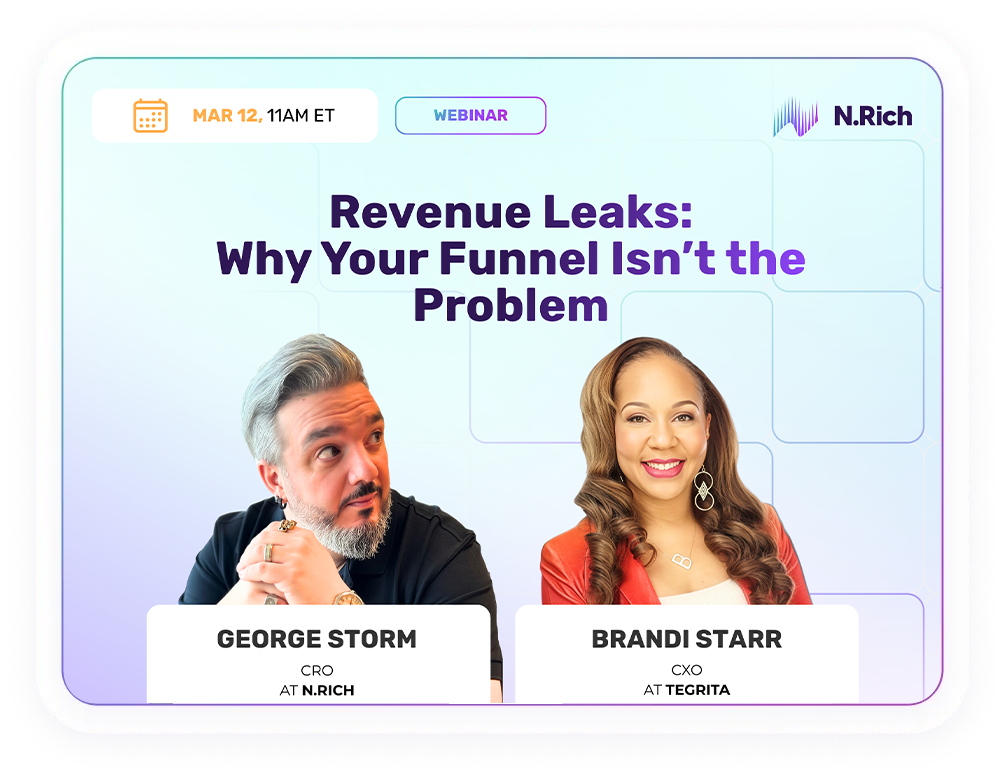
Transcript:
Speakers:
Josh Weale — Head of Demand Generation at N.Rich
Brandi Starr — Chief Operating Officer at Tegrita
George Storm — Chief Revenue Officer at N.Rich
Welcome, welcome to everybody who's on time. George, Brandi, nice to have you both here. How are you doing?
Doing great, brilliant.
Good. Nice Thursday. Good way to close out the week, having a nice conversation like this, right?
Yep, it's going to be quite fun, I think. It's always interesting topics just before closing the week. Nice.
We've got a few people joining, so I'll set up the session today and then hand over to you guys to do a little intro, and then we'll get into the conversation. For those who are here already, thanks for joining. My name is Josh, I run the demand gen department here at N.Rich, and today I'm really excited to be joined by Brandi Starr, CXO at Tegrita and host of the Revenue Rehab podcast, and also George Storm, our CRO here at N.Rich. I'm fortunate enough to work with George on a daily basis, which is great.
The reason we're here today is to talk about something fundamental: if you've ever looked at your pipeline and thought the numbers look okay stage to stage, but something really isn't working, then this conversation is going to dive into that. Most teams diagnose revenue problems by looking at conversion between stages, which is useful, but ultimately it only shows you where things slow down, not why. We're going to dig into that today, see what's happening inside those different stages, and identify the moments where revenue quietly leaks out before it ever shows up in your forecasts.
This isn't a lecture—it's a conversation. Use the chat, drop your questions as we go through, and we'll get to as many as we can. Before we jump in, I'll hand over to the guys to introduce themselves. Brandi, do you want to go first?
Perfect. Yes, I am Brandi Starr, Chief Operating Officer at Tegrita. I've spent pretty much my entire career in marketing and seeing some of the misalignments that we're going to talk about. I'm in Atlanta, Georgia, and really excited to talk to you all.
Nice. Really happy to have you here. And George, yourself?
That's me. I didn't really hear if you said you're fortunate or unfortunate to work with me on a daily basis. It could be either since we're representing the two sides ourselves, right? Chief Revenue Officer and you're heading marketing. Historically there's been a love-hate relationship between the two departments. Before we get into that, about myself: I'm on the other side of the pond in multiple ways. I'm in Stockholm, Sweden, in Europe, not in the US. I've spent 23 years in sales, and as you can see, I'm pretty old in sales. Now we're combining the two sides together. That's all for me for now.
Nice to have you here as well, George. I wouldn't say it's a love-hate relationship at all.
Not now, no. But historically for the departments, yes.
Yeah, that's fair. So what I want to start with is what I mentioned in that intro: we talk about stage conversion, and that's normally the main diagnostic we tend to look at. Why do you think that's become the default? Why is that the first thing leaders tend to go to when trying to understand how their revenue is operating? Brandi, do you want to start?
Yeah, I can start. I think people focus there because that's what's obvious. If we look at the journey, speaking about driving net new: you have all the things that marketing does. You have the things that marketing does to get people to know that you exist, the things that get them to want to talk to you once they know you exist. There's a point where they pass off to the sales team, and then from there sales has their defined stages in their CRM. Looking at those stages and the conversion metrics of how they move through is the most obvious place to look, so it becomes the de facto starting point. I don't necessarily know that anybody ever consciously said this is the way we want to measure ourselves or this is the only approach. To me, it's just the thing that's in front of you, so it becomes very natural.
And George, anything to add from the sales side?
Yes, quite a few things actually. First, I want to second what Brandi is saying. It's part of industry standards—we're used to measuring that way, boards consume information that way, management consumes information that way, and that's how we present it. From a mathematical perspective, it makes sense. From an operational perspective, does it tell you a lot about what's going on in each stage or why they look the way they look? Not really.
I don't want to be too contrarian, but it's also an easy out, right? On the sales side, it's easy to say we have problems with MQL to SQL conversion and point at marketing, saying marketing is not giving great leads. I won't look at what happens in between or why that is, because that's a lot more complicated to unpack. It's a lot more data and, unfortunately, a lot more responsibility on each side, compared to just looking at the connecting number.
Brandi, anything to follow up on?
Yeah, I definitely agree, and I'm very much a contrarian on this topic. It is, to me, the lazy way out. Most stage-to-stage metrics are team-to-team finger-pointing. You have the general public and your TAM, then potential in the database—you can point at marketing. MQL to SQL—you can point at marketing. SQL to opportunity—that's generally an SDR team or internal MDR, whatever you have for qualifying. Then opportunity to close, and essentially it's just giving you places to point the finger and say this is who's screwing up. Could it be? Maybe. But it's not that clean. The way marketing or sales works is not like a relay race where I hand the baton and now it's all on you. There's a certain level where we're all running this race together. The difference is someone is the lead at that point, but we're still all running. I equate it more to American football where somebody's got the ball, but the whole team is running with them. There are different scenarios where the ball is passed and someone else now owns it, but there's no scenario where everyone else on the team just stops. It's not like, well, I did my part and now it's on them.
Yes, and to be transparent, part of why we're only looking at this is because it's the safe way to sort of protect your position and protect what your team is doing. But we're not able to actually diagnose what's happening stage per stage or where things are going wrong, or where they're leaking. When we use the word "just" in diagnostic, that's where it starts becoming sticky. Nothing in pipeline or funnel diagnostics is "just." It's like, okay, if SQL to SQO is problematic, just look at the BDRs, or just look at sales, or just look at marketing. It doesn't work that way. I wish it did, but it really does not.
Josh, you're muted.
Sorry. Yeah, I think that's really great insight into how we think about this today and maybe the reasons why. The webinar itself talks about revenue leaks. What would be good for everybody on the call, from both your perspectives, is: what does that actually mean in practice in terms of what is happening, and what do you guys see in the revenue operation? How do you define that leaking revenue, and what are you specifically looking for?
Yeah, I can start there. I really look at what I call micro conversions. We start with all those stages we talked about as kind of the first layer because they do have value—it's not like looking at those doesn't bring value. But within each of those stages, we break down to truly the micro-conversion level: what is everything that has to happen for the next thing to happen, and understanding where that breaks.
Just a really simple example, looking at going from SQL to opportunity. That can happen in a very small window depending on your sales cycle. It could be days or hours for some companies with really accelerated sales cycles. In there, marketing passes something over to sales and says, hey, this person has some potential. They're showing buying behavior that may indicate they're in the market. An SDR, using sort of the most common sales approach, has to reach out to that person. They may have to make multiple attempts to reach them via email, phone, LinkedIn, et cetera. So there's that step: once they've been passed over, can they actually get their ear in some way? And then if they can, can they get that initial discovery call scheduled? If they get it scheduled, does the prospect actually show up to the conversation? During that conversation, are you able to get the answers you need to do that most basic level of qualification and say, yep, thumbs up, this is a real opportunity? If the SDR is able to do that, can you get the buy-in from the prospect to move to the next step? Because it has to be mutual. You have to say, yep, we feel we can help them solve whatever they're aiming to solve. But the buyer also has to say, yep, based on that conversation, I heard enough that I at least want to continue the conversation. All of those things are micro conversions. They could potentially all be owned by the SDR, but if marketing's not doing any sort of segmentation and they're just sending stuff to everybody and sending over anybody with a pulse, guess what? People aren't going to respond. So you've got to break down: I can't get anyone on the phone—that points to a different issue than if the SDRs are doing great getting discovery meetings scheduled but then nobody shows up. That's a potentially different issue. If the call happens but everyone after is like, yeah, I don't want to move forward, I don't want to talk to you anymore, that's a potentially different issue. Within all of those things, really looking at where the breakdown is happening—that's where you start to uncover: is this a process issue? Are we making it difficult for our buyer to buy? Is there a training issue? Do we have the wrong SDRs? Are the things that are happening before that not meeting the need, moving people to the right place? You really get to this granular level, and that's where you're able to see where people are falling out. If everybody's falling out because they have calls and then they no longer want to talk to you, that's where your revenue's leaking. You don't just have to fix the SQL to opportunity process—you've got to figure out why, after people talk to you, do they not want to talk to you anymore?
Yeah, I can add quite a bit to that. I will, well, it's not very often, but come to the defense of marketing and say that very often I see signals coming in, or there are accounts showing interest one way or another. MQL to SQL is a very popular conversion point that sales likes to talk about a lot and point the finger at. And there's a "what happens" question that has a lot of components. When it comes to, for instance, what Brandi mentioned about BDRs reaching out: are they putting in enough effort? What is the expectation from the previous stage, from the previous person holding the ball, in terms of what they should have done up to that point?
Very often there's an expectancy from sales that marketing should deliver people that are ready to buy already, that are ready to move forward, ready to talk. In that scenario, to be honest, if marketing was able to do all that, then operationally, from a management perspective, we would be better off cutting sales resources and adding money into marketing spend. If that's the world we lived in, what's the point? If sales is just order-taking, basically: here's a potential buyer, here's an address to send DocuSign to. I mean, yeah, thank you, but in no world does it work like that.
Then when doing activities, we very often focus on amounts of activities or binary metrics: have we reached out or have we not reached out? One point people miss is how fast did we reach out after we got something from the previous stage? How much follow-up did we do? How many channels did we use? Do we actually put SLA-level effort into getting to that next stage? That goes throughout all stages, not only MQL to SQL. I've heard in so many pipeline reviews that we're leaking revenue because our win rate is too low, and then there's a slew of excuses: the product isn't good, we're missing this feature, the pricing is too high, the competition is too strong. There's a slew of alleviating factors, but it rarely connects back to it, if you break it down enough.
Yeah.
Josh, I know you're moderating, but I'll interrupt and ask: from a marketing perspective, do you think I'm on the right track when it comes to what sales expects?
No, I think that's exactly it. It's about collaboration ultimately. We have to have a shared agreement and shared ownership of how we're going to operationalize the way we work together. It's not just about the traditional marketing bringing leads and throwing them over the fence to sales and then sales doing the last mile. It's about marketing and sales being in lockstep from the outset. These are the accounts we want to focus on. This is how we're going to market to them. This is the SLA in terms of when we see engagement and interactions with these accounts, which we can map to the different stages we want to map them to. But it doesn't mean anything unless there's that agreement: this is what marketing is going to do, this is what sales is going to do, and this is how we're going to communicate about it.
One thing that came to my head when you were both talking is around the speed to action. When that revenue is leaking, the default is often to plug that gap as quickly as possible. I see all the time on LinkedIn people turning to AI agents and AI to solve that problem. I'd be interested to hear how you guys both see that at the minute. These people selling the AI dream of an agent that can look at your funnel, diagnose issues, go talk to people, and solve that problem for you. It sounds like a dream, but what do you guys think?
I have the biggest eye roll right now because do I believe AI can help in some really significant ways? Yes. Do I believe most companies today are using it in a way that is helpful and not harmful? No. Right now, there's this perception that you can rip out whole teams and insert AI and it's magically going to solve your problems. The problem is you're trying to insert AI to solve this massive problem that you really haven't defined because companies haven't done the work.
To your point, Josh, there are places where AI can be used to dig through your data, dig through your systems, and actually surface: here's what might be the problem. AI can do that way faster because it can absorb massive amounts of data that exist in your marketing and sales systems to really say, here's what's happening, here's this pattern that no human has time to analyze. That does happen. Are there places where George, you talked about speed of response—that's a place where I've seen AI help really effectively. I've seen a number of tools where when someone is actively ready to buy, AI can jump in and not only connect the right salesperson but also get a meeting scheduled on the calendar so that happens really fast. Depending on the size of the company, in some cases that discovery meeting can happen same day. Very similar to what we see in healthcare with telemedicine: I can log into my telemed app and be on with a doctor in 20 minutes or less. AI is able to help salespeople do that same sort of thing.
So when companies are really looking at where is the place that we're leaking revenue, those are the companies able to effectively use AI because they're looking at: AI can help me solve this one thing, not AI is going to come in and do magic and we're going to get rid of our whole marketing team or rid of our whole SDR team. That's where I see companies failing—this pipe dream that AI is at the place it could do everything. I don't think humans are at a place to understand how AI could help with everything, which is why AI can't help with everything. There's what they call the human in the loop. There are lots of places where we don't have enough human in the loop for AI to be effective. George, what are your thoughts?
Yeah, I agree with you to a large extent. There are two contradicting circumstances here. One is that we keep saying AI will replace outreach teams or BDRs, and at the same time you see job ads from OpenAI hiring BDRs because they want to do outreach themselves. But at the same time, to tie into the previous topic, we're saying we have a problem even diagnosing where the leak is or where the problem is. Sending a technician to fix something in your house when you don't know where the sound is coming from—it's going to be a lot harder to do. You're giving a task that you can't complete because you don't know how to diagnose and you don't know how to fix. Implementing a layer of tech on top of that, in most scenarios I've seen, has caused more harm than good if you don't know what your baseline is.
So I think AI can be a great data aggregation layer to Brandi's point. It can flag patterns to you, it can analyze heaps of data you would never have time to do. The interpretation is contextual to your business. Fortunately or unfortunately, that's what our roles are. We need to be able to interpret what the data is telling us in the context of what business and what motions we're running. Otherwise, what are we doing here?
It's interesting, George. We've recently gained access to an AI tool that's helping us do that. It's really, from a marketing perspective, being able to understand pipeline data and chat with that data rather than just seeing it in spreadsheets—it's really helping me think about the challenges we have and come up with solutions from marketing and sales perspectives to solve those problems. We have a question in the chat that I'll open up to you guys. Someone says: It sounds like the core problem is everyone feels there's a problem but no one can diagnose specifically what is going wrong. So how do you typically start this process, not just from a technical analysis, but also how do you get various teams involved and aligned? Because by the time the topic's brought up, everyone is starting to feel a little anxious about it.
Yeah, I'm excited to see that question because it's a great one. Obviously, pulling some data and understanding some of those microconversion metrics is a key starting point. But beyond that, once you have some data, you have to approach the conversation as us as a company or as a go-to-market team against the problem. What happens a lot today is what George mentioned earlier: sales is saying, "Hey, marketing, you're giving us crap leads, do better," or your AE team is like, "Hey, SDR, you're not giving me enough, do better." It becomes this finger-pointing. But when you're able to look at where the breakdown happens, you're able to figure out how to collectively tackle it.
Let me give an example I saw a couple years ago with a client. They had better numbers than just stage-to-stage. What they saw was post-demo, there were a lot of opportunities that were either stalling or getting completely ghosted. The natural thing, the common thing, is sales points at product and pricing, and leaders point at the salesperson not doing their job. But when everybody says, here's the problem, we're seeing this drop-off, and collectively as a go-to-market team, what can everyone do? Marketing, what's something you can do to help influence this? They may say, we can add more nurture campaigns here or do this there. Okay, SDRs, this is way past you in terms of what you own, but what can you do to influence this? Product, is there anything you're hearing in the marketplace that may help us overcome this? When we look at everybody playing a role in solving wherever it's broken, and it's not that anybody's not doing their job—it's not about you, it's about we. This is a thing that is happening. The data is showing us that it's a thing that is happening. Nobody can deny that it is happening. Nobody has to take accountability for it being their fault. But instead, we're going to figure out what can we each do.
And then as leaders, you really keep a light focused on that one number. So if we were moving 10% from demo to the next stage, say demo to pricing conversation, if it's 10%, how do we get to 11? We're not going to try to move from 10 to 20. How do we get to 11? And then if we get to 11, how do we get to 12? What ends up happening when you focus all that effort is you don't move from 10 to 11, you move from 10 to 20, because everybody's focused on how do we just get a little bit better. When everyone is focused on that little bit better, it becomes incrementally better because we're all focused. And then we can all high-five because we solved this problem together. Now we can look at what other metric in here isn't working and tackle that one. That's why I always refer to it as the 1% because if we all start looking at the places where those micro conversions aren't working and tackle it as a go-to-market team against the problem, and focus on just moving those things 1%, when you do the math of what comes into the top to the revenue that comes out the bottom, it becomes huge. There's no, "Oh, I didn't do my job," and we all feel good that we're not in this alone. It's not one person's job on the line. We're all moving in one accord. That makes such a huge difference.
George?
Yes, really nice, really nice question. Thanks for that, Brandi. This is an exciting one. So if we take a step back, where I think a lot of us are failing initially is it starts with the diagnostics. When we lift—okay, we're leaking money, we're not reaching targets. What's happening? Usually the solution happens a bit ad hoc where we say, oh, it's this conversion or that conversion, or sales, or marketing, or product, or pricing, whatever. First of all, starting by saying, one of my old managers used to say that whenever you point a finger at a person, you're pointing three fingers at yourself. Every single time you do that motion. This is an alignment piece in itself, but to be honest, since I know this is in most scenarios, especially in big organizations, sort of a pipe dream to align everyone under the same umbrella, I want to talk about a bit more practical topic.
And I'm glad Brandi mentioned math because it makes my soul happy. The equation, if you look at it pragmatically or break it down: what generates new revenue? You have meetings that are coming in. You have starting to contact people. Then some of these people you book meetings with. You convert them to opportunities. You close some of them. And then the last multiplier is how much you sell for. So traditionally we have MQL or MQA to SQL, SQL to SQO, SQO to 1 times ACV, average contract value. The math is not more complex than that. Unfortunately. So when we look at leaks, we can look at each number and say, okay, what can we tangibly touch from this? Not where the problem is initially, but what can we affect? To Brandi's point, what from this math is a growth lever? Because each of these numbers is a growth lever. We have two solid numbers. One is touchpoints in the beginning. The other solid number is how much we sell for. The rest is presentational conversions.
So where are we leaking? Where does the equation break? The math that I do very often with customers is: let's start with the end goal. Where do we need to be? And start diagnosing the math step by step. If I want to end up with 20 million, what do I need to get to that level? Based on my historical data, I'm selling for $100,000 per deal. How many deals do I need to create? You know the math. It goes down to the first input. So if I look at my math, where is it breaking? Am I selling for enough money to make that number? Or if I set—this is why I usually, when I do that math, start from ACV. What are we selling for? If we're selling for too little, if we're discounting a lot, if we're underselling ourselves, we will run out of companies to bring in. The tail end of the math will never make sense. If we're selling something at 50% discount or 20% discount because we had very strong competition and needed to close in the quarter, the math will never make sense. It's an impossibility.
If we're getting stuff from marketing and registering deals as ghosted—because I love seeing that in CRMs—because ghosted is registered as a reason for losing a deal. Which is not the reason. It's us failing to engage that person and then they stop talking to us. So if we're not able to convert enough for what marketing is giving us, then the first number won't make sense. We will need hundreds of thousands of companies. Going point by point in the math and saying, okay, what did I do last year? Which parts of this equation broke? You can look at it in a formula format, point by point. And then once you diagnose the number, whoever in the chat wants to talk about this more, reach out to me on LinkedIn. We can have a chat about how to put Excels together because I love Excel.
So once you diagnose the number, to Brandi's point, then you go, okay, so who is attached to this number? Because even if we say X department owns that number, all departments influence that number. So if we're looking at ACV, how does marketing impact ACV, as an example? If there is room to fluctuate—if you're selling something at set price, then it's immaterial, but for most of us it isn't. So how does marketing influence ACV? ACV is usually a number that marketing doesn't get attributed to, or ACV is not traditionally impacted by marketing, according to public perception anyway. So marketing can influence ACV with building trust in the earlier stages of the customer's journey. If the customer trusts your company, if they know your company, if you've engaged enough people in enough levels—CFO level, usually the person holding the purse—have you built trust enough early in the journey, or are you just saying the sales will push them for more money? Unfortunately, it doesn't work like that. If they don't trust you, why would they invest more? The same goes in all stages. Somebody owns the number, but we all affect all of these numbers. The same with early conversions. If sales is not providing the right guidance for ICP accounts, if they're not providing marketing with what they're hearing—is the messaging resonating, is it not, which parts are resonating—and we're just blindly throwing the ball back and saying do better, like Brandi said. "Do better" means nothing. "Do better" is just complaining.
So to finish answering the question: diagnose which number is breaking, see who owns it, be transparent with yourself about who impacts it, and then from there, exactly what Brandi said, sit down. What can I do? What did we commit? Who committed? Who delivered? Who fell off? Why did they fall off? Nothing works without follow-up. So start from the number, go to impact analysis, and end with follow-up. That's my two cents.
And I just want to add one point because I agree wholeheartedly. There's a nuance in here that I think a lot of people miss. There's a level of creativity and deeper thinking that every department needs to do to think about how they impact something. Marketing's influence on ACV is a great example because to your point, marketing starts thinking exactly what you said: we've got to build more trust, we've got to make sure. And those are the places where it's like, yes, and. This is where it's great to get creative. We know the CFO holds the purse strings. How can marketing get ahead of that? What can marketing do so that—because the CFO is not naturally in your database engaging with your webinars and downloading your content. And often marketers will assume, well, I can't do anything about that. I can think of—and I mean, this was like 15 years ago—one of my most successful campaigns. I was cross-selling into ERP customers. I had content that I developed for every person in the buying committee. Were they in my nurture campaigns? No, not at all. Procurement's not in there. CFO's not in there. But for that champion who is trying to push things forward, who is the person you're going to talk to? It's one of those: here, slide this across to your IT team who is going to scrutinize the security. Here's all the answers to the questions they're going to ask. So when we get there, they're already comfortable. Give this to your CFO because this is all the positioning of how it ties to what they're going to report to the CEO and the board. It's like, it was an example of getting creative about, I don't have these people, I don't have—as the marketer—I don't have access to these people. They're not talking to me. They're not in my database. But that doesn't mean I can't influence it. That is a place—and I hate the phrase think outside the box because it's so overused—but you really do have to get creative and dig deeper and assume that there's more you can do to influence every single part. And if you take that mindset of there's always more I can do, that means no matter what you're already doing, you're going to push yourself into figuring out what is that more. That again goes back to how we are all collectively moving the needle. And George, you hit on another thing that's really important: those feedback loops. We can't just assume that information only flows one way. It's got to also flow backwards. If the SDRs are seeing like, hey, when you're giving me somebody and they've done X, Y, and Z, that makes my job so much easier. Or when we get here in the sales process, this is a big objection we're hearing. How can we get ahead of it? That feedback loop has to—the information has to flow both ways, which allows every person to do better, have better understanding, to focus more on the customer, all of the things.
I love that point, Brandi, about the influencer approach. I've been recently working on an inbound pipeline campaign which does exactly that—about how we can arm our champion with what they need to engage those personas ultimately. Because yeah, nobody's ever sat on a discovery call and suddenly the CTO is there in front of them as well. They're coming in later in the stage. We've got about 15 minutes left, so I want to do some rapid-fire questions if that's okay. The first one ties back to both your previous points. We've talked a lot about where things break and how to diagnose and fix that. A lot of our audience are a mix of mid-market going upmarket, and there'll be some enterprise in there as well in terms of ACVs. I'm curious from your perspectives: is there a fundamental difference in the process of how you diagnose and fix this depending on deal size? Other than scale, is there a different approach? Or am I in the wrong ballpark?
I would say foundationally it's the same. If we look at the big steps of what needs to happen, it's the same across the board in my opinion. Where I see the nuance is going to come into what you do, what potential solutions, how people can influence, because deal size plays a role. Your average deal cycle, how much competition is in your marketplace, is it something your buyer needs, or is it more of a luxury for them? There are a lot of variables that are going to change a lot of things. But in terms of looking at the numbers, figuring out where the problem exists, figuring out how we collectively move that, thinking critically about how we do that, staying laser-focused on that number and creating those feedback loops—those are your high-level steps.
I can continue from here, and to warn you, Josh, I don't think either of us can do actual rapid fire. We can do higher. I don't know if it's going to be rapid. So to the first time to disagree with Brandi: I think that high ACV or enterprise sales motions are actually fundamentally different from each other. Yes, math is the same, I agree the equation stays the same, the numbers stay the same, the levers stay the same, but contrary to low or medium ACV motions, it changes from the baseline narrative. It changes from value first to risk first. The higher we go on the investment scale, the higher the risk aversion and the importance of trust becomes. Can I get a person to invest $10K a year with me without the board or CFO being involved? Potentially, because my HR director has their own budget. They bought a system pretty fast cycle, went on relationship, went on some LinkedIn ad. Fantastic. Am I investing half a million to this? The equation changes dramatically.
We have this term we use: winning the day one battle. If the investment is big enough, if the service or software is business critical enough, it's a board or management-level decision tied into strategic decisions. To make a decision like this, your buying committee needs to know of you. You need to influence a lot more people. And unfortunately, if you're not in their vicinity when they start looking at this, if you don't end up in this top 3, top 5 list, even if you book them, even if you create an opportunity, I hate to tell you, you're most likely being used as a benchmark to push other people to give them a better price. We've all been in these RFQs. You're the fourth player. What they do is they get you to drop price to go to the selected vendor and say, but George is giving me 50% off. Give me more discount. Right? Enterprise buyers buy—the tiering goes risk first, trust, value. Unfortunately or fortunately, because the people involved have a lot more to lose. If I bring in a half-million investment that flops, next year I'm probably looking for another job, right? So it's a lot of risk.
To Brandi's point before, to influencing several people: if I'm the CFO at a company and you slide a proposal across my table for $100,000 that I haven't heard of that company from before, I don't know what the company is, what it does, who they work with, nothing of the sort. Either I will flat out reject it or I will scrutinize to a point where I will drag the sales cycle for another six months or they will flat out just give up on the deal and move forward. So no, I think the emotions are fundamentally different, both on the marketing and on the sales side.
That makes sense to my point of view, George. I guess the other elephant in the room here is whether everybody is on the same path and the same journey of how you're going to market. Because I think quite often what I've experienced when I've worked with different companies trying to sell into that enterprise motion is there's a disconnect: sales is doing that enterprise risk-based motion, but I've seen marketing teams approaching it from the value-based motion. There's just a gap in between, like a void of content and enablement and the ability to tell that story. That's where I've seen it fall down so often. We have—
Just to share, Josh, sorry to interrupt you. I know we have 10 minutes, but I want to say—to offer an anecdote from my own career. When I was building my first enterprise team, that was, I don't know, 10 years ago now. I remember doing a presentation for my management teams at the time. What I was trying to explain, I had this picture in one of my slides. I was saying that we're trying to run a Formula 1 race and we're on a tricycle. We can't do this like this. We have a PLG motion where somebody bumps into the website, converts into a meeting, books something for $3K, and we're off to the races. We don't have the content, we don't have the competence, we don't have the process, to address these guys because it's a whole different ball game. It's what it is. Josh, back to you. Just wanted to offer that anecdote.
That's a good point. So the last question I want to wrap up with: we're coming towards the end of the week now. There are probably some executives sitting at their desk thinking we're coming up towards the end of Q1. They may feel something's not quite right with their pipeline. They may feel there are revenue leaks there. Over the weekend, they're thinking about what do they need to do, how can they change it, how can they come into work on Monday morning and say, this is what we're going to do to fix this? What advice would you give them if they called you over the weekend? Where do they go with it? What do they need to start measuring? How do they know what the right thing is to fix?
I think if they called me over the weekend, I would kindly ask them to call me on Monday. To the actual answer: it depends on what you want to fix. If you want to fix your Q1, you need to look at a different number. If you want to fix your H2, you need to look at a different number. If you're looking to fix Q1 now and we are on the 12th of March, I will probably wish you good luck, but you need to look at the things you can affect. What can you affect on the 12th? On the sales side, unless your sales cycle is two weeks, you can affect how much discount you give or not give to affect your ACV. You can affect how you multi-thread, get executive sponsorship involved to push some of these deals forward. If you're planning for Q2, depending on the sales cycle, you need to look a lot earlier in the pipeline. But again, breaking down numbers one by one.
But my big piece, my more long-term piece of advice, is to look at these things ongoingly and look at these things way before they become a problem. It's never too late to fix your revenue model. Even if everything is going well—you don't need to. If you get stuck in a firefighting mode, you will never fix the model. It's like the historical problem with training: we're doing too well, we can't train, or we're doing too bad, we need to sell, we can't train. It's never a good time to sit and look at Excel and fix numbers because no one besides probably me likes doing that. But even if it's too late and you're missing the quarter, it's still worth analyzing, looking at your entire machinery, the math, and figuring out what do you want to impact and work from there.
And thinking about it, I realized my response would be less tactical, more emotional. I would say don't panic. And don't make rash sweeping changes. Because the way you phrase the question, Josh, when someone's calling, especially if they're calling on the weekend, I'm with you, George—like Monday, please. But in that instance, quite often there's this panic that has set in. We are 2 weeks from the end of the quarter, and that panic coupled with time often leads people to trying to make sweeping changes that just create the illusion of doing something significant. Those rash decisions and big changes often make the problem worse down the line. It will seemingly solve something right now or give the appearance of a solution, but long term it will make a bigger issue.
And so, all the advice George is giving is great. I would say the first step is calm down, think clearly, and then do all the things that George said, because you're right—there are things that will help move the needle a bit in the short term. And if you're calm, you can also think ahead to what those short-term decisions could mean long-term. What I see often is: we've got to get these deals closed this quarter. So that's where they inject discounts to make people sign faster. Yes, that can get those deals closed. But if you can't sustain that discount in year two, and their price is going to double, you run the risk of churn, which is just kicking the can down the road. Or there are all these other risks. As a leader, the most important thing is approaching things with a level head and some forethought into how does this decision today impact the company down the road. And in some cases, you may want to make that decision and consciously decide to cross that bridge when you get there. But that's a very different thing than doing this thing and then having an "oh shit" moment later because you didn't have foresight. We want foresight to be 20/20 as well.
Yeah, when you said, Brandi, keep calm and do what George says, I just had a vision of getting some merch printed with that on it.
Oh yes, please, I want a t-shirt out of this.
This is brilliant.
We don't have any more questions in the chat, so I think we can wrap up there. Before we do go, just where can Brandi and George be found? How can people talk to you, or where can people go?
Yeah, for me, LinkedIn and Substack are the two main places. I'm very active on LinkedIn. When you search Brandi Starr, I'm usually one of the first to come up. And then I also have the Brandi Starr Substack where I share all sorts of things—whether it's lessons learned from clients, articles and things you should be paying attention to from other people, et cetera. I would always love to hear from anyone. Definitely let me know that you saw me here, and I'm happy to continue the conversation with any of the attendees.
Pretty similar. I don't have a Substack, but LinkedIn DM. Yeah, happy to chat. Especially if it has to do with math. I'm more than happy to engage, potentially even during the weekend, if it's data heavy enough. But that's about it.
That's exactly what I was going to say. As long as it's about math, George will reply to you. Well, thanks so much for your time today, guys. It was a really great conversation. Anybody who's been on live will receive the recording as a follow-up, and anybody who wasn't able to make it, they'll get it as well. Thanks for all being here, and take care.
Thank you all.
Thank you.
Create more pipeline and prove where it came from
Book an N.Rich demo and see how it works on your own data.
Book a demo