Ready to become an N.Rich AI builder and get paid for it?
Replay
How Marketing Leaders Are Cutting Through the Noise
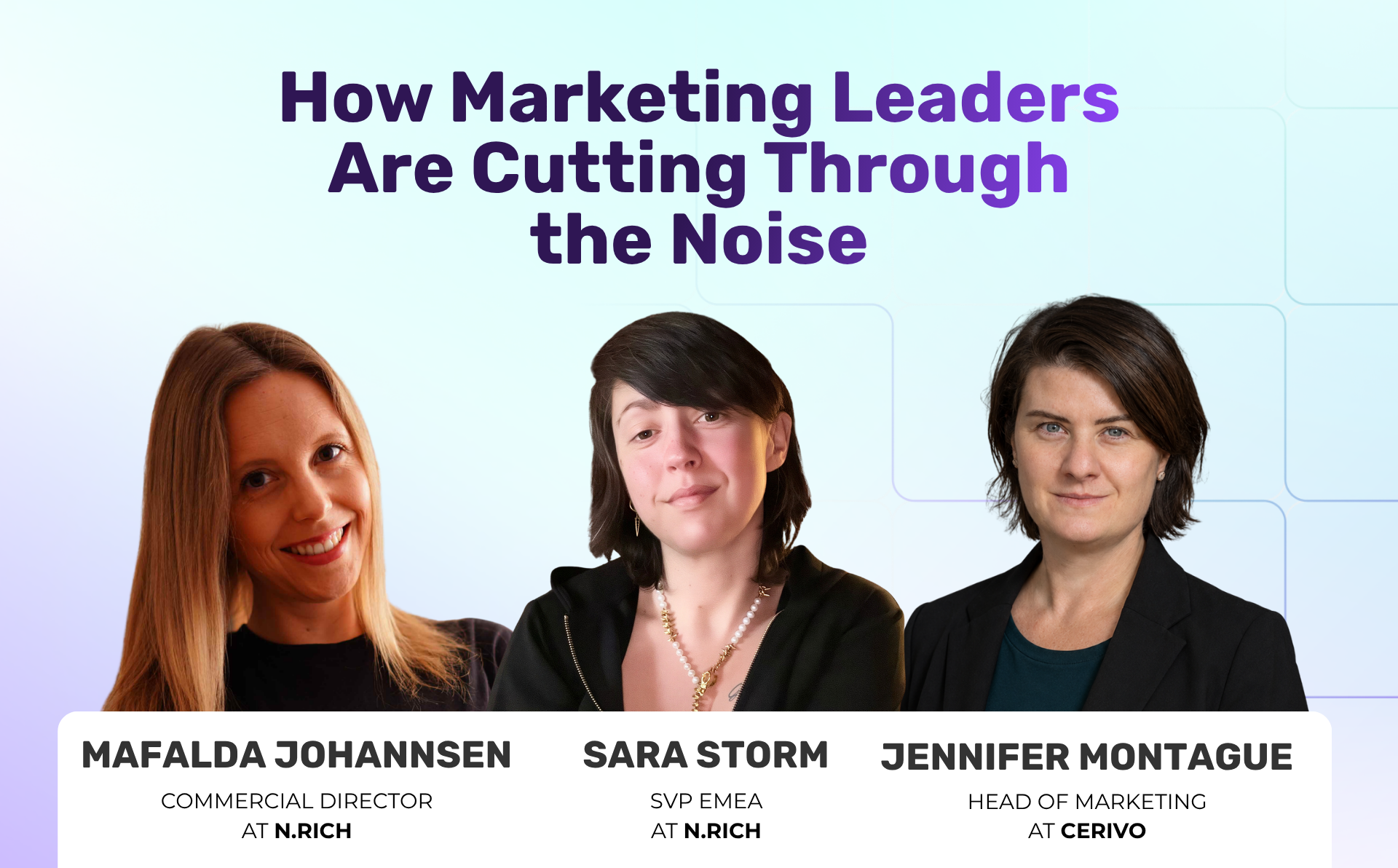
In this webinar session, Sara Storm (SVP EMEA at N.Rich) and Jennifer Montague (VP of Marketing at Cerivo) discussed how marketing leaders are cutting through the noise in today's complex market environment, addressing challenges from AI, economic uncertainty, and industry distractions.
They explored the root causes of market noise and shared practical strategies for staying focused on what matters. Learn their insights on avoiding shiny object syndrome and building processes that drive real revenue results.
Transcript:
Speakers:
Mafalda Johannsen — Commercial Director, N.Rich
Sara Storm — SVP EMEA, N.Rich
Jennifer Montague — Vice President of Marketing, Cerivo
And we are live! Welcome everyone. Today we will talk about how marketing leaders are cutting through the noise. We have our speakers that we'll be introducing in a moment. We also had a webinar last week with James Buckley, and we're going to have another one next week as well. Keep up with what's going on by N.Rich Events.
While you are tuning in, I would love to know where you're located. This recording will be available for everyone, but we would love you to stay here until the end. The more questions you ask, the better. We have our points and our presentation ready, but like last week, we would love to shape the webinar and the chat towards what you'd be interested in within the topic. As I mentioned, the webinar will be recorded. Ask your questions, tell us where you're tuning in from, and follow us for the next webinars because we'll have lots of them in May, June, and July.
Sara, would you like to introduce yourself?
I would, but let's address the elephant in the room. Jennifer isn't here yet. We're experiencing what you guys in marketing have experienced before—technical issues. Mafalda is trying to fix it to get her into the room because she's our star for today. While we wait for that to be sorted, I will do my first intro. You can go back to the first slide so we can get the titles and everything there.
My name is Sara Storm, and I am the SVP EMEA at N.Rich on the sales side. I have spent 23 years of my career—my entire career because I'm a nerd—in sales from the start and then in GTM for the last 15 years. I've been in the software industry for the last 15 years, working for SaaS vendors of different versions, doing sales or marketing technology. What comes with that besides building teams and seeing the market in motion is a lot of insights into other companies' GTM motion. When you work from the vendor side, you get to address different customers in your portfolio and collect very interesting signals and information from all of these teams. You basically get insight into far more companies than your own.
I am happy to bring what I see on the market right now to this webinar. I'm very excited to talk to Jennifer. I've had a business crush on her forever. I saw her on a stage once and I was hooked. I was like, I need to know this person. Having Jennifer on the show is super exciting, and I think we will have a really good conversation.
Before we get started, please put questions in the chat. If you don't feel comfortable doing it publicly, feel free to send them to us on LinkedIn after. We're happy to discuss. No questions are stupid because we are here to not just cut through the noise, but also learn from each other. This is a forum for information so we can all become smarter.
Thank you for having me. Apologies for being a little late, but we got there in the end. I can't blur my background, so you're looking at my spare room and my dog might move around. I usually blur everything so I look more professional.
Authenticity is a good thing, especially in these AI times, so we are happy.
It's very authentic. You've got art from my kids, my dog over here. Everything's great. My name is Jennifer Montague and I'm the Vice President of Marketing at Cerivo, which is a GRC platform. I'm based in Copenhagen, but I've been working within GTM for the last 10 years. I met Sara and George from N.Rich at the Winning by Design panel where we first met each other. We've been supporting each other on LinkedIn a lot.
Your sound is a bit sketchy, Jennifer.
Is it?
I don't know what happened there. I think it's your sound.
I can hear you, Jennifer. Please go ahead.
I'm using my fancy microphone, so hopefully that shouldn't happen or I'm going to get a refund. I've been working in GTM for the last 10 years across different companies, mostly in Copenhagen. I also spent the last year working in PE, where I was the Senior Director of Go-to-Market, working with a portfolio of 100 B2B companies to help them with their marketing, sales alignment, and things like that. I'm really excited to be here and have a chance to talk to Sara and answer some questions and see what you guys in the audience also have on your minds.
Amazing. Sounds great. Let's start with the first generic question and then go more specific. Jennifer, in your opinion, what is causing the noise in the market right now?
AI. The end. No, I think AI is a double-edged sword. It is helping incredibly with efficiency, but it is also creating a lot of noise and a lot of crap. It's making it harder and harder for marketers to stand out in this sea of noise. I think there is also the shiny object syndrome that a lot of investors, boards, and C-level tend to get. We should be doing AI, and it's distracting people from what they should be doing. It should be an enabler, but I think a lot of times we get so distracted trying to stay ahead of the curve when it comes to AI that we're not actually focusing on the things that matter.
The talk that I give at Cessius, which I think is a lot of what we're going to talk about today, has no AI in it at all because I think we need to focus on tactics.
I agree. Sara, I think I know already your opinion, but the audience doesn't. What is your take here? What's causing the noise?
I am also experiencing technical issues. I think maybe we have a Livestorm challenge here. Am I back?
You are back.
My opinion on the market when it comes to noise: Jennifer has obviously strong points, but I also think there's more complex things going on in the background for most companies and for most people. When I look at the market right now, we see a financial economic situation in the world that is complete chaos. We have political winds of different kinds that I'm happy to discuss offline, but we have political winds flowing all over the place. We also have problems with supply chain and wars going on. I think noise is an interesting conversation from a perspective of marketing messaging right now. It needs to be so compelling that you can't ignore it in a very noisy world because people are being laid off left and right. There is a tech boom of layoffs. All of these things impact people's ability to receive new messaging. We really need to be very thoughtful about this.
I think we lost her.
I think we lost Sara. But I'll just summarize quickly your point. So not only the AI that Jennifer mentioned, but also all the layoffs, all the political situation in the world, it's adding to the noise that's already created by AI. Let's go to the first point. Jennifer, I will hand the ball to you. What's the first thing marketers can do to cut through the noise? We cannot stop the AI, we cannot stop the war, unfortunately, or the layoffs. What can we do instead?
One of the things I would see happen as an in-house marketer, but also as an investor, was lack of focus. There's a lot of distractions out there. We need to focus on what's important, what is going to generate money. At the end of the day, we need to make money and generate revenue by offering things to people that help them. We have to focus on avoiding shiny object syndrome and do the hard work. I think that's probably something that is detrimental to a lot of go-to-market teams. We think that by having a new tool, we don't have to do the alignment, we don't have to do the analysis, we don't have to collect the data because we have an AI that can do it for us. That's BS.
We need to focus on what's working. We need a process. Focus on things, have processes. You don't need to rebuild things every single time something happens. You need to have a playbook and you need to focus on what matters and block out everything else that is just a distraction right now.
Sara, what's your take here? Are you back?
I am back, but I can't guarantee stability. It's almost like it's a metaphor for life. Jennifer, obviously you're right. We still need to do the fundamentals. When we look at how to approach a market that looks like this, we need to lead with empathy in how people are in their state right now from a perspective of where they are mentally and emotionally based on how the world looks. We also need to lead with authenticity. All of these things that brands didn't really have to do in 2022 or 2023—they just needed to go out and sell. We are not in that stage anymore.
I think anyone who's been doing go-to-market and sales in financial crashes, anyone with the background of having gone through that period, knows that there is a lot of light at the end of the tunnel, but also knows that we need to nail down fundamentals now. We also need to look at how we can address a market that really needs to cost cut, that really has a very anorectic GTM team because people are being removed from the team as they're shrinking. How can we address them in a humane way in our marketing while we also make money? We're going to suffer through this storm that we're in because we've had four black swan events happen in the last five years. A lot has been happening on the market and we're all just trying to survive. Boards want us to thrive and grow, and that's a challenge in itself.
It goes beyond GTM too. Even if you're in marketing now, you will feel the pressure from the board through your C-level.
Absolutely.
And then the question becomes, how do we manage that?
I often say it's like what I was telling my team. I feel like a tuna can because I have C-level and board coming down, I have you guys coming up, and I'm in between trying to keep everyone focused and happy and dealing with a team that emotionally, because of the situation in the world, it's just like when I managed a team through Corona. It was a lot of extra things that we didn't have to deal with before, as Sara said.
Absolutely. I think this is a great segue for the first mistake that people are making, marketers at the moment, or GTM leaders. Let's talk about the first one: focusing on new logos. Jennifer, what do you have to say here?
There's a bunch of things that I've been seeing. I only had time to focus on the three biggest, most prevalent ones. The first one is focusing only on new logos. New logo expansion is important, don't get me wrong, but it is not the only way to generate revenue. The issue I take with this is that a lot of GTM teams are built around sales. Sara, you know I love salespeople. This is nothing against salespeople, but sales are very expensive. If I look at it from a PE investor lens, I want to look at your CAC. I want to know your customer acquisition costs. I want to know your LTV to CAC ratio. I want to know when you're going to be profitable. If you are focusing 100% on new logos, you're missing a huge opportunity.
If you're looking at profitability, you need to have a better balance of new logos but also existing customers. As an investor, we like customers or companies that have customers who love them, customers who stay with them, customers who expand with them. I'm not saying new logos are not important, but this overemphasis on the left side of the bowtie, which is the acquisition funnel, usually gets between 65 to 85% of the headcount and the budget, leaving the rest for the right side of the funnel, which is actually where the compounding revenue is. Expanding upon customers and keeping them is where you scale because you spend money to make money on the left side of the funnel, whereas you're not spending money to make money on the right side of the funnel.
I don't want people to think I don't care about new sales. New sales are very important, but they're not the only thing. Your GTM should not only be built around new sales. It should also be looking at retention and expansion.
Do you feel, Jennifer, that a lot of companies understand how to do that? Because I'm sitting in a lot of customer conversations right now, and it's net new, net new, net new, net new. I see exactly what you're talking about on the market. One of the challenges depends on what type of company you're in. Some companies don't have the land and expand opportunity that will bring them enough to cover off the loss of net new that we will see in a cost-cutting environment. They don't have the potential. But if you do, I can give an example. I'm working with a company that has a different bulk of different product lines, and these product lines can fit into four different use cases in each company that they work with. In many of the cases, they have use case A and they haven't even talked to the customer about B, C, and D. They haven't talked about that potential either in marketing or in sales because their CS team or their team that runs existing accounts are trying to retain option A in that use case. They're not really trying to expand because they don't have the structure for it. They might not have worked like this because net new have been a focus for a long time for a lot of companies, which is why churn is high in SaaS. That's why we lose customers because there is no stickiness because we're only in one team.
One of the things that's so interesting when you look at bigger deals or the accounts that can grow into becoming a lot of revenue, you can expand an account times four with the same effort it takes to land one net new logo. This is something that a lot of marketing departments get told net new about, but they don't bring the conversation to the C-level. But guys, look at the math here. Look at what we can create if we do campaigns running towards use cases B, C, and D. We can make four times the money in an account that already knows us. There's already been a vendor process, we've gone through the legal assessment, we are done with the contract. They just need to expand the existing contract. It's a much easier play and a lot faster because this is one of the low-hanging fruits with enterprise marketing. And we're ignoring it. Why do you think that is?
I think it's just legacy way of working. When you have a sales-led organization, sales are the main player. Again, I have nothing against that. Most companies I've ever worked in have been sales-led organizations. But you're absolutely right. It is 10 times more expensive to get a new customer than to expand upon a happy customer. I think it goes a little bit earlier to our intro. That's the hard part. The hard part is building something people love, talking to those customers, investing in those customers, and looking for brand expansion opportunities because that also impacts upon product. You have to build a product that can be expanded upon. You could just sell something like shoes, right? You're not going to upsell shoes. You're not going to buy a pair of shoes and then add a new sole to it and suddenly expand. We're operating a SaaS model, which is subscription as a service like it's B2C.
I think that's the mental shift. I said in my SaaS talk that 70% of my work is mind shift changing, shifting mindsets because a lot of us are operating in a funnel that was invented over 150 years ago by an insurance salesman. How much has the world changed in 150 years? It was invented before the radio, the television, the internet, and certainly before AI. We're still operating in that model. I think the problem that we have is people are not used to this. We say NFMP—not my problem. My target as marketing was to get an MQL. I got my MQL. Sales, your target is to sell. Now it's CS's problem. That's not the world we work in. We need to keep our customers. That's why I really like the metric of NRR, the net revenue retention, because instead of just looking at new ARR, you're not looking at the cost of losing these customers. You're not looking at the cost of retaining and expanding.
NRR is calculated by new revenue plus expanded revenue minus churn. Now you have two parts of the funnel that you don't usually calculate being calculated into this metric. That's going to give you a real picture of how your business is doing, because what is the point of new customers if you're just losing them after two months?
But you've also been on the board side. Do boards look at these numbers properly?
Investors do.
Investors do.
Good investors do.
Because this is also an educational question too. At the end of the day, if no one lifts this with the data and the math that is required, the mindset needs to go both down and up because otherwise we will value KPIs that won't actually get us through the storm. We will value them more than we should.
If your customers don't stick around, you're never going to make it. If your customer acquisition cost is $2,000 and you close a big deal, maybe it's a $500 deal per month for $2,000. I have to keep that customer for five months to turn a profit. If they leave in three months and CS is seen as a cost center, not a revenue engine, that's BS.
When I was working at Planday, I leaned into my CS team heavy because they know what people like, they know what they hate, they know how people talk about the product, and they're the ones translating everything for me because we have to do things in all languages. CS needs to be elevated more. They need to be seen as a real player in the revenue engine instead of being seen as the people who just take care of the customers while sales are the lone wolves out there keeping the business going. No, it's really not that. Again, no offense to salespeople.
No, but please offend salespeople. I'm on the sales side. Please do. But I feel like there is a gap of knowledge across the board in an organization right now to be able to understand, because you also need the top line to hold the line of these narratives. If they don't fully understand, if they're too much in their own competence box, which happens a lot when you recruit an individual contributor in marketing or sales and then you recruit them and career them up the ladder, right? Unless you're sitting on the board or you're in C-level for a couple of years, or you have done advisory work, you won't see these things. You won't see the trends.
One of the things I wanted to ask before we move on, Jennifer, is we're very much talking about the SaaS bubble that we all live in now. I see a difference on how this is viewed in companies outside of SaaS. I think that SaaS is a very unique ecosystem where we have this tendency of believing that whatever goes on in here is the world. And obviously that's not true. For companies that don't look like SaaS, that don't have CS, that have products—maybe physical and online products, they have services—I think that looks different. But from a perspective of the people delivering, being seen as a cost center, I think that's hugely different from SaaS. I think that in most organizations outside of SaaS, these people who are delivering the value to the customer are seen as very much more important, which is often why sales-led in those companies means a lot more consultative approach because you're trying to sell competence and trust as a partner rather than a platform. Do you agree with seeing that on the market? Is there very much a difference between SaaS and the rest of the industries out there?
Absolutely. In SaaS, there's even more emphasis on why we need CS part of the conversation because we need those customers to keep paying us. It's not a one and done. It's a recurring fee that we rely on and we don't want it to go down. In a SaaS business, we're trying to shove the old way of doing things into a SaaS model and that's what we see. A lot of the people who rise to the ranks are people who have succeeded in the old way of doing things.
What would it look like if a salesperson's commission was based on that customer staying with the company for three months instead of the commission being paid on signature? I worked at a company like that, and it was very different conversations. Instead of tapping product on the shoulder saying, I need you to build this feature so I can hit my quota, it was: how do we get these customers to stay? Imagine how strict would you be on an ICP if you're paid your commission when they onboard and they're successfully using the platform? Suddenly it's not about getting signatures. It's about getting the right people to sign on the dotted line.
We did this at one of the companies I worked at, and maybe we didn't retain a lot of sales talent because the sales mentality is a little bit different. But the people who stayed, it was a much more collaborative environment where sales were working with product, working with CS, working with marketing to make sure that these are the right customers, that they have what they need, that they're set up for success, and they're onboarded quickly because the faster they're onboarded, the sooner they get their check.
I think that's a very interesting concept. At N.Rich, we don't have the commission structure laid out like that. What we do instead, which is a much more accountability-driven way of working, I think this is a magical way of doing it, and I've done this before in previous companies, is that the person who runs the sales process stays with the customer for the first year. We often run in teams because we target enterprise and mid-market companies, which means that it's a team effort to get a customer to trust us enough to go in with us because it is a competence play as well. We're not just an ABM vendor. We're also a strategic ABM partner because we need to be, because platforms will not solve your problem with marketing. No platform will. We understand that because we've seen it so much with this type of motion.
Account-based marketing or enterprise marketing or mid-market marketing for that matter—people fail not because of platform. They fail because of other things that are not in place internally for them to succeed. One of the things that we do instead is that the person who runs the sales process stays with the customer for the first year. Those people who have then promised and said things to the customer will sit in meetings and listen to success. They will run escalations. They will support CS, the entire CS team because we have a structure where we have a person who's an account owner—that's the head, the CS person. We have a solution engineer named for that account. We have executive support through our CRO George or our CEO Marcus, or in some cases me. I will stay with the account in certain sense. They will have people who do platform training, absolutely, people who have marketing strategy. It's a team effort to support the customer because the signature is just the start. It's not the end. It's the start.
Since you need to sit in those meetings, the reps we have feel very accountable to make sure that what I'm telling the customer will actually happen is reasonable, is timely, and efficient. I will be able to sit in the first quarterly meeting and feel good about what we agreed was supposed to happen in the first and second quarter. That's also a way of structuring this where suddenly now we have reps coming to product with product ideas that they have designed to say we should build something like this because I think that's going to help the customer take it to the next level. Our product development has changed a lot since we put this in place. I think it's a mindset that needs to come from C-level. If Marcus and George didn't believe that this is the way to operate, this will be very hard to push from bottom up.
Agree.
This is a great segue for our next mindset shift: the ICP one. Jennifer, again, what do you have to say about this?
I think this is an interesting one, and this is the one that I probably encounter the most: people who ask, is our ICP too narrow? Remember, ICP stands for ideal customer profile, but it is often treated as anyone who's willing to pay. I joke that ICP does not mean I can pay. What you see is, sure, if we loosen our ICP, if we start opening up to smaller customers right? Maybe we're being too strict on our size and maybe we can open up to the smaller ones. Sure, that means as a marketer, I can get more MQLs now because I can get you smaller deals. And as a BDR, because you've been told to accept these now, you are accepting loose fit leads. Smaller deals are able to get into the pipeline. From an MQL perspective, if that's what you're measured on, you're over target. You're doing more than you did before. If you're a BDR and you're measured on meetings booked, you're doing more than before. Great job everyone.
But then it goes to an AE, and now this AE who is very expensive and very knowledgeable and should also be sourcing—they have their own work to be doing. They're not just sitting here waiting for marketing to give them meetings. Now suddenly they are looking at spending a lot of their valuable time on smaller deals. That's where you're going to see the impact of a bad fit ICP coming in is when the AEs are really having to roll up their sleeves and talk to these people. They're not going to be the right buyer. They're not going to maybe have the ideal use case, but they're willing to pay you money. This is where you're going to start to see the impact because it's going to require more touchpoints. That's more time from your AEs. What else are they not doing if they're talking to this guy who really doesn't get your product or how it helps them?
If you go further along, yes, you're going to see opportunities go down. You're going to see closed ones go down because obviously they're not the right fit customers. More touches, average ACV is going to come down. The velocity will get slower. So the further you go into the funnel, the more impact this is going to have on your team and distracting your team. And again, when I pull back to focus on what matters, is this how your AE should be spending their time? If we go even on the other side of the funnel, right, once they're a customer, CS has a fraction of the headcount, but now they have to take care of these people. These people who maybe aren't ideal fit are going to be a pain for CS. They're the ones who are going to take up a majority of the time. What could your CS team be doing instead of taking care of these small deals? You're going to see the impact the further along the funnel you go.
Jennifer, can I ask a question? These things are so self-explanatory. I've been in the software industry for 15 years and I understand that I have a lot of experience, but these things are so self-explanatory. If you take the analysis of the paths of these different types of accounts, the amount of effort and time, and I'm not even talking about the cost of salary or the cost of acquisition on the marketing side, just the time that we will spend with a non-fitted ICP that should never have gone into business with us. We should never have talked to them. This is a ruin throughout the bowtie. It becomes more and more degraded as we progress through the bowtie. On the churn side, it's insane. Why are we still trying to educate on this? Seriously?
I think it comes down to targets. I think it comes down to legacy. I've worked in business and I'll give you an example. One company I worked at, my entire marketing team was measured on sales meetings booked. What drove sales? Webinars. So instead of doing one webinar a month, we did two webinars a month, maybe three. We killed it. I hit my target every single month. I got my check. Thank you very much. Not a single one of those became a customer. But I did my job. I was measured on sales meetings booked. Even when I went to the CFO and I said, hey, this doesn't really make sense. I'm pretty sure I should be maybe judged on pipeline or revenue or something that is a little bit more aligned with what the company needs right now, he said we need predictability. We need to be able to predict something. You can't predict revenue. You can't predict what's going to go into pipe. You can only really predict if you get a meeting booked. That is how we did a podcast episode about it on Marketing Corner. But we did a podcast episode about how everyone can hit their targets and you still don't hit your revenue goals. If marketing are judged on meetings booked or MQLs, this is how we get it. This is how we hit it. We loosen that ICP and we hit our targets.
But it's misalignment. Again, it comes back to the hard work. Doing what matters is aligning with sales and CS. Who does CS want to talk to? Remember, it's ideal customer, not ideal prospect. Ideal customer. CS, who do you want to talk to? What do they like? What don't they like? How is it solving? Pulling back to that. And it's a quality over quantity game.
I think that also relates to shortsightedness. Because a lot of companies are chasing, and especially I think with big deals or higher ACV, longer sales cycle deals, we're chasing quarter or even month, which is insanity when a buying journey before sales even gets in contact with the customer can be a year. We're not thinking. This is also another thing I thought about when it comes to why this is a discussion point now. Because I was at the Microsoft stage in 2016 talking about ideal customer profile. It's so many years ago. I think that one of the reasons why it shows up now is because when we get stressed and we get pressured, we have a tendency of being like, I'm going to shoot on everything that moves instead of being like, now I'm going to tailor even more.
I have the EMEA territory. We need three deals a quarter to hit our target. That's it. Three deals. But they need to be a certain type of deals. Those type of deals only comes from a certain type of company. I can't do the widespread and pray and spray because if I do, I might hit all of the other KPIs before that. And by the way, we're not really following those because meeting books it's not an indication of how much money you're going to make. Other things are. For me, this is a given thing. I think that this is one of these things that gets lost because it's an old concept. Ideal customer profile is an old concept and we're discussing it now.
I was sitting with Donald, the SVP of marketing in Senseye, and he said something really interesting. He was like, I don't really, ICP is one thing. We have that nailed. We're now looking at ICS—ideal customer signals—because we're trying to understand where they are timing-wise. Because we know our ICP. It's not huge. We have a very specific, tailored how we want to look at it, which means that now timing is everything. It's not the amount of accounts on that list. It is when they are in their journey. I think we're losing traction of timing. We're losing traction of long-term thinking.
One of the reasons for that is that the normal CMO tenure in SaaS now is like 18 months. You will put together actions to drive revenue in two years that you will never see the results of, even though you have done all the right things. You won't even be around for the results. This mentality, this short-sightedness that we live in as a world right now—at least the Western world—is one of the problems with this. It's one of the challenges with being measured on monthly or quarterly when at the end of the day, some companies have people who are very invested in their quarterly reviews.
It's very hard to do a good job and take care of the customers when you're being measured quarterly. Because for me personally, this has also always been an ethical problem. I have turned down customers many times to the disgruntlement of my management when I know that they will fail in six months. I'm not doing this. You can be angry all you want. It's not happening. This has always been an ethical question for me because, and especially now, we're playing with people's careers. These decisions that they make about purchasing software or products or whatever is a much higher risk of getting fired now if one of those projects fails. How many salespeople think about that? Very few. How many sales leaders think about that? Very few, because they're thinking from a perspective of numbers that they need to hit rather than the impact that they have on the world. Again, ethics is a separate question, but it blows my mind that we don't even consider it. I do personally, and it's important for me. Do you understand what I mean? It's a question of how responsibility is being taken on the market as well.
But I think it also, in that same vein, right? What happens to that salesperson if they miss their quota because they've turned down a customer? They get fired too. Everyone's pushing to not get fired. We're just trying to say that. But if you get what you incentivize for, if my incentive wasn't sales, I would have been doing something different. I would have been working on that branding and optimizing for AI search and those long tail initiatives. What if the salesperson again was incentivized for onboarded customers or customer satisfaction or NPS results? I know that's a long shot.
I hear a lot about leading indicators. My pushback is I can get as many leads as you want. I can ask my entire family to sign up for a demo. I've hit my target. You get what you incentivize for. I think the whole model needs to be revisited. We have to move away from this immediacy of month on month on month. Are we just going through the motions so that I can point to a graph and say things are growing? It's made further complex by long sales cycles. You can't wait six months to see if that salesperson did a good job or if that marketing campaign worked. You can't. So you do have to find, and I love this, signal-based models where it's like, okay, well, traffic has gone up, the right kind of traffic has gone up, we're surfacing on AI searches for the right prompts. There's other things these days that we have thanks to AI that can show if we're moving in the right direction more than did someone sign up for our newsletter.
100%. 100%.
Jennifer, you mentioned at the beginning as well that part of your job is changing this mindset to what you just described. How have you tried to do that internally? Very shortly, and then we move to the next thing. How do you try internally to shift that mindset to exactly what you just described?
Data. Data is the only thing that works with these people. It isn't me going, this makes no sense. If I went into a board meeting and said, but ethically, should we be selling to these people? They're not going to care. I know for you and me and people with a soul, it does matter. But for me, it's always data and it's visualizing that data. Knowing the right metrics, knowing what moves the needle, and showing that you know your data—having that data layer is so important. Because no one gives a shit if the marketing person walks into the board and says, look at how many followers we have on LinkedIn. Who cares about that? You have to know what they care about and be able to translate your activities and your performance in a way that they understand. It's metrics, it's looking at NRR, not just at new ARR, it's looking at CAC reduction because that is going to impact your profitability. That is something that investors really do care about—how profitable are you going to be?
At Verdaen, we didn't care if you were the biggest. We cared if you did one thing really, really well in a very small market that we saw potential in. That's focus, focus, focus. So I think it's having the data and making sure that you speak the language of the CFO, the board, and they speak data. They speak revenue.
Do you have—because this sounds like a framework to me. So if people reach out on LinkedIn and they're like, Jennifer, hook me up with this framework, do you have one of those? You have something to share?
I have. I used to do a presentation for entrepreneurs here in Copenhagen called Business Metrics Every Marketer Should Know. So I do have something there that is calculations of metrics that you should know inside out so that you can make your case to management. Spoilers: NRR, CAC, LTV to CAC ratio. Those are the three big ones to show maybe we're not making money, but we're saving you money. We're saving you time. Sales velocity. There's a lot of other things that marketing has the power to do.
Bear with me one second because I know we're over time, but that's the important thing that I want everyone who's listening now to take away: marketing is more than branding. Marketing is more than deals or MQLs. If you only think that your marketing team is there to run ads, you are not unleashing the full power of marketing. Marketing can help, yes, run ads, raising awareness. We can also close customers faster with sales enablement. We can onboard them faster. We can help you keep them and we can help you expand them. You need to know the full breadth of what marketing can do, and then marketing needs to translate their initiatives into things that the board understands.
I love that. I love that. I'm sorry, I need to say that, Jennifer. I love that. I know we're over time too, but this is such an interesting conversation. I want to add that one of the things that you brought up now has to do with understanding how marketing can support the company's growth across the entire bowtie consistently. But as a marketing leader, you need to feel comfortable standing in the numbers that that means. You need to be able to understand how to operationally execute on all of these different stages because marketing messaging in land and expand will be very different depending on how your land and expand would look comparatively to net new. There is a different line of communication that needs to happen, but we have so much to take from net new that we can place into the rest of the bowtie.
I think raising awareness is something where a lot of the CMOs that I talk to—because that's part of my role to sit in these type of meetings discussing how to progress what they're trying to do from a growth perspective. I think that we are overwhelmed by all the things that we could unleash, which makes it easy to go back to what we know. Now and moving forward is a time to grow way above and beyond what you know today and take the opportunity to actually educate yourself. Because a lot of these conversations, if you go into Claude and start the discussion, you will learn so much. This is a perfect bouncing board to get the insights of other people to move. And then also don't be afraid to try more things than what you already feel comfortable with. I think that's really important in today's age—that we need to be super curious about what we can do, even if it's forcible. You need to stand in your ground a lot more.
Let's just talk because we only have 10 minutes left and I want a couple of minutes for questions in case someone has. Let's just go quickly on the funnel blindness, which ties very well with what we just stopped. Jennifer, what would you like to highlight from these frequent mistakes?
I think this also leads into knowing your data because the thing that happens for every marketing person—and I'm sure sales has your own version—is we need more leads. If we're not going to hit target, if pipeline is down, if sales are not having the right kind of conversations, usually fingers get pointed when that pressure comes on. Not only do we look at lowering the ICP, but we look at who we can blame. Maybe I have a little bit of PTSD, but it's usually we need more leads, marketing, it's your fault.
I want to show you this data. This is data from a company I worked in. We were generating leads with a 15% conversion rate of MQLs—leads coming into MQL. An MQL for us was someone who wanted to book a demo or talk to sales. That's a very hand raiser, that's a very high-intent action. Then from an MQL to an SAL—so agreeing to a meeting—was 69%. These people have said I wanna book a demo, so you're probably gonna show up for that meeting. But then from that meeting taking place to that deal being closed, six percent. Let me ask the folks at home: is this a marketing lead issue? Is there a lack of leads here? If a deal has gone through two levels of qualification and we still can't close that deal, is that marketing's fault or is there something else going on? This is what I mean by funnel blindness. People don't usually look at the full funnel metrics.
What I did in this model is I said, okay, you want me to double leads? Let's double leads. Here you see twice as many leads, but we didn't do the hard work. We didn't fix the handover. We didn't fix the qualification. We didn't train sales any better. We did the easy thing. We threw more money at it. We doubled the leads. We're still missing our target because it's not the volume that's the problem. It's the quality and it's the conversion and it's the handover in between that is the problem. If you don't know your funnel metrics as a marketer, this is going to save your ass a lot. Because if you don't know this data, then it is your fault. The leads are your fault. If you're CEO, if you're head of sales, if you're CRO or CCO, whoever it is who looks at performance, if they don't know these numbers, they're going to think it's your fault. You got to do better marketing.
I had a CEO tell me once early in my career: we have the best sales team on the planet. So if they can't close deals, it's marketing's fault. I think a lot of people might think that. Of course, your perspective might be that it's sales' fault. But if you don't know this data, you can't cover it. We have the CYA—cover your ass. I was able to go into that meeting when I had everyone saying leads, leads, leads, we need more leads, Jen, where are our leads? And I said, tell me it's leads that's the problem here. They couldn't. Now what is the strategy? The strategy is improving sales training, improving sales enablement, improving the handover process between BDR to AE. That is what we're focusing on. If we can get these conversion rates up, we don't need to double costs. We don't need to buy a shiny new tool.
What this company did was they invested more in the handover, in the qualification ICP process. We did see a drop in conversions of MQLs to SALs because it's not 69 percent coming through anymore. It was smaller amounts getting through, but we knew they were good. Those smaller amounts, the SAL meeting to closed one, we improved on the handover process. We improved on the notes. We made CRM hygiene a thing. These are the notes that the AE has to have. We also improved on the playbook for AEs. You need to reach out, you need to give them something, you need to introduce yourself, make sure they bring the right people to the right meeting. You're the expert. You're the consultant. You're the advisor. You tell me who I bring to this meeting to make it productive. I've never done this before. You've done this 100 times.
We also separated the sales team into vertical-specific pods. If you were working in construction and then maybe they have another one that is in procurement, AEs were trained in that industry. You're talking to an actual expert. When we did that, we got that conversion rate up from six percent to 40 percent, which is a SaaS benchmark. A benchmark of SAL to closed one should be around the 30 to 40 percent range, ideally 50, because they've already had two very strict qualification filters applied. We achieved target by 122 percent without adding new tools.
Just by doing the work and adding the competence that was required because that's where the brokenness lied. It's process and competence. I think the difference between what you're describing now and how many marketing leaders approach their CEO and their board is huge. That's my take from this. Because when I sit in these type of discussions—because I'm mainly talking to GTM leaders of different levels—I ask questions to understand. When we discuss this, we're talking about a vendor being able to provide ABM for them. But my goal is to understand: can we create a good, successful situation for them? Which means I need data from their current state.
I will ask one of the teams, which is marketing, about full funnel metrics, conversion through the stages. What happens when a deal hits pipe and we book a meeting? What is the conversion from that stage to the next stage in the pipe, et cetera? And they know until what they would say top funnel ends, which is the meeting has been booked. Now I don't know anything. This is a challenge in itself. It's not like we can't go into whatever AI we're using and ask, because we can, because the data is in their CRM environment, assuming it's clean data.
Yes, assuming it's clean data. If it's not clean data, then you will see it when you start looking under the hood. But this is the point—when you start looking under the hood, because if the data comes back and it doesn't make any sense, that's a different conversation to be had. But we need to actually look under the hood for the entire funnel all the way over to when the customer continues staying with us or not. If you start doing that, a lot of things will reveal themselves. But the step to do it I think is super important because then you will start feeling a lot more comfortable as a marketing leader in these conversations as well because you will know your data. So I very much agree that this is one of the focus areas. You need to get to a point where you feel comfortable being able to say our conversion rate from lead to MQL is 20 percent. This is how it impacts the funnel because that's the connection point between putting the dots together, seeing the pattern, and then being able to diagnose where in the funnel is my problem. I think we get lost in not having the full picture. It makes it harder to have these conversations as a marketing leader.
Absolutely. 1000 percent. So knowing your data—I live in Copenhagen and we like to bike. I say it's like putting a bike tire in water to see where the leak is. That's what this is. If you don't do this as a marketing lead, no one's going to do it for you. It's very rare that your CFO will have access to this data. You need to do this to cover your ass. You need to make sure that you're not just getting blamed.
And they will just blame you instead. Yes.
It's easy to blame. It's easy to blame marketing. It's easy to blame sales. But when we saw this data, it wasn't me pointing the finger at sales. It was me saying, this is the problem, guys. Here's how I can help. I can mobilize my team. I can invest more in sales enablement. I can invest more in better targeting. But I need you guys to improve your parts too. We could work together on fixing this problem instead of, well, marketing, you need to make more leads. Well, sales, you have to make more calls. How many of us have been in that situation where marketing and sales are fighting instead of actually solving the problem?
We are almost at the end. We have four minutes left. While we wait eventually for questions: what is one thing that you'd like for our audience to take away from this fire chat today? I know we talk about many things, but do your best with just one.
For me it comes down to knowing your data, knowing your conversion rates, and knowing the different funnel conversion rates so you can know if the ICP is working, you can know where you can move the needle best. Maybe new acquisition isn't where you can best contribute. Maybe it is expansion or retention. It also helps you obviously diagnose the problems that are really impacting upon revenue generation. Know your data like the back of your hand, like your kids' names. Know your data really, really well because that's going to separate you from the marketing leaders who don't really contribute or don't last very long.
I have advice instead of a key takeaway. First, if you feel like you're struggling with this, get a mentor. Jennifer is a unique creature, I know, but there are other people out there around you who can support with certain things. CEOs and CROs are really good at giving you access to the information you need to be able to speak to those teams correctly. Number two, AI is your friend. Get educated. Sitting in a webinar is one thing, but sitting down with your own data and starting to experiment with the analysis. You have 14,000 math scientists available at your fingertips right now. There is no real excuse to not run analysis anymore, but you need to know what to ask for. Talk to your AI. Move.
Third, if you're going to feel good and thrive in this environment, if you don't have natural curiosity, you need to practice putting that curiosity in place. This is a learned skill. I didn't have it naturally, and then I became obsessive. When I started working, it became a pattern of behavior. You can train it. No one should tell you that you can't train curiosity. It's like saying sales comes from an innate personality type. It's not true. Practice it. These are my three pieces of advice: get a mentor, start understanding and experimenting with your own data, and third, get curious now.
Can I maybe add to that, Sara? Just for practical things, one thing that I did is I took my CFO out to lunch and then I set up a weekly cadence with him. To understand: what do you need from me? What do you want to look at? How do I learn? That's where I learned these business metrics—actually talking to my CFO on a weekly basis, just 15, 20 minutes over coffee. I learned a lot that way. When it comes to AI, I sit here with my microphone and I talk to Claude at least 15 to 20 minutes every day. I'm thinking of this, I'm seeing this, I saw this article, what am I missing? I just talk to him. I don't even type anymore. I just sit and I talk to Claude for at least 10 to 15 minutes to show me the gaps and show what I'm missing. So that's really good.
That's great advice. Great advice. Just verbal. I do the same. That's great advice. I agree.
We are up. There is a question in the queue, but the time is unfortunately up. But feel free to connect with Jennifer and Sara on LinkedIn because they're super happy to answer your question. To everyone who joined, thank you so much for being here.
Can I add one really quick? For you, know your data, look at the data, and show your sales team and go, hey, how much time did you spend on this? How many touchpoints did you have on that? That's for me, if I could do a very quick add within the timeframe we have: know your data and understand how quickly these deals are going and if they're slowing down.
Amazing.
And lead scoring helps. Lead scoring helps.
Yeah, amazing. Good. Then if you guys have more questions, you know where to find us. Feel free to write to us. We are super happy to keep the conversation on LinkedIn. And thank you so much, Jennifer, for coming to the show. And Sara, you didn't promise stability, but you had it in the end. So I'm so happy for that.
So am I.
Great job.
I'm glad that the rest of the webinar didn't have the initial technical problems. So we end up on a high note. Thank you so much, everyone, and see you around.
Thank you, and thank you guys for tuning in. Bye-bye.