Ready to become an N.Rich AI builder and get paid for it?
Replay
16/4/2026 | 11 AM
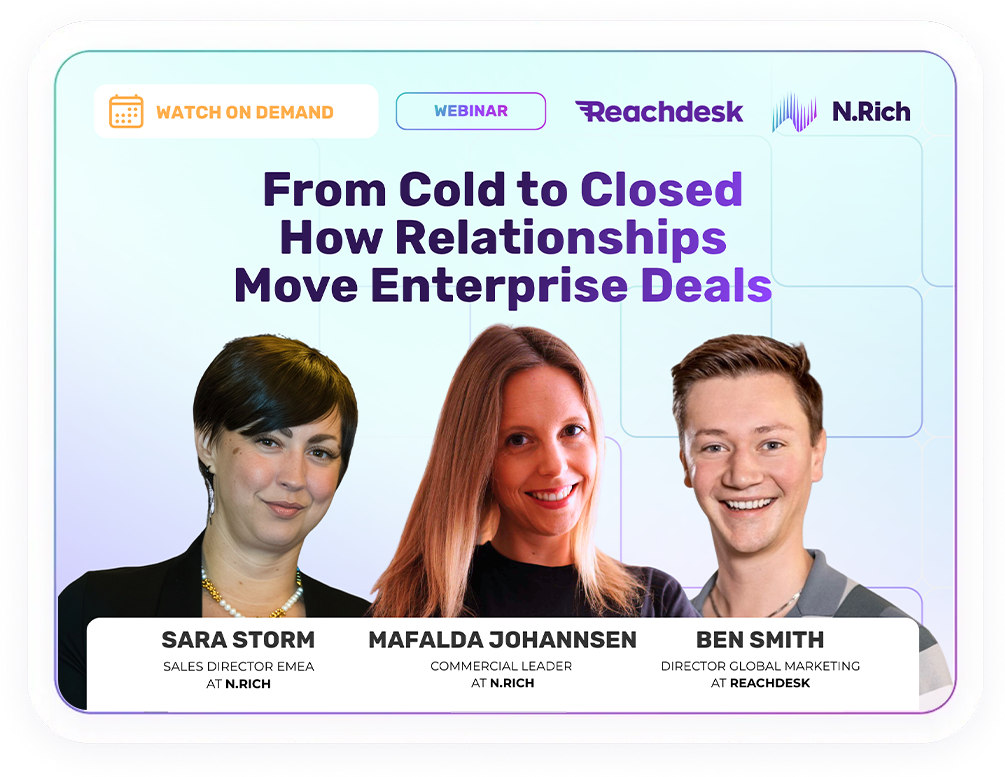
From Cold to Closed How Relationships Move Enterprise Deals
Join Mafalda Johannsen and Sara Storm from N.Rich alongside Ben Smith from Reachdesk for an in-depth conversation about orchestrating complex enterprise sales motions and building lasting customer relationships.
Discover how to navigate account-based marketing, leverage signals to identify in-market prospects, and use gifting strategically across the entire buyer journey to move deals forward.
Transcript:
Speakers:
Mafalda Johannsen — Director of Commercial Strategy at N.Rich
Sara Storm — Sales Director EMEA at N.Rich
Ben Smith — Marketing Director at Reachdesk
Today we are talking about "From Cold to Closed." My name is Mafalda — I just started at N.Rich a week and a half ago, so I'm super happy to moderate this first webinar. I'm so lucky that my first webinar with N.Rich is with two people that I've known for a couple of years; that's the best start I could ever ask for.
Today we will talk about how to move enterprise deals, how to use signals, how to use ABM — and I know there are a lot of different opinions about what ABM actually is — and how to use gifting beyond the postcard for the first sequence. Feel free to write in the chat where you're from, why you're attending this event, or anything you'd like to share. The more interactive we can make this webinar, the better.
As I mentioned, my name is Mafalda. I'm the Director of Commercial Strategy here at N.Rich, and today I have Sara Storm, Sales Director EMEA at N.Rich, and Ben Smith, Marketing Director at Reachdesk. This is supposed to be a fireside chat, so we will have one slide — that's it. This is supposed to be a lively conversation, and the more you ask, the more relevant it will be for you. There are no stupid questions and no bad comments. Before we dive in, Sara — who are you and what do you do at N.Rich?
I love fireside chats, and I know Ben and I don't have the exact same view on everything — which is going to be fun. My name is Sara Storm and I am the Sales Director at N.Rich for EMEA. I started with the Nordics, then expanded to Nordics and the UK, and now I have all of EMEA, so I have a huge territory. I have been in revenue for 23 years, and I have spent the last 12–15 years working in SaaS companies selling to mid-market and enterprise, specifically sales and marketing software of different kinds.
I've been on the vendor side a lot, but since I am also a leader, I've been on the purchasing side as well. I've been part of rolling out software — CRM, HubSpot, lead platforms, prospecting platforms, and ABM platforms. I often stay closely involved with accounts in this type of role because, first, you need an ear to the ground on what is going on for sales and marketing teams today — not five years ago, but right now. Second, the customer succeeding is an ethical thing for me. I really want to be part of that process and not let go once a deal is completed.
That's something we will address today, because a lot of us talk about net new almost exclusively. We treat retention, land and expand as an afterthought, and some SaaS companies don't think about it at all. I think that is a huge mistake in the market we're in, and I'm super excited to talk about that part as well.
You basically summarized the whole webinar! Ben — who are you and what do you do at Reachdesk?
I'm absolutely happy to be here. I've been with Reachdesk for seven years now — I joined as one of the first employees. When I joined I was in business development, grew out the business development function, and then just over two years ago I was lucky enough to move over to marketing and lead the marketing team. We focus on a global market, mainly the UK, Canada, and the US.
I'm here to talk about everything gifting. There isn't a gifting campaign I haven't seen, and I'm excited to discuss how gifting ties into different parts of the buyer journey. Really happy to be here — thank you.
We're happy to have you here. I feel we have a similar path — I started many years ago as a BDR and now I sit between marketing and sales, so quite similar. Let's kick in. Sara, I know you are very excited to talk about how deals actually move. Let's start with a general framing and then go deeper. And again, everyone, feel free to chime in and ask questions.
This is meant to set the stage for the conversation, because I do believe we live in a pretty complex environment as GTM teams. It's not a simple task to align all the different parts of this motion together. For those of us focused on mid-market and upper mid-market enterprise, if you work on the SMB segment this is simpler — but also lower average contract value — because you have one to two people you're trying to address and move. Enterprise and mid-market, by contrast, involves a buying committee. You're not only trying to address an account; you're trying to address twelve, fifteen, twenty people in that account, each with different titles, different motivations, different hobbies and interests, and their own internal political agendas. That makes the enterprise and mid-market journey very complicated to orchestrate.
The first step is to define what the journey looks like for your business. I'll walk through the definitions we use at N.Rich, and from there we can dive into how to utilize account-based motion across different channels — including gifting — to move and orchestrate deals forward in the funnel.
The first stage is Cold. At N.Rich we define a cold account as a dormant account. They are an ICP fit and they are on your target account list, but they are showing no traction for you or your category today. They're living their life, going about their day-to-day — gifting from Reachdesk is not top of mind for them at that moment. You see no signals in any direction indicating interest in the category or your brand: no website visits, no category-level intent. They're simply floating along.
The next stage is In-Market. For N.Rich, in-market means that the company on your target account list is showing interest in your category of solutions. For Reachdesk, that would be gifting or improving sales process and stage conversion. At this point they are not yet engaging with your brand specifically — they're engaging with content that indicates they are probably looking for a solution to a challenge they have internally.
The stage after that is Engaged. Engaged means we have moved from an account being interested in the category to being engaged with your specific brand. They've gone from looking at gifting broadly to looking at Reachdesk specifically. At this point we use both third-party signals and first-party signals — your website, your ads, your own data — to confirm that engagement.
Then we have the Hot stage. Hot means a smaller amount of third-party data but a large percentage of brand engagement: lots of activity on LinkedIn campaigns, ABM campaigns, display campaigns, and your website. They're looking at your pricing page; they're really searching within your account. They turn hot based on whatever criteria you've set. To give a real example: at N.Rich we had a prospect become a customer just a couple of months ago whose journey started in 2024. We didn't begin talking to them until they hit the engaged stage, which was months into that cycle, and then they progressed to become a deal. The sales process from discovery to close was about three months — but the journey before that was huge in comparison. Understanding those long cycles is very important, because you can't run a campaign today and expect to close a large deal next quarter.
Once we move them to hot — and actually already at engaged — we want to start addressing them from a sales perspective. Then the SQL to SQO to close-won phase opens: money is on the table, there's confirmed interest, we're talking to two or three people, and we need to expand to the wider buying committee to gain access to the hidden buying committee, which is often more senior. The second part that is frequently ignored is the Lifetime Span: the ongoing customer relationship, which contains plenty of phases where we can use marketing, gifting, and other engagement methods to drive expansion, contract growth, and adoption of new use cases. Ben, I'm sure you have input on the stages where you see the most traction — do you want to share that?
Absolutely. And to go back a step — this framework is great for knowing where accounts are, but I also want to know where their minds are. Earlier in the funnel, these are busy people who are not interested in your problem or your solution at all. What we need to do is move them from being busy to being curious. Once they're curious and in-market, we need to move them from curious to interested, from interested to committed, from committed to choosing a provider, and then from committed to choosing you.
As I think through these stages, what I'm really trying to discover as a marketer is: what is the buying committee thinking right now — or not thinking — and what tactics, messaging, channels, and positioning do I need to put in front of them to get them to that next stage?
I'm going to add a poll so we can see where everyone listening is currently focused — cold, in-market, engaged, or further down the funnel. While we set that up, let's move on. Sara and Ben, that was essentially an entire webinar in ten minutes — great job. But beyond the buying journey itself, we also have the increasing complexity of buying committees. Before, enterprise was always complex, but heads of department had more budget authority and could make decisions on new tools without engaging much of the rest of the organization. That has changed. What's your experience navigating that added complexity with ABM and gifting?
A lot of the sales process and decision-making now happens before someone even talks to sales. The biggest reasons people don't move forward with a deal are either that a relationship with a competitor has already been established through marketing influence and prior work, or it's the status quo — people don't make a change because they don't feel the pain is big enough compared to what they're doing today.
With buying committees getting larger, the key question becomes: how do we influence a larger committee earlier so that we're impacting every stage of the journey? That might mean targeting users so that when the deal does close, they're already bought into how to use your solution and how to roll it out. It might mean the CFO, who needs to understand why this is impactful enough to justify the budget. It might mean the CMO, who — if we're talking about Reachdesk and a gifting platform — primarily cares about adoption: is this being used and are we seeing the ROI? Everyone has very different views of what matters in their role, which is why messaging is so critical. To target a wider buying committee, we need to think about what's in it for each person individually — walk a mile in their shoes — so we can be relevant, personalized, and hyper-focused on helping them achieve their own goals.
Sara, I know you're a big fan of gifting and treating each step of the buyer journey differently. Do you have real examples you'd like to share?
I do — and before I get into the examples, I want to set some additional context around what Mafalda just raised about complexity. In the meeting when I'm sitting as a sales rep, you will typically meet two or three people. Behind those two or three people there are often sixteen people you won't get access to through sales. You can try creative tactics to reach them, but even if you do, you may not get enough time to build a real relationship. That means marketing needs to do the heavy lifting for the hidden buying committee, and needs to do it very early.
For the active buying committee, we need to speak to users, their managers, and their manager's manager — three layers of seniority. But the hidden buying committee can only be reached through trust-building, not direct sales. In my situation, the goal when a proposal lands on a CFO's desk for budget sign-off is simply that he looks at N.Rich and thinks, "I trust that brand." That's all I need him to do. It's a perception thing, and marketing needs to run trust campaigns toward that hidden buying committee — including gifting.
One example: for a senior economic buyer I knew I wouldn't be able to get a meeting with because they were too senior, I sent a spa voucher the day after they'd been on their feet all day at an event. To do this, I monitored when that person was attending events, and the day after they received a spa treatment as a gesture of care. That person felt looked after even though we had no direct relationship. These are the kinds of touches that get creative and human — even with someone you don't yet know personally.
Another example: when I have a champion who has been running alongside me throughout the entire process — building business cases, gathering internal arguments, navigating her manager and her manager's manager — I reward her before we sign, because of all the work she did regardless of the outcome. We have to remember that the tenure for a CMO in SaaS has dropped to around 17 months. People are burning out and getting laid off constantly. The time they are at a company, they're closing fires and working on one or two priorities at most. Gifting is a way to address that reality in a human way. Giving gifts is one of the love languages — this is a very human approach to building relationships.
Throughout the funnel, we use gifting alongside ABM signals from LinkedIn and N.Rich — or whatever ABM platform you use, that's not the point. When you can see surges of intent, you can create gifting that fits the nature of that intent and then decide which buying committee cluster you're likely trying to reach at that moment. Then you engage them accordingly.
You mentioned two things that really stood out to me. First, trust. Trust is not tangible and there's no easy attribution model for it, but it's essential to close the deal — especially in times like these and especially with certain buyer personas. Previously at a cloud company, I was selling to heads of infrastructure and CTOs who are fundamentally concerned about security and safety. If the trust isn't there, it doesn't matter how strong your product or your salesperson is. Trust is not a nice-to-have.
Second, gifting needs to be matched to the buyer persona. It's the same principle as receiving a birthday gift from your partner that completely misses the mark — it signals they weren't listening. In B2B, that translates into knowing your buyer persona, which is the area I most often see companies not investing enough time in. Ben, your turn.
All very valid points, and Sara, I love how much you and the N.Rich team have adopted Reachdesk and truly understand the power that gifting can have in influencing a wider buying committee and delighting important customers and prospects. When we think about gifting, sending a mug is just sending a mug — that's not going to do anything on its own. Gifting cannot be a standalone channel that you execute with the expectation of something in return. When gifting is done really well, it's a strategic part of your wider campaign and the moments you're trying to build.
You mentioned multi-threading strategies and engaging wider buying committees, and one play I love that you use is enabling your champion to be the best champion they can be. That could be anything from sending your champion an offer to run a lunch and learn with the wider committee — virtually, using an Uber Eats, Deliveroo, or Just Eat voucher so everyone can come together from wherever they are. You're giving something before making the ask, and when the gift comes from your champion, you're going an extra step further because they already have internal trust. You're empowering them to surprise, delight, and reward other people for their time. I always love the post you put up, Sara, about how quickly someone signed a deal after you did exactly that for them. It's a great example of how these small touches — which don't cost a lot of money — can meaningfully accelerate sales cycles.
I have to tell that story, because it's a good one. It was the last day of the quarter — and yes, we still have quarters, which is a whole other conversation. The CEO I hadn't had many interactions with was the person who needed to approve the ad spend that N.Rich required, which had to come from the CMO's budget. I knew from my champion that he was dealing with chaos on his sales team and was sitting in the evening preparing reporting for a board meeting two weeks out. I wanted to reach out in a way that didn't come across as a pushy rep who just wants a contract signed, but I still wanted that contract signed.
So I sent him an Uber Eats voucher with a message along the lines of: "Since you won't be able to make dinner tonight, here's food for while you're working away — and all you need to do now is sign a contract." The voucher was already in his hands, so I wasn't really asking for much. It was a lighthearted way of saying, please give me two minutes of priority because this deal is literally already done — legal has approved, we're good to go. And he went in and signed. He also got food for his late night. That's the kind of moment in the sales process that is genuinely efficient.
I also want to mention a live campaign example. Right now we're running a 6sense displacement campaign — 6sense is a US competitor of ours, and we're seeing customers move toward us because of challenges on their customer support side. We're running a displacement campaign in N.Rich paired with a LinkedIn campaign. When we see engagement, one of the things we will deploy is a therapy gift card — essentially a spa experience to recover from time spent with a "black box" vendor. Those gift cards go out once we've identified the right people, after they've already been engaged by the digital campaign. They've seen our brand, they've engaged, and we put a bow on the whole experience: "We get it — we understand it's frustrating." This is a clear early-market gifting motion that works well without sales being involved yet, just to get the prospect to feel cared for.
We have a great question about gifting from the audience. Catherine is asking: "We operate in highly regulated industries and have strict guidelines around gifting. How do we do this in a compliant way?" Ben, given the breadth of customers you've seen, do you want to take this one?
Absolutely. If you're selling into government or finance, you do need to be careful about what you send. Companies typically have a policy around the maximum value of a gift they're allowed to receive. One strong alternative is branded merchandise, since that is promotional material at the end of the day. You do need to check the specific rules for each industry you're prospecting into — and by country as well.
Yes — and countries matter a lot. Germany, for example, has an anti-bribery law that caps gifts at €10.
Exactly. So it doesn't always need to be the most valuable gift — it needs to be the right gift at the right moment with the right impact. Branded merchandise is a great route because it is promotional material. If you combine a branded mug with your latest white paper and a handwritten note, that's a really nice touchpoint that layers on top of your other strategies. You might be running an email campaign featuring a new white paper and invite people to receive a physical copy — and when you send that copy, you include the mug. That mug stays in their cupboard, gets used every morning with tea or coffee, occupies desk space, and keeps your brand top of mind. It's a great way to amplify the value you're already driving from your other activities.
And we have a follow-up question — Isotta is asking what to do when she's not allowed to use vouchers at all. You've touched on company merchandise, but do you have any other voucher replacement ideas?
My favorite alternative is a Pay It Forward or donation campaign. Through Reachdesk you can make it very easy: if someone can't receive a gift themselves, they can donate it to a charity of their choice. That's a great way to make someone still feel appreciated and valued, while also giving them a moment to support a cause that's meaningful to them.
My other favorite is the Pay It Forward play itself: if the recipient can't accept the gift, they can send it forward to someone else of their choosing. That way you're empowering them to pass on a gift to someone they know. They get that emotional experience of giving — which ties back to gifting as a love language — and you've still done something for them in the process. Those are my top two tips for regulated environments.
I love that — you might even save someone who has a birthday party the next day and no time to get a gift! That happens more than we'd like to admit.
That's actually a great example of a campaign we ran this past February. We wanted to re-engage closed-lost opportunities and accounts that weren't quite ready to buy. Around Valentine's Day we ran a Pay It Forward campaign with the goal of getting into more decision-makers within accounts that already knew us. The campaign allowed recipients to send a handwritten note and gift to someone in their team or company that they really valued. It did extremely well at creating noise and conversation — and ultimately that's what it's about: creating conversations among a wider group of people that bring attention back to you.
Mike has a question about sustainability. How do you approach the sustainability aspect of gifting?
One of the best ways we address this is through address confirmation. Before COVID, gifting often meant sending boxes and packages hoping they'd reach someone in the office — not very sustainable, because there was no confirmed intent or relationship in place. With address confirmation, recipients can opt in to receiving a gift, so there's real intention behind what you send.
The other thing you can do is be very conscious about the partners you select and make sure they are genuinely sustainability-focused. Rather than sending low-value swag that nobody really wants — pens and cheap items that end up in landfill — it's better to think carefully about your key accounts and the strategy behind each send before you dispatch another piece of plastic. Those are my top tips on sustainability.
Going back to the poll results: as we kind of expected when we were preparing this fireside chat, most people are working in the top funnel — 19% are focusing on cold, another 19% on in-market, and 13% on engaged. Everything is top funnel. And guess what, Sara? Zero people on land and expand.
Told you! This is so interesting, especially since net new is becoming increasingly harder to acquire and we still don't see a fast enough shift. A lot of the companies we work with have one account they're targeting that actually has four different teams that could purchase from them. They may have signed a contract with one department but could expand by three more — multiplying their contract value — and still nothing meaningful is done about it. Product marketing is not the same as land-and-expand motion from a messaging perspective. Getting users to activate is not the same as reaching the buying committee members who hold economic authority in those different use cases. And still, even though this is comparatively easy money with a contract already in place, most companies either do nothing or run a campaign for two months and wonder why it didn't work.
Two months is not enough time to take a cold department — and that department is cold — all the way to hot. It's not enough time even in SMB. We need long-term strategies here, not two-month sprints.
Not even in SMB. Not even close.
No. And I also want to address the feeling of being limited with gifting, because when I started as a rep and didn't yet have a gifting platform, what I did was write physical letters — handwritten, with a pen — where I would review their annual report and tie whatever I was selling to specific initiatives they were already running. That letter went to their office, addressed to them by name. There are creative ways to add these human touchpoints without a formal gifting platform. When you close a deal, send a handwritten note telling them how grateful you are for their championship. Legislation should not stand in the way of creativity. The tighter the restriction, the more creative we need to be.
Exactly — tighter restrictions should boost creativity, not kill it. Let's bridge into signals, because I think that ties nicely into timing: sometimes we send gifts too early or too late in the buyer journey. Let's talk about signals throughout the funnel and how we should act on them — with and without gifting. Sara, do you want to start?
For me, the further along into the process I get — or if there's already an existing customer relationship in place — the higher-value the gift I'll provide. It's an effort-based thing. If a prospect receives a very expensive gift too early in the journey, they'll feel uncomfortable: you don't yet have the level of relationship with me that justifies this kind of gift. So I increase gift value progressively as we move through the funnel, into open pipeline, and then into the customer lifecycle — where, based on the poll, almost no one is currently using gifting, but they absolutely should be.
The other thing I want to address is scale. If you hand gifting over to sales and say "use this," they're not going to use it consistently. You need a framework: which signals coming in from your digital campaigns should trigger a gift, to which people, at which stage. At N.Rich, we started building out that framework around August last year. Before that, gifting was ad hoc — someone on sales or customer success would decide a person deserved something and send it. It wasn't connected to events, wasn't connected to our GTM, wasn't integrated with the four or five digital channels where we run campaigns. Now gifting is a structured part of that journey.
If you want your sales, marketing, and customer success teams to use gifting at a level that produces clear ROI, you need a framework — and I know Ben's team supports exactly that. Signals can come from digital campaigns, from job changes or new titles, or from a LinkedIn post showing someone attended an event. We need to collect all of those signals efficiently into our CRM to get a 360-degree view of the account's activity and the individual buying committee members' engagement, so we can trigger the right response at the right time. That's my take — though I'll acknowledge it's hard to say definitively "this signal triggers this action" because it is contextual.
Absolutely. And what's really important is not to treat gifting as a standalone activity, but to tie it into the wider purpose of what you're trying to drive. For awareness campaigns — which are much more top of funnel and where you're trying to generate or identify a signal — you probably wouldn't want to send a hyper-personalized gift, because you don't yet know much about the person and haven't had a conversation with them. An educational or awareness-stage campaign is much better suited there.
For example, thinking about Reachdesk and our value proposition as a global gifting provider that helps you scale gifting everywhere, our current campaign theme is around making your marketing unforgettable. So I'd create a bundle with some collateral around how to make campaigns unforgettable — a notebook with fun branding so the recipient can start jotting down ideas, and maybe Seth Godin's Purple Cow because it's all about standing out. You're building a bundle focused on the awareness-stage message you're trying to land.
At a later stage — say someone has clicked on content in your email campaign and you want to convert them into a conversation — that might be a great moment to engage them with an ebook and a coffee voucher, something that will genuinely move the needle and get a reply. Email reply rates from cold outreach are extremely low right now, but when you pair an email with a gift, those reply rates go up dramatically. So think about the stage the account is in and match the type of gifting, swag, or direct mail to that stage.
Ben, I have a question on that. What's the difference between territories and markets here? I can imagine that a coffee voucher combined with some content might land very differently in the US versus certain countries in Europe. As an overarching vendor, do you see any trends in what works where?
It's a great question. The important thing here is giving options and variety. We would never send out just one branded coffee voucher as part of a campaign, because someone in France is probably not going to respond to it the same way as someone who'd prefer a different type of voucher. The power of Reachdesk — and why it really exists — is that you can give the recipient the choice. You can let them claim something for themselves, donate it, or select something that genuinely resonates with them.
I've had people try to send me gifts in the past that just weren't something I wanted. You also have to be very careful around alcohol — some people don't drink — and dietary restrictions and personal preferences. If you empower people to choose something that is super relevant to them, you can scale your campaigns across any region or personal preference without running into those issues.
I need to mention this — a couple of years ago, every time I did good work or it was my birthday, bosses would give me alcohol. I don't really drink, but because I went to a lot of parties they assumed I was a big drinker. I was accumulating bottles and I still have some from ten years ago that I've never opened. It is really true: you have to be careful, especially with something like alcohol, because you don't know what someone is going through or whether they even enjoy it. There are small but important things to be conscious of. Sara, sorry — I interrupted you.
No — I actually had a question for Ben, because I know Reachdesk uses ABM as part of your own go-to-market as well. When you go after named enterprise accounts — accounts that you're planning to win within one or two years — what are your lessons from combining gifting with digital ABM campaigns? And what would you tell the audience: don't do this, definitely do this?
There's so much I could cover here. I'll talk about some favorites we're running right now. LinkedIn is a huge channel for us because we know our enterprise audience uses it to consume content. At the early stages of the funnel, the power of influence is massive. Creating a campaign that gets well-known and trusted LinkedIn voices to post about what you sent them — and then drives engagement from their audience — is a great way to build awareness within target accounts and warm them up.
Two recent examples I love: Slack. Their iconic thing is their Huddle music. They took that Huddle music and pressed it onto a vinyl record, then sent records to 200 LinkedIn influencers. Those people were so delighted that they posted about it. Imagine someone with 20,000 followers posting a video of something they received from Slack — that generates 300,000 impressions. You're not just thinking about paid advertising for your digital campaigns; you're combining gifting with influencer reach, then boosting those posts, and the scale is massive. It's taking what we've seen in B2C — sending someone something physical, building brand trust — and applying it at the top of the B2B funnel.
The other one is events. We don't always sponsor events and don't always have the budget for a booth at every trade show, so we get creative. One thing we've just done is create a branded swag store portal with fifteen different items of higher-value swag, and we're being very selective about who we invite. Part of the strategy is to send them a link showing the swag that's available, invite them to take a meeting with us at the event, and then give them a code to unlock their selection. The swag is shipped to them after the event — they're not carrying it around the trade show floor. It becomes another touchpoint when they get home, keeping you top of mind. Add handwritten notes and a QR code to book a follow-up meeting and you've built a full event strategy around pre-event, during-event, and post-event engagement rather than just counting badge scans.
That's brilliant. We work very similarly at N.Rich. Dinners — tight-knit, highly specific dinners — are a huge part of our GTM and a significant driver of pipeline. We also run fireside chats like this one, digital campaigns to move content, and award ceremonies tied to certain dinners. We're really focused on building the brand as an excellent host of peer-to-peer conversations among our tier-one and tier-two accounts.
But before we ever invite them to a dinner, there's always significant hype, and we engage LinkedIn voices who post about the dinners before and after. Tier-one and tier-two accounts that attended will receive a gift afterward, which they then post about — talking about both the dinner and the experience. That gift is sent by the BDR managing the territory, along with a note saying, "By the way, you should sit down with Sara" — or whoever owns that territory — "to discuss what you learned at the dinner and what you're doing with your GTM today." That is a huge meeting-booker. A lot of companies struggle to get value from events and dinners after the fact; this is the flow that makes it work.
We're not relying on individual reps to scan badges. We've already decided exactly who we want to talk to, and those people get targeted before, during, and after the event by someone other than just the rep who met them in person. Gifting is baked into that flow. And critically, most of those dinner invitations go out in a personalized, one-to-one way — but those recipients have already been seeing and engaging with our brand because we run always-on ABM display and LinkedIn campaigns toward that audience. Once they get that personalized invite, they feel special and chosen — because they are. That's the whole point of the experience.
Another campaign I love that we ran in partnership with the Exit5 community — Dave Gerhardt's community — around his Drive event coming up in September. We were supporting them with driving early registrations. For everyone who signed up in February, we sent a branded swag box with a handwritten note saying thank you for coming to the event, and if you'd like to share this on LinkedIn and tell your network, we'd be thrilled. That generated 20 posts from registered attendees sharing with their networks — some creating really creative unboxing videos — and through that momentum they were able to drive significantly more sign-ups early for a September event.
So really think about the goals you're trying to drive and how you can tie gifting, swag, and direct mail into your wider strategy to elevate it. And if you're struggling in a particular area, think about how gifting and direct mail could bridge that gap.
Absolutely. It all comes back to the ICP foundation — the fundamentals of your GTM strategy. Who are you targeting? Why? Which challenges do you solve? What are their priorities? Where do they live and what does their buyer journey look like? What does the buying committee look like? When you map that out, you can start adding ABM, messaging, and gifting in a structured way — not an ad hoc way. That's really the summary of everything we've discussed: you need to be intentional. It's not random gifting, or as Sara said, responding to a random signal with a random email or phone call. You need to know exactly why you're doing each step, why you're reaching out now, why you're sending this specific gift, and what outcome you want. If you don't have answers to those questions, no ABM or gifting platform will save you. Sara, you want to add something?
Yes — it also depends on what market you're going after. If you're targeting mid-market and enterprise and you want to do it well, these motions require at minimum a mapping of your accounts, a categorization by industry, and a mapping of the buyer persona clusters within those industry verticals. You cannot send the same thing to an IT manager or CIO — whose trust you need to build before they approve you as a vendor through a legal process — as you would send to a CMO. They are completely different buyer persona clusters.
Sales needs to work together with marketing here because sales already knows who they're talking to in active deals, and marketing needs to understand those same clusters. I'm not talking about buyer personas used only in marketing — I mean the full buying committee: who are the clusters, what reality do they live in, what matters to them? Without that foundational mapping, nothing you do with gifting or ABM will be sufficiently relevant. One thing I genuinely appreciate about our collaboration with Reachdesk is that their account manager is actively helping us build this strategy piece by piece — suggesting where to add gifting, how to design a campaign around a specific stage — and I wouldn't have been able to construct that framework alone, nor would our marketing team. So if you feel like you don't know where to start, get a partner to help you work through the foundations. Once those are in place, everything else starts to make sense.
It's really about creating conversation, isn't it? In those early stages, the most powerful thing you can do is create something worth talking about. How often does someone receive a cold email or a cold call and think, "That was so good I want to share it"? But if you send someone something physical and give them something to talk about, that's a hugely powerful way to create influence and awareness at the top of the funnel.
And that's exactly what business development and top-of-funnel teams — whatever you call them in your organization — need to focus on. Many times, because they're measured on meetings booked and meetings converted, they're in a rush to book that meeting with the AE. That's natural when you have targets. But the mindset needs to be: the meeting is the end goal, but you get there through a genuine conversation, by understanding the person's challenges and whether there's real interest. That's not wasting time — that's the path. Sara, I can tell from your body language you want to add something.
Yes. BDRs in most cases will follow whatever strategy is set for them — so this has to be a top-level decision. Leadership needs to commit: we are willing to spend time and money on nurturing these prospects as we move them through the journey. We are not looking for the quick fix. We are not booking SMB meetings here — we are working toward large ACV contracts with long sales cycles, and that's where this type of motion makes the most sense. When a single BDR wants to do this but is alone in wanting to do it, they won't get the resources or the support to make it happen.
Management — whoever is in management in this group today — please align on this. Gifting and ABM as a combined motion is not something an individual BDR should run in isolation. It requires company-level alignment: we are committing to this channel, we are willing to invest for potentially four months before we see a meeting, and we are okay with that. The CMO and CRO need to agree together that this is the motion we are running for at least a year, because our sales cycles are too long to evaluate it on a two-week campaign. Yes, you'll get a few meetings from a short push, but the goal is to influence a buying committee — not just book one meeting.
Absolutely. We are three minutes from the end — time flies when we're having fun. One last word or sentence from each of you: what's the single most important thing you want people to take away from this webinar?
If you feel like you don't know where to start, connect with Ben and me on LinkedIn and just ask. Seriously — we are both happy to spend time on this; it's a genuinely complex topic that requires a sounding board. We'll also be sending out some additional material after the webinar with more detail on the different stages. And talk to people around this before you start building. I don't have a fancy final sentence because this is a complicated matter that you need to get ahead of inside your organization, and that can't be summarized in one line.
My parting thought: start breaking patterns. Think about unique touches you can bring to your buyer journey, because everyone is exhausted from digital fatigue and the same playbooks. This is our moment as marketers to take some risks, experiment, and have fun trying new things. Try something new and create a genuinely unique journey for your buyers — I know they will appreciate it.
And you as a sales or marketing person will appreciate it too. Our jobs are much more fun when we're being creative. That's always been the part of top-of-funnel and business development that I've enjoyed most — finding creative ways to genuinely get the attention of the right prospect in the right way. So that's a great note to end on. Thank you so much, Ben and Sara, for all your real-life examples and genuinely practical advice. And thank you to everyone who joined us. As Sara mentioned, feel free to connect with any of us on LinkedIn if further questions come up — even weeks from now. We're always happy to help. Wishing you all a wonderful day.
Create more pipeline and prove where it came from
Book an N.Rich demo and see how it works on your own data.
Book a demo