
We have spoken about intent, intent reports and how to go about creating them, as well as what data each intent report will surface. This guide will zoom into the Buyer Journey Intent report and explain what makes it so special (TLDR - its linked to our progression analytics and it gives a lot more weight to 1st party than 3rd party signals)
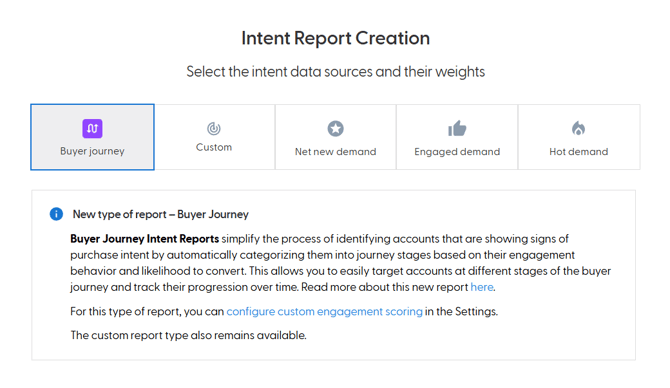 Unlike custom intent reports, which require marketers to define their own set of logic, intent score weights and underlying workflow and segment logic), the Buyer Journey Intent Report removes the need for assumptions. The model automatically classifies them into the right buyer journey stages based on engagement data. This allows for more accurate targeting, better segmentation, and a more dynamic approach to tracking account progression.
Buyer Journey Intent Reports is a new type of intent report designed to help marketers easily track, categorise, and act on account engagement across different buying stages. This feature simplifies ABM execution through:
- Streamlined Intent Monitoring – Identify high-intent accounts at different stages with minimal manual effort
- Journey-Based Account Scoring – Prioritize accounts based on progression trends rather than static intent signals
- Adaptive Buyer Journey Modeling - The scoring model continuously refines itself based on customer-specific opportunity
- Easy Segmentation – Segment accounts by buying stage for more relevant targeting and nurturing with a few clicks
- Seamless Integration – Works with ABM Progression Analytics, helping marketers measure ABM progression across stages
- Digestible and Actionable Insights - Instead of sifting through 100’s of accounts trying to find those that should be actioned, use ABM Progression Analytics to find accounts that should be handed over to sales.
About the Scoring Model
The Journey-Based Account Scoring is designed to provide a data-driven approach to identifying accounts that are actively progressing through the buying journey. Unlike traditional intent models that rely solely on engagement data, this model has been trained on real engagement behaviour observed across multiple companies, industries, and touch points. This model uses an initial dataset trained on diverse B2B interactions, creating a baseline scoring framework able to identify buying intent at different stages with a high degree of accuracy. This means that when an account is classified into a specific stage, its engagement behaviour closely aligns with that of accounts in real training data that demonstrated similar patterns—patterns that historically led to a measurable likelihood of conversion into an opportunity.Below is the stage classification and characteristics to help you interpret the data:
|
Stage |
Score Threshold |
Stage Threshold |
Characteristics |
|
Cold |
Equal to 0 |
No intent or engagements (1st or 3rd-party) |
Minimal engagement, low likelihood of immediate conversion. |
|
In Market |
Less than 30 |
Mandatory 3rd-party intent signals |
Early research phase, showing signals of potential interest. |
|
Engaged |
Between 30 and 60 |
Mandatory ABM ad engagements |
Actively interacting with marketing content. |
|
Hot |
Greater than 60 |
Mandatory quality website engagements |
Strong intent and high likelihood of conversion. |
Coming soon: Adaptive Buyer Journey Modelling is the scoring model’s ability to continuously refine itself based on customer-specific data. Once applied within an N.Rich customer instance with active CRM integration and access to opportunity data (see prerequisites), the model adapts and recalibrates using that your own engagement trends, making intent classification more precise and aligned with their unique sales cycle.
How It will work:
- Baseline Model – The system starts with real-world engagement data from a large B2B dataset spanning multiple companies, ensuring a robust initial model.
- Customer-Specific Calibration – Once deployed, the model analyzes the customer’s historical account activity and adjusts scoring thresholds accordingly.
Before you can create an Buyer journey intent report, you should:
- Connect your CRM and enable pulling of opportunity data.
- Install the Website Tag
- (optional) Launch a campaign
- (optional) Find the 3rd party topics relevant to your business within our taxonomy
Key Features and Functionality
Advanced Intent Scoring and Journey Stage Classification
- Uses a progression-based model that prioritises first-party engagement signals
- Tracks Engagement Behaviour - Prioritises engagement type, frequency, and website visit quality, making it ideal for pinpointing accounts at specific journey stages. (Tracks and scores account movement instead of just static intent snapshots.)
- Automatically adapts stages and scoring to engagement threshold (e.g., number of ad clicks, website visits + CRM opportunity status) based on customer-specific data for better accuracy and buyer journey lifecycle adaptation.
Integrated with ABM Progression Analytics
- ABM Progression Analytics available for Buyer Journey Intent Reports - Shows you where your accounts are in their buying journey. Accounts are tracked across Cold → In Market → Engaged → Hot stages.
- Provides actionable insights for sales and marketing teams to engage accounts at the right time.
Journey Stage-Based Account Segments
- Automatically creates dynamic segments for each buying stage (through ABM Progression Analytics).
- Supports hyper-personalized campaign targeting by aligning ads and content to account readiness.
Closed Loop ABM
- Journey-Based Account Segments will help marketers launch tailored campaigns for each stage. Campaign engagements can then be used by the Buyer's Journey Intent Report to further enrich engagement behaviour, leading to even more accurate journey classification and progression measurement, closing the loop for your ABM program.