
Intent reports allow N.Rich users to surface the intent of the accounts in their segments.
How many intent reports you can create depends on the plan you are on, ranging from 1 on Lite, 10 on Growth to unlimited on our Enterprise plan. Similarly, your plan determines the number of 3rd party intent topics you can monitor depends, ranging from 10 on Lite, 25 on Growth to unlimited on our Enterprise plan.
To create intent reports, navigate to:
🇪🇺 https://app.nrich.ai/intent-reports
🇺🇸 https://us.nrich.ai/intent-reports
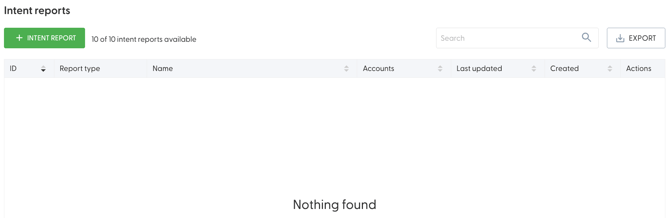
In the top right of the screen, select '+ Intent Report'
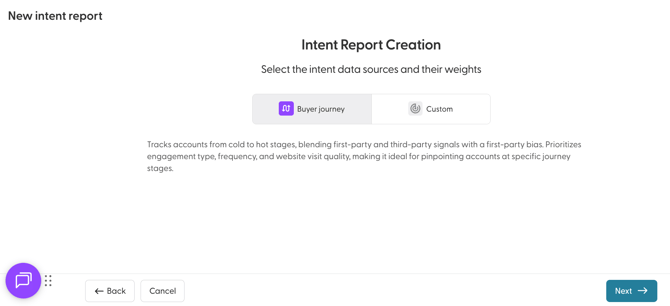
Here you can choose one of the two available intent report types:
Buyer Journey
Custom
If you are running no campaigns and don't have the website tag installed, you will not be able to create a Buyer Journey intent report nor leverage 1st party intent in Custom intent reports.
Creating intent reports varies ever so slightly between the two report types, so this guide will look at the commonalities and serve as a general "how to create an intent report" guide. Buyer intent doesn't let you choose the data source weights, as these are pre-determined. Custom reports allow you to define any distribution of first and third party intent in your report:
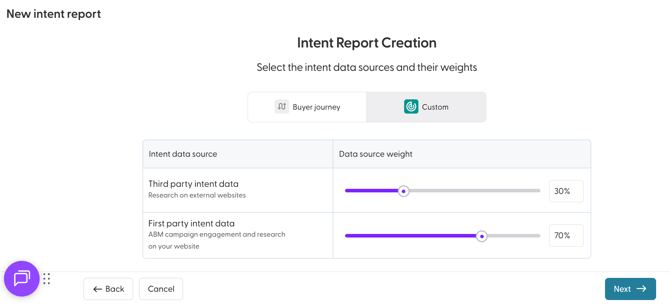
The data source weights represent the weight that will be given to the composite intent score in this intent report, following this formula:
(1st Party Weight x 1st Party Score) + (3rd Party Weight x 3rd Party Score)
Next up, we get to choose the targets of our intent report: 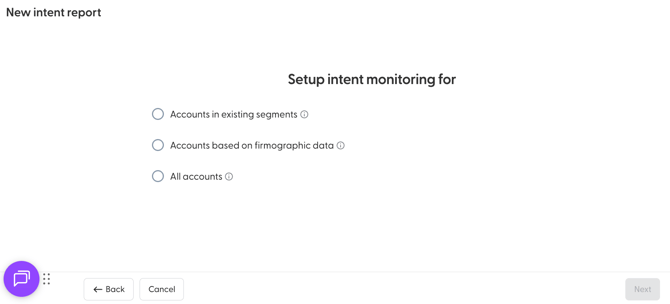
Here we have three options available:
- Accounts in existing segments - allowing us to determine which of our existing segments should be the subjects of our intent report.
- Accounts based on firmographic data - allowing us to define an industry, countries and company sizes that should go into the scope of our intent report.
- All accounts - literally all accounts that N.Rich knows of and has in our massive database of companies.
For the purpose of the guide, we shall focus on accounts in existing segments:
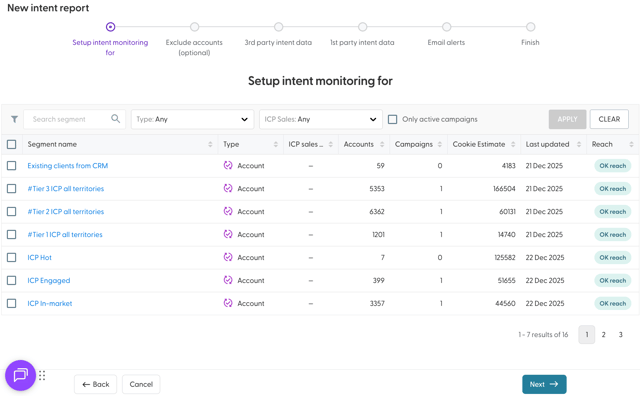
It is required to select one segment, while it is possible to select multiple or even all segments. You can leverage the filters in the top of the table to shorten the list of available segments and even display only the segments which are in scope for active campaigns via the "only active campaigns" checkbox. Applying any filter happens after hitting the Apply button in the top-right corner of the table.
Going further, reach the optional step of excluding segments from an intent report - similarly to campaigns, the exclusion will trump inclusion if an account exists in both segments: 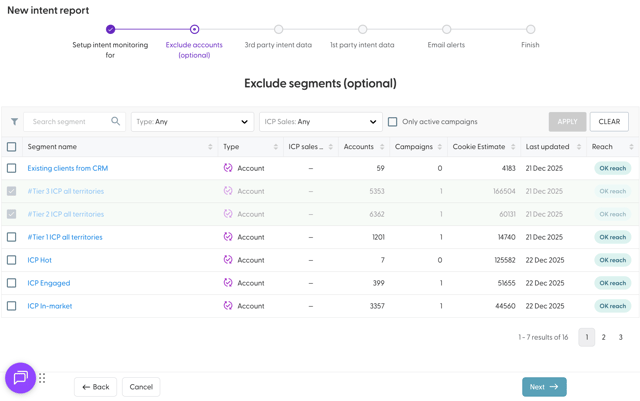
Segments that have been included can not be excluded. The same filters described in the previous step are present.
Next up, we have the 3rd party intent configuration:
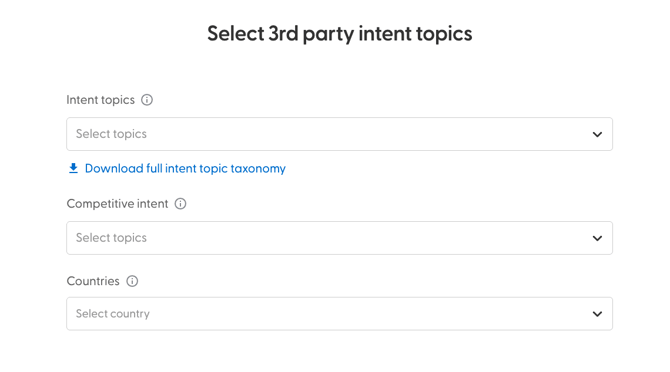
Here you can choose which intent topics the report in question should monitor for, with general topics and competitors being split across the first two fields visible in the screen shot above.
You can also download our entire and latest taxonomy (updated weekly) via link on this page (or by clicking here)
🇪🇺 https://app.nrich.ai/intent_taxonomy
🇺🇸 https://us.nrich.ai/intent_taxonomy
In case you can't find a specific topic or competitor, you can request it to be added to the taxonomy - see more details here
Clicking into any of the three fields will reveal a search modal for intent topics: 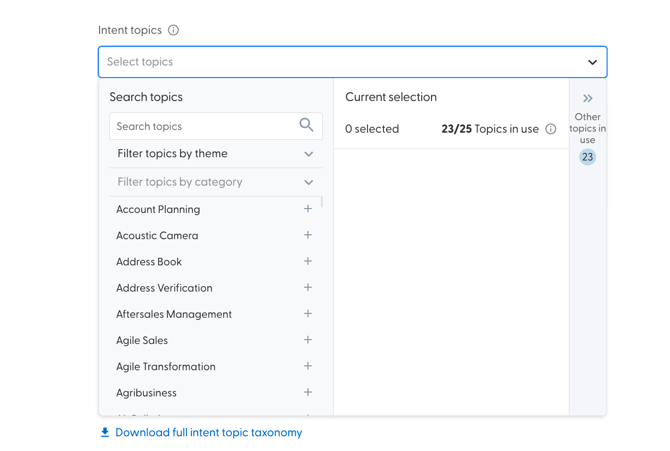
You can search through the entire taxonomy or explore topics per themes. The same modal will display how many intent topics from the allowance you have used up as well as allow you to see which intent topics you are already monitoring across other reports (via the right section of the modal)
It is also possible to limit 3rd party intent to specific countries only by adding countries in the "Countries" field on this page.
Next up, we have the 1st party intent configuration: 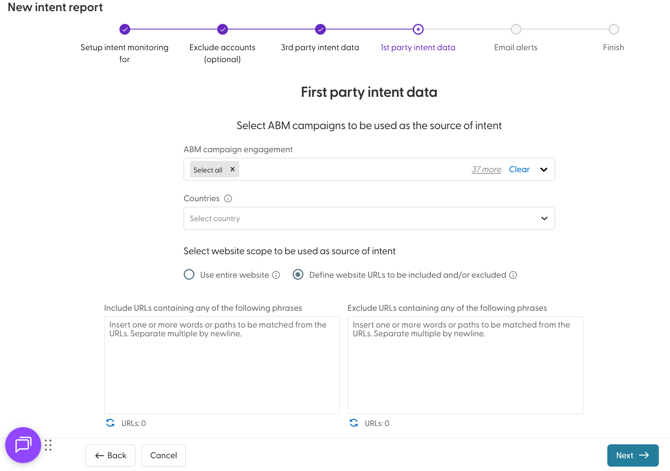
Here you get to choose which campaigns are in scope of this intent report, define which countries are in scope for 1st party intent and determine whether your entire website or only activities on some specific set of URLs should influence the 1st party score in this report.
From here, we move to email alerts, which come in two variations: 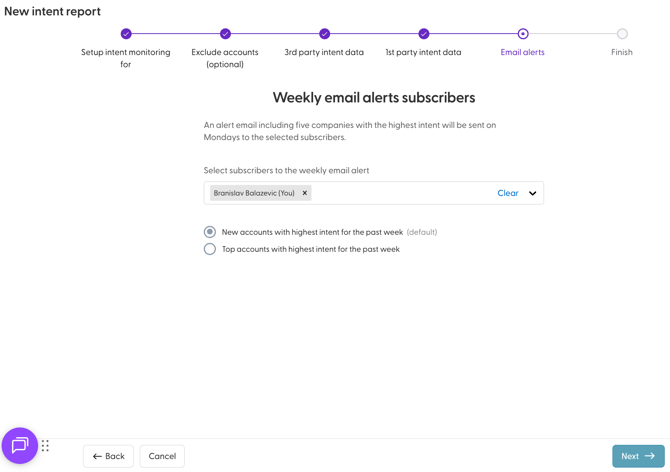
Both variations will send every defined recipient an email every Monday, including 5 accounts that are either brand new accounts to this intent report (with the highest score) or the 5 highest scoring accounts on this intent report in general that week.
Finally, we reach the final section of the intent report creation modal: 
Here we get to give our intent report a name, we are shown which segments are in scope and whether any are excluded.
Additionally, we can see an option to create a dynamic segment (and workflow) that is tied to this intent report, which is quite powerful for account discovery and saves quite a bit of time. Last, but not least, we can connect our new dynamic segment to a LinkedIn matched audience.
Now we have created our intent report - lets see how it is structured.